
A large traditional IRA is not entirely yours. The Internal Revenue Service is a silent partner in every dollar of it, and the size of its share is set not today but on the day the money finally comes out. The uncomfortable arithmetic is this: for most retirees with a substantial balance, that day is not one they choose. It is chosen for them, by the required minimum distribution rules, at rates no one can see in advance; Roth IRA?
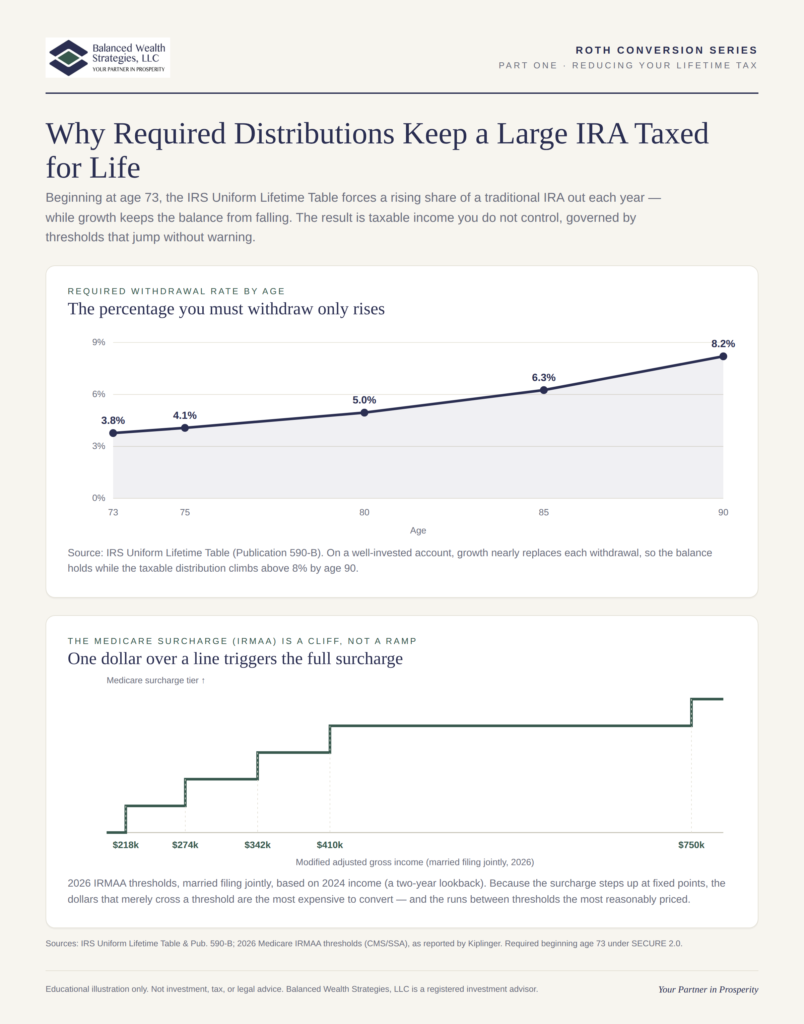
Consider the shape of the problem. Under the IRS Uniform Lifetime Table, a taxpayer who reaches the required beginning age of 73 must withdraw roughly 3.8 percent of the account in the first year. That figure climbs to about 5 percent by age 80 and above 8 percent by age 90. On an account of any real size, growth very nearly replaces each withdrawal, so the balance holds close to where it began while the taxable distributions keep rising for the rest of your life.
This is the first and most personal reason to consider a Roth conversion, and it is the subject of this article: not what your heirs inherit, and not what a surviving spouse faces, but the tax you yourself will pay across the decades still ahead. The other two questions belong to Parts Two and Three of this series.
The Account That Will Not Shrink
Retirees are often surprised to learn that required distributions do not meaningfully draw down a well-invested traditional IRA. They are designed to force taxation, not to empty the account. A balance that earns a reasonable return will replace most of what the distribution takes, and the distribution percentage rises only gradually with age. The practical result is that a retiree can take required distributions for twenty years and still leave behind an account close to its original size.
Two consequences follow. First, those distributions keep you near the top of your bracket for the remainder of your life, whether you want the income or not. Second, every dollar you do not spend continues to grow inside an account where all of the growth remains taxable on withdrawal. Doing nothing is itself a decision, and it is the decision to pay tax later, at rates you do not control, on a base that keeps expanding.
What the One Big Beautiful Bill Hightend Roth Focus
The tax environment in which Roth conversions are now evaluated shifted meaningfully in 2025. The One Big Beautiful Bill Act, Public Law 119-21, signed into law on July 4, 2025, made the individual tax rate structure of the 2017 Tax Cuts and Jobs Act permanent. The seven brackets — 10, 12, 22, 24, 32, 35, and 37 percent — were previously scheduled to sunset after 2025. They will not. Today’s comparatively low rates are now the baseline of the law rather than a temporary provision counting down to expiration.
The Act also set the 2026 standard deduction at $16,100 for single filers and $32,200 for married couples filing jointly, indexed going forward. Alongside these permanent features, it layered several temporary provisions in place only through the middle of this decade: an additional senior deduction of up to $6,000 per person age 65 and older, available for tax years 2025 through 2028, and a larger state-and-local-tax deduction cap of roughly $40,000 that reverts to $10,000 in 2030.
The planning significance is a change in posture. The old case for converting rested partly on urgency — act before rates rise in 2026. That urgency is gone, because the rates did not rise. What remains is a steadier and, in some respects, more durable case: a known, permanent rate schedule against which a conversion can be measured, coexisting for a few years with temporary deductions that widen the low-cost runway. The years within that window deserve particular attention.
How a Roth Conversion Reduces Lifetime Tax
A Roth conversion moves money from a traditional IRA to a Roth IRA. The converted amount is added to your ordinary income in the year of the conversion and taxed at your marginal rates. In exchange, three things change permanently. The money grows tax-free from that point forward. Qualified withdrawals are tax-free. And, critically for this discussion, a Roth IRA has no required minimum distributions during the original owner’s lifetime.
That last feature is the mechanism by which a conversion lowers lifetime tax. Every dollar moved into a Roth is a dollar that will never appear on a future required distribution, never stack on top of Social Security or other income, and never push a later year’s income into a higher bracket or across a Medicare threshold. You are choosing to recognize the tax now, deliberately and in a measured amount, rather than allowing the distribution schedule to recognize it for you later in amounts you cannot control. This is the same reasoning that shapes a coordinated investment approach generally: deliberate, measured decisions now tend to outperform decisions made for you later by rules you do not control.
The strategy, at its simplest, is to convert enough in a given year to fill a chosen tax bracket without spilling into the next. There is no income limit on conversions and no dollar cap on the amount, and since the recharacterization of conversions was repealed effective 2018, the decision is final once made — which is why the amount is chosen with care rather than reversed after the fact.
The Thresholds That Govern the Right Amount
The marginal tax bracket is rarely the only cost of a conversion, and often not the binding one. Additional income can raise the cost in ways that do not appear on the face of the rate table, and a sound Roth conversion is sized around these thresholds rather than the brackets alone.
The most important for retirees is the Medicare income-related monthly adjustment amount, known as IRMAA. Higher-income Medicare beneficiaries pay surcharges on their Part B and Part D premiums, determined on a two-year lookback — 2026 premiums are set from 2024 income. IRMAA operates as a cliff rather than a ramp: one dollar over a threshold triggers the full surcharge for the year. For 2026, a married couple filing jointly stays free of any surcharge below $218,000 of modified income, with higher tiers beginning at $274,000, $342,000, $410,000, and $750,000. Because the surcharge jumps at fixed points, the dollars that merely cross a threshold are the most expensive dollars you can convert, and the runs between thresholds are the most reasonably priced.
| 2026 Modified Income (Married Filing Jointly) | IRMAA Position |
| Up to $218,000 | Standard premium — no surcharge |
| $218,000 – $274,000 | First surcharge tier |
| $274,000 – $342,000 | Second surcharge tier |
| $342,000 – $410,000 | Third surcharge tier |
| $410,000 – $750,000 | Fourth surcharge tier |
| Above $750,000 | Highest surcharge tier |
Three further thresholds shape the picture. The 3.8 percent net investment income tax, under IRC §1411, applies once modified income exceeds $250,000 for joint filers and $200,000 for single filers. The new senior deduction phases out as income rises, beginning at $150,000 of modified income for joint filers and disappearing entirely by roughly $250,000, so conversion income can quietly erode it. And the taxation of Social Security benefits under IRC §86 tops out once 85 percent of the benefit is taxable — a ceiling that, once reached, means additional conversion income does not increase the taxable share of the benefit.

The Low-Income Window
For many retirees, the most valuable years for conversion are the ones between the end of full-time earnings and the onset of required distributions and Social Security. In that window, taxable income is often the lowest it will be for the rest of a lifetime, and there is room beneath the upper brackets that will never be so wide again. A conversion strategy is built precisely to use that window, in measured annual steps, each sized to the tax you are willing to accept and stopped short of the nearest costly threshold.
How far to go in any one year depends on what you are trying to accomplish, and reasonable plans differ. Some taxpayers weight their own lifetime tax most heavily. Others are more concerned with what they leave behind, or with the position of a surviving spouse. Those goals can point toward different conversion sizes, and they are the subject of the two articles that follow this one. Working through a question like this is exactly what our wealth management services are built around: sizing a strategy to your specific goals rather than a generic rule of thumb.
Frequently Asked Questions

- Is there an income limit on doing a Roth conversion? No. Unlike direct Roth IRA contributions, which phase out at higher incomes, Roth conversions carry no income limit and no dollar cap. Any traditional IRA owner may convert any amount in any year. The converted amount is added to ordinary income and taxed at your marginal rates for that year, which is why the size of a conversion is typically planned rather than maximized.
- Will a conversion push all of my income into a higher tax bracket? No. Tax brackets are marginal, so only the portion of income that crosses into a higher bracket is taxed at that higher rate. A conversion is usually sized to fill a chosen bracket without spilling into the next. The greater watch-points are often the threshold effects, such as Medicare surcharges, that can raise the true cost of the last dollars converted.
- Should the tax on a conversion be paid from the IRA or from other funds? As a general educational matter, paying the tax from funds outside the retirement account allows the full converted amount to keep growing tax-free and preserves more of the long-term benefit. Paying the tax from the IRA itself reduces the amount that ends up in the Roth and, before age 59 and a half, can raise additional penalty considerations. The right approach depends on individual circumstances.
- What is IRMAA, and why does it matter for conversions? IRMAA is the income-related surcharge that higher-income beneficiaries pay on Medicare Part B and Part D premiums. It is set on a two-year lookback, so a conversion this year can affect premiums two years later, and it operates as a cliff — a single dollar over a threshold triggers the full surcharge. For many retirees, IRMAA thresholds govern the size of an annual conversion more than the tax brackets do.
- Does a Roth IRA have required minimum distributions? Not for the original owner during their lifetime. This is a central reason conversions reduce lifetime tax: money moved to a Roth is never subject to the required distributions that apply to traditional IRAs beginning at age 73, so it does not force taxable income in later years or stack on top of other income. Different rules apply to beneficiaries who inherit a Roth, a subject covered in Part Two.
- Can a Roth conversion be undone? No. The ability to reverse, or recharacterize, a completed conversion was eliminated for tax years beginning in 2018. Once a conversion is made, it is final for that year. This permanence is the reason a conversion amount is chosen carefully and, for many taxpayers, spread across several years rather than done all at once.
This is Part One of a three-part series on Roth conversions. Part Two turns to what a traditional IRA leaves your heirs; Part Three turns to the position of a surviving spouse. You can browse more analysis like this in our Insights library.
Important Regulatory Disclosure: Balanced Wealth Strategies, LLC is a registered investment advisor. This is not an offer to sell securities or the solicitation of an offer to purchase securities. All investing involves risk, including the potential loss of principal. Past performance is not indicative of future results. Please see our Disclosures for Form ADV Part 2A and 2B for complete details about our services, fees and professional background.
If you would like to examine how a measured, multi-year conversion strategy might fit your own retirement picture, schedule a confidential consultation with Balanced Wealth Strategies.