

By Mark J. Burger, CPA · A companion to the Roth Conversion series · BalancedWealthStrategies.com · As of October 2026
Required minimum distributions (RMD) now begin at 73 for those born between 1951 and 1959, and at 75 for those born in 1960 or later. The penalty for missing one has dropped from 50 percent to 25 percent, and to 10 percent if corrected promptly. Roth accounts inside employer plans no longer require lifetime distributions. This is a plain-language reference to the RMD rules for 2026, and why the years before distributions begin are the window the Roth conversion series addresses.
Required minimum distributions are the point at which the Internal Revenue Service finally collects on decades of tax-deferred saving. For years the rules were stable; recent legislation has moved several of them, and the details decide both when the withdrawals start and how costly a mistake can be. This is a plain-language reference to where the rules stand for 2026, and a companion to the Roth conversion series, since the years before required distributions begin are the window those articles address.
When Distributions Must Begin
The starting age now depends on the year of birth. Those born between 1951 and 1959 must begin required minimum distributions at age 73. Those born in 1960 or later begin at 75. The first distribution may be delayed until April 1 of the year after the year you reach the applicable age, but doing so means taking two distributions in that following year — the delayed first one and the current one — which can push income higher than intended. Every distribution after the first is due by December 31.
Worked example (illustrative). A retiree turns 73 in 2026 with a $1 million traditional IRA. Using the IRS Uniform Lifetime Table factor of 26.5 for age 73, the required distribution is $1,000,000 divided by 26.5, about $37,736. Delaying that first distribution to April 1, 2027 seems harmless, but the 2027 distribution is also due by December 31, 2027, so two distributions, roughly $75,000 combined, land in one tax year. For someone near a bracket edge or a Medicare income-related premium threshold, stacking them can raise the marginal rate on the second distribution and increase Medicare premiums two years later. Taking the first distribution in 2026 instead keeps the income level. Figures are illustrative, use the current Uniform Lifetime Table, and depend on the reader’s own facts.
The Penalty Is Lower, but Still Real
Missing a required distribution once carried a 50 percent excise tax on the amount not taken, among the harshest penalties in the code. Under current law it has been reduced to 25 percent, and to 10 percent if the shortfall is corrected within a defined correction window. The penalty is far less severe than it was, but it is still a meaningful cost for an avoidable oversight, and the correction relief rewards catching the error promptly.
Required Distributions and the 3.8 Percent Net Investment Income Tax
A required distribution is retirement-plan income, not net investment income, so the 3.8 percent net investment income tax never applies to the distribution itself. It does raise modified adjusted gross income, which can push interest, dividends, and capital gains over the $250,000 married-filing-jointly or $200,000 single threshold, and it feeds the Medicare surcharge measure on the same two-year look-back. A qualified charitable distribution is the one route that satisfies the requirement without adding to income at all, which is why it is worth pricing first for anyone over 70½ who does not need the money.
Roth Employer Accounts No Longer Require Distributions
A significant change now in effect removes required minimum distributions from Roth accounts inside employer plans, such as a Roth 401(k), during the original owner’s lifetime. Roth IRAs were never subject to lifetime required distributions, and the workplace Roth now aligns with them. For savers with Roth balances in a 401(k), this removes a reason many previously rolled those balances to a Roth IRA solely to escape the distributions.
Two Rules That Trip People Up
A still-working exception can allow an employee who is not a major owner of the business to defer distributions from that current employer’s plan while still employed, though it does not apply to IRAs. And the aggregation rules differ by account type: required amounts across multiple IRAs may be totaled and taken from any one of them, but amounts from employer plans generally must be taken from each plan separately. Mixing these up is a common source of an accidental shortfall.

A Charitable Option Worth Knowing
Account owners who are at least 70½ can make a qualified charitable distribution directly from an IRA to a qualified charity. The gift counts toward the required distribution for the year and is excluded from taxable income, up to an annually indexed limit. For a charitably inclined retiree who does not need the full distribution, it is one of the cleaner ways to satisfy the requirement without adding to income, and it coordinates well with the broader giving strategies covered in our article on charitable giving under the 2026 rules.
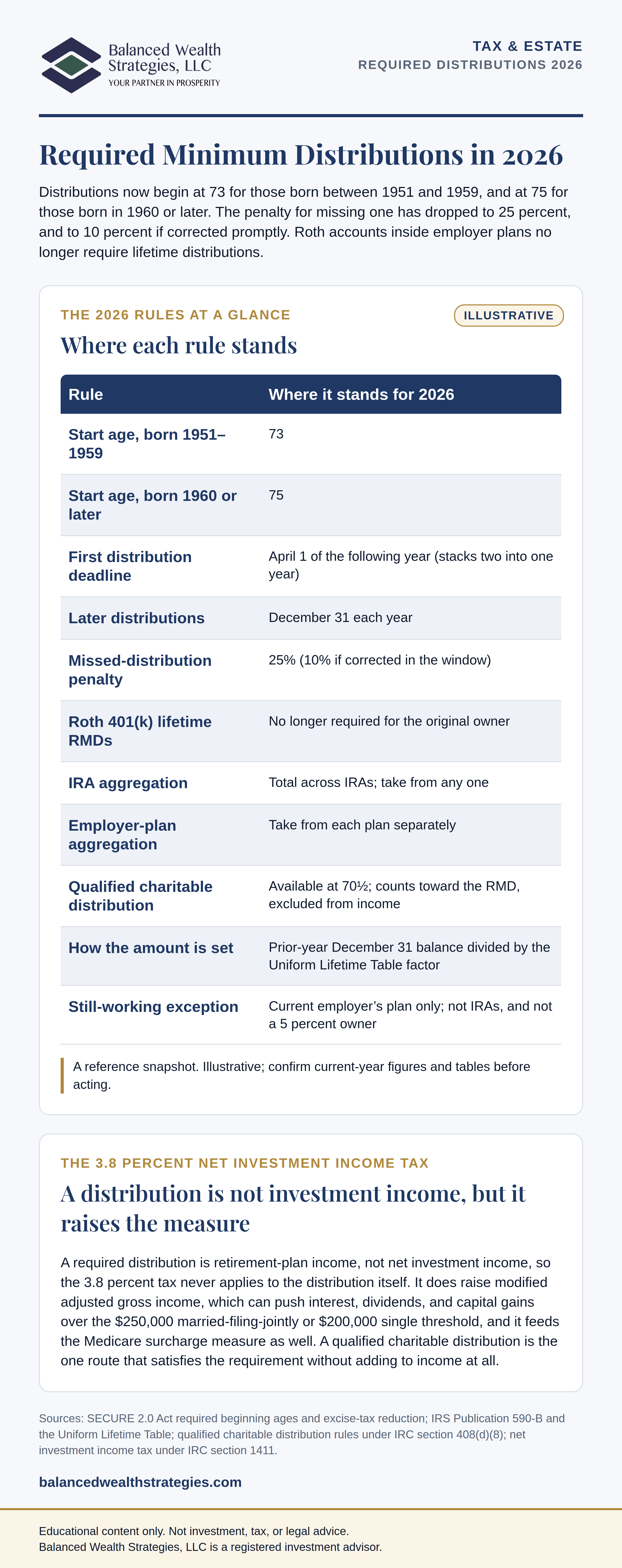
The RMD Rules for 2026 at a Glance
| Rule | Where it stands for 2026 |
|---|---|
| Start age, born 1951–1959 | 73 |
| Start age, born 1960 or later | 75 |
| First distribution deadline | April 1 of the following year (stacks two into one year) |
| Later distributions | December 31 each year |
| Missed-distribution penalty | 25% (10% if corrected in the window) |
| Roth 401(k) lifetime RMDs | No longer required for the original owner |
| IRA aggregation | Total across IRAs; take from any one |
| Employer-plan aggregation | Take from each plan separately |
| Qualified charitable distribution | Available at 70½; counts toward the RMD, excluded from income |
Case in point (illustrative). A retiree held both a traditional IRA and an old 401(k) from a former employer and, knowing IRAs can be aggregated, took the total required amount for both from the IRA. Because employer-plan distributions generally cannot be satisfied from an IRA, the 401(k) distribution was still unmet, triggering the excise tax on that shortfall. Catching it within the correction window cut the penalty to 10 percent, but the cleaner path was to take each employer plan’s distribution from that plan. The scenario is anonymized and illustrative and describes no identifiable client.
How the Amount Is Actually Calculated
The required amount is not a percentage anyone chooses. It is the account balance on December 31 of the prior year divided by a life expectancy factor from the IRS Uniform Lifetime Table, and because the factor falls each year, the required percentage rises for the rest of your life. One substitution matters: where the sole beneficiary is a spouse more than ten years younger, the Joint Life and Last Survivor Table applies instead and produces a smaller distribution. Custodians usually calculate the figure and report it, but the obligation remains the account owner’s, and a balance that moved between institutions during the prior year is where reported figures most often go wrong.
Two Situations That Change the Answer
An employee still working past the start age, who does not own more than 5 percent of the business, can generally defer distributions from that current employer’s plan until retirement. The exception applies to that plan alone; individual retirement accounts and plans left behind at former employers still require distributions on schedule, which is one reason a consolidation decision deserves thought before the start age rather than after. Inherited accounts follow an entirely separate regime: most non-spouse beneficiaries must empty the account within ten years, with annual distributions required in years one through nine where the original owner had already begun taking them.
What to Do Each Year
- Confirm your start age. 73 if born 1951–1959, 75 if born 1960 or later; mark the first year it applies.
- Decide whether to delay the first one. Weigh the April 1 deferral against the two-distribution stacking that follows.
- Calculate from the right table. Use the current Uniform Lifetime Table factor for your age against each account’s prior-year-end balance.
- Respect the aggregation rules. Total IRAs and take from any one; take each employer plan’s amount from that plan.
- Consider a qualified charitable distribution. If you are 70½+ and give, route part of the requirement to charity to satisfy it without adding income, and confirm current-year figures before acting.
If you are approaching required-distribution age, or want to use the years before it, an objective, CPA-led review can coordinate distributions, conversions, and giving. Schedule a confidential consultation with Mark J. Burger, CPA →
Frequently Asked Questions
What age do my required distributions start?
If you were born between 1951 and 1959, at 73. If you were born in 1960 or later, at 75. The first distribution can be delayed to April 1 of the following year, but that stacks two distributions into one year.
What happens if I miss one?
A 25 percent excise tax applies to the amount you failed to take, reduced to 10 percent if you correct the shortfall within the allowed window. Catching and fixing the mistake quickly substantially reduces the cost.
Do I still have to take RMDs from my Roth 401(k)?
Not during your lifetime. Required minimum distributions no longer apply to Roth accounts within employer plans for the original owner, aligning them with Roth IRAs, which were never subject to lifetime distributions.
Can I use my required distribution for charity?
Yes. If you are at least 70½, a qualified charitable distribution sends money directly from your IRA to a charity, counts toward your required amount, and is excluded from your income up to an annually indexed limit. It is an efficient option for those who do not need the full distribution.
How does this connect to Roth conversions?
Directly. Because required distributions force taxable income for life once they begin, the lower-income years before they start are often the best time to convert traditional balances to Roth. That window, and how to use it, is the subject of the Roth conversion series.
Does a required minimum distribution trigger the 3.8 percent net investment income tax?
Not on the distribution itself, which is retirement-plan income rather than net investment income. The distribution does raise modified adjusted gross income, so it can expose your interest, dividends, and capital gains to the 3.8 percent tax above $250,000 joint or $200,000 single, and it can lift you into a Medicare surcharge tier two years later. A qualified charitable distribution satisfies the requirement without adding to income at all.
Important Regulatory Disclosure
Balanced Wealth Strategies, LLC is a registered investment advisor. This is not an offer to sell securities or the solicitation of an offer to purchase securities. All investing involves risk, including the potential loss of principal. Past performance is not indicative of future results. Please see our Disclosures for Form ADV Part 2A and 2B for complete details about our services, fees and professional background.
Sources: required minimum distribution rules under IRC section 401(a)(9); required beginning ages of 73 (born 1951–1959) and 75 (born 1960 or later) under SECURE 2.0. Excise tax on missed distributions reduced to 25 percent, and 10 percent if corrected within the correction window, under SECURE 2.0; as summarized by Kiplinger and Fidelity, 2025–2026. Elimination of lifetime RMDs for designated Roth accounts in employer plans effective 2024; qualified charitable distributions under IRC section 408(d)(8) for owners age 70½ and older, subject to an annually indexed limit. The Uniform Lifetime Table factor of 26.5 at age 73 in the worked example is the current published factor; confirm current-year figures and the QCD limit against IRS guidance before acting. Net investment income tax under IRC section 1411, thresholds $250,000 married filing jointly and $200,000 single; retirement distributions are excluded from net investment income but are included in modified adjusted gross income. Uniform Lifetime Table and Joint Life and Last Survivor Table under Treasury Regulation section 1.401(a)(9)-9; still-working exception under IRC section 401(a)(9)(C); inherited-account rules under the SECURE Act.