

By Mark J. Burger, CPA · A follow-up in the Net Unrealized Appreciation series · BalancedWealthStrategies.com · As of October 2026
When you retire with highly appreciated company stock in a 401(k), one nearly irreversible decision comes first, the NUA vs IRA rollover choice: move the shares out under the net unrealized appreciation rules, so the appreciation is later taxed at long-term capital gain rates, or roll the whole account to an IRA, where every future dollar is ordinary income. The paperwork makes the rollover look like the default. For low-basis company stock, treating it as the default can be an expensive mistake, and for other accounts it is exactly right.
When someone retires or leaves an employer with highly appreciated company stock inside a 401(k), one decision comes before all the others, and it is largely irreversible. The stock can be moved out under the net unrealized appreciation rules, or the entire account can be rolled to an IRA like any other balance. The paperwork makes the second path look like the default. For an account holding low-basis company stock, treating it as the default can be an expensive mistake, and for other accounts it is exactly right. The related mechanics, how the cost basis is determined and when to sell the shares afterward, are taken up in the other articles in the Net Unrealized Appreciation series.
The Two Paths
A full IRA rollover moves everything, company stock included, into a traditional IRA. The balance continues to grow tax-deferred, every future withdrawal is taxed as ordinary income, and required minimum distributions eventually apply. It is simple and familiar. The net unrealized appreciation path treats the company stock differently. On a qualifying lump-sum distribution, the shares are moved in kind to a taxable brokerage account rather than to an IRA. Ordinary income tax is paid now, but only on the stock’s cost basis — what it was worth when it went into the plan — not on its current value. The appreciation, the net unrealized appreciation itself, is not taxed until the shares are sold, and then at long-term capital gain rates rather than ordinary rates. The rest of the account, the portion that is not company stock, is typically rolled to an IRA as usual.
The 3.8 Percent Net Investment Income Tax
One difference between the two paths is easy to miss, and it favors the net unrealized appreciation route. The net unrealized appreciation itself is excluded from net investment income, so when the shares are sold that portion of the gain is taxed at long-term capital gain rates alone and the 3.8 percent net investment income tax does not apply to it. Any appreciation that accrues after the shares leave the plan is ordinary investment gain: it is net investment income and is subject to the 3.8 percent tax once modified adjusted gross income exceeds the threshold, which is a further reason the post-distribution holding period is its own decision. Distributions from an IRA are also not net investment income, but they do raise modified adjusted gross income and can therefore push other investment income over the threshold.
NUA vs IRA Rollover: A Worked Example
Worked example (illustrative). A retiree’s 401(k) holds company stock worth $500,000 with a cost basis of $50,000, so the net unrealized appreciation is $450,000. Under the NUA path, ordinary tax is paid now on the $50,000 basis, roughly $16,000 at a 32 percent rate, and the shares move to a brokerage account; a later sale taxes the $450,000 of appreciation at a 20 percent long-term capital gains rate, about $90,000, for roughly $106,000 of total tax. Roll the same stock into an IRA instead and the entire $500,000, plus any growth, is eventually taxed as ordinary income on withdrawal, about $160,000 at 32 percent on the $500,000 alone, and more as it grows. The NUA path saves on the order of $54,000 here, before considering the escape from future required distributions on that money. The lower the basis relative to value, the larger the gap. Figures are illustrative, ignore state tax, and depend on the reader’s own facts. The net unrealized appreciation itself is excluded from net investment income, so the 3.8 percent net investment income tax does not apply to it; appreciation that accrues after the shares leave the plan is subject to that tax once the income thresholds are met.
When NUA Tends to Win
The strategy rewards a particular shape of account. The larger the appreciation relative to the cost basis — that is, the lower the basis as a share of current value — the more income is converted from ordinary rates to capital gain rates, and the more the strategy is worth. It also depends on being able to pay the basis tax comfortably, ideally from funds outside the account, and it favors those who value the capital gain treatment and the escape from future required distributions on that money. For an executive or long-tenured employee sitting on company stock bought years ago at a fraction of today’s price, the numbers can be substantial.
When the Full Rollover Tends to Win
The opposite shape points the other way. If the appreciation is modest and the basis is high, there is little ordinary-to-capital-gain conversion to capture, and paying tax now on the basis buys little. An owner who wants to keep every dollar deferred, has no near-term need for the money, and expects to hold for a long time may prefer the simplicity and continued deferral of a full rollover. Concentration in employer stock is a real risk, but it is a manageable one on either path, since the shares can be diversified after the fact under whichever route is chosen.

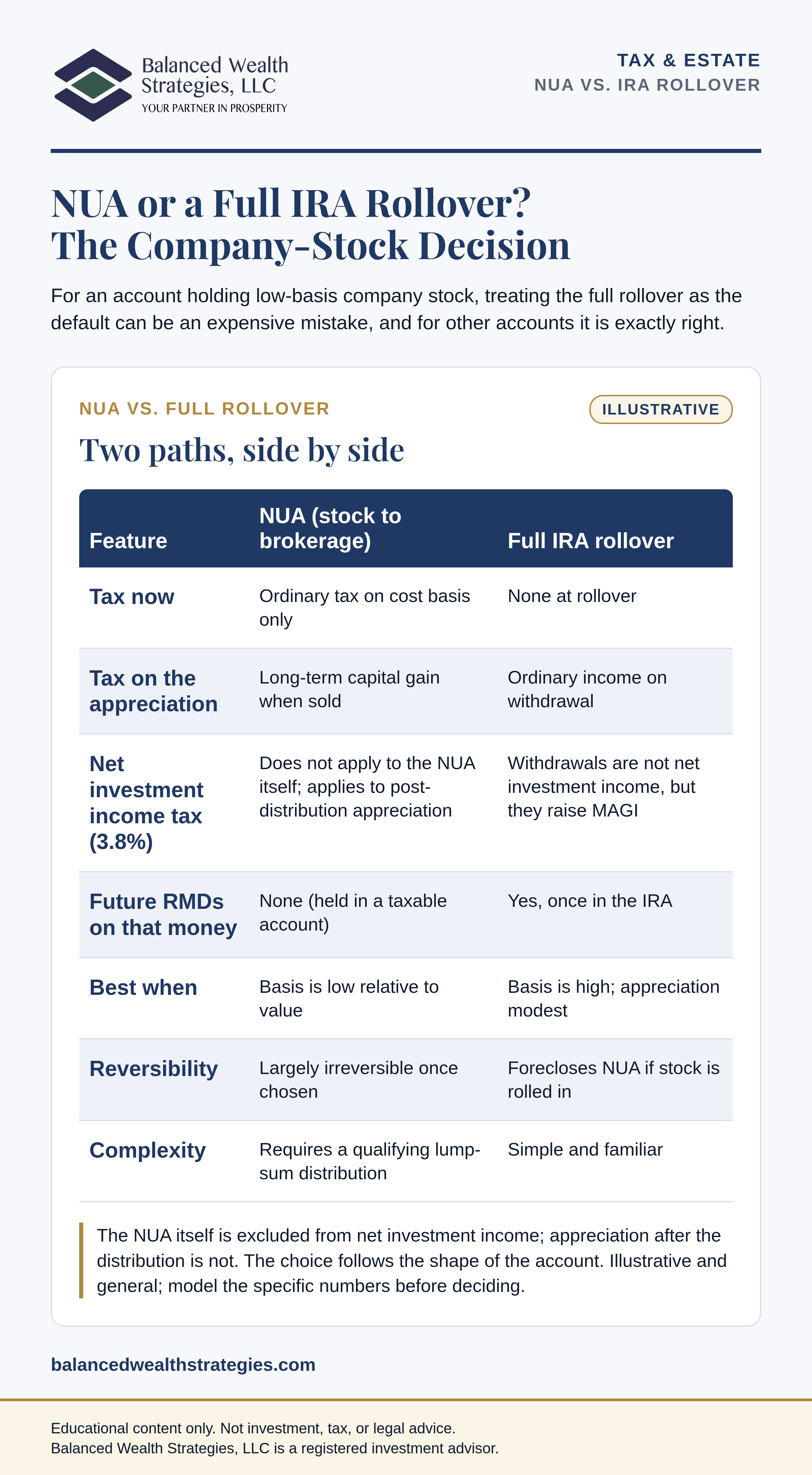
NUA vs. Full Rollover, Side by Side
| Feature | NUA (stock to brokerage) | Full IRA rollover |
|---|---|---|
| Tax now | Ordinary tax on cost basis only | None at rollover |
| Tax on the appreciation | Long-term capital gain when sold | Ordinary income on withdrawal |
| Net investment income tax (3.8%) | Does not apply to the NUA itself; applies to post-distribution appreciation | Withdrawals are not net investment income, but they raise MAGI |
| Future RMDs on that money | None (held in a taxable account) | Yes, once in the IRA |
| Best when | Basis is low relative to value | Basis is high; appreciation modest |
| Reversibility | Largely irreversible once chosen | Forecloses NUA if stock is rolled in |
| Complexity | Requires a qualifying lump-sum distribution | Simple and familiar |
Why the Choice Is Largely Irreversible
The net unrealized appreciation treatment depends on meeting specific requirements: a qualifying triggering event, a lump-sum distribution of the entire account within a single tax year, and the stock moving in kind to a taxable account. If the company stock is first rolled into an IRA, the opportunity is generally lost for good; the appreciation becomes ordinary income on withdrawal like everything else. Because the decision cannot be comfortably unwound, it is one to model deliberately rather than to make by signing whatever form the plan administrator provides.
Case in point (illustrative). A retiring engineer had about $700,000 of employer stock in his 401(k) with a $60,000 basis. The plan administrator’s standard packet defaulted to a full IRA rollover, and he nearly signed it. Modeling the NUA path first showed that paying ordinary tax on the $60,000 basis now would preserve long-term capital gain treatment on the $640,000 of appreciation, a materially better after-tax result than converting all of it to ordinary income inside an IRA. Because the stock had not yet been rolled, the door was still open; a week later it would not have been. The scenario is anonymized and illustrative and describes no identifiable client.
How to Decide Before You Sign
- Find the cost basis. Get the plan’s per-share basis for the company stock; the spread between basis and current value is what drives the entire decision.
- Model both paths. Compare ordinary tax on the basis now plus capital gain later against ordinary income on the whole balance over time.
- Confirm you can pay the basis tax from outside funds. Paying it from the distribution itself weakens the strategy.
- Preserve the qualifying distribution. Do not roll the company stock into an IRA before deciding; that forecloses NUA permanently.
- Coordinate the sale and diversification. Plan when to sell the shares and how to manage concentration, and confirm current-year figures before acting.
If you are approaching retirement with company stock in a 401(k), an objective, CPA-led review can model the two paths before the decision becomes final. Schedule a confidential consultation with Mark J. Burger, CPA →
Frequently Asked Questions
What makes NUA worth it?
Chiefly a low cost basis relative to the current value of the company stock, because that is the spread that shifts from ordinary income tax to long-term capital gain treatment. The larger that spread, and the more comfortably the basis tax can be paid from outside funds, the stronger the case.
If I roll the stock into an IRA first, can I still use NUA later?
Generally no. Once the company stock has been rolled into an IRA, the net unrealized appreciation opportunity is typically forfeited, and the appreciation is taxed as ordinary income when withdrawn. This is why the decision is made before, not after, the rollover.
Do I have to sell the stock right away under NUA?
No. The appreciation is taxed at long-term capital gain rates when you choose to sell. Timing of the sale is its own decision, addressed separately in this series, and it interacts with diversification and your overall tax picture.
Is NUA an all-or-nothing choice?
The favorable treatment attaches to the employer securities distributed in a qualifying lump-sum distribution. The analysis of how much stock to treat this way, and how it fits the rest of your plan, is exactly what a review is for.
Does state tax change the answer?
It can. States tax ordinary income and capital gains differently, and some do not tax capital gains from a former residence the way a current-residence state would. For a Florida resident there is no state income tax at all, which strengthens the after-tax case. The state-tax interaction is covered separately in this series.
Does the 3.8 percent net investment income tax apply to NUA?
Not to the net unrealized appreciation itself. That portion of the gain is excluded from net investment income, so a sale is taxed at long-term capital gain rates without the additional 3.8 percent. Appreciation that accrues after the shares leave the plan is net investment income and is subject to the tax once modified adjusted gross income exceeds the threshold. The distinction is one reason the decision of when to sell the shares afterward is worth planning on its own.
Important Regulatory Disclosure
Balanced Wealth Strategies, LLC is a registered investment advisor. This is not an offer to sell securities or the solicitation of an offer to purchase securities. All investing involves risk, including the potential loss of principal. Past performance is not indicative of future results. Please see our Disclosures for Form ADV Part 2A and 2B for complete details about our services, fees and professional background.
Sources: net unrealized appreciation treatment of employer securities under IRC section 402(e)(4); exclusion of net unrealized appreciation from net investment income under Treasury Regulation section 1.1411-8(b)(4)(ii) and the instructions to Form 8960, with post-distribution appreciation subject to the 3.8 percent net investment income tax under IRC section 1411; requirement of a lump-sum distribution following a triggering event. Ordinary income tax on cost basis at distribution; long-term capital gain treatment of the net unrealized appreciation on later sale; loss of NUA treatment if employer stock is rolled into an IRA. The 32 percent ordinary rate and 20 percent long-term capital gains rate in the worked example are illustrative and depend on the taxpayer’s bracket. NUA is fact-specific and largely irreversible; confirm all figures with your tax advisor before acting.