

By Mark J. Burger, CPA · BalancedWealthStrategies.com · As of October 2026
Many co-owned businesses have a buy-sell agreement in a drawer; far fewer have one that would actually work if it were needed tomorrow. A buy-sell is only as good as its funding and its valuation, and both go stale quietly, unnoticed until the moment they are called upon, which is exactly the moment there is no time to fix them. An agreement that promises a buyout the remaining owners cannot finance forces a distressed sale or a broken promise at the worst possible time. This is a review of buy-sell agreement funding and valuation, and how to tell whether yours would work.
Many co-owned businesses have a buy-sell agreement somewhere in a drawer. Far fewer have one that would actually work if it were needed tomorrow. A buy-sell is only as good as its funding and its valuation, and both tend to go stale quietly, unnoticed until the moment they are called upon, which is exactly the moment there is no time to fix them. It is the funding half of the succession question our anchor article on business succession paths raises.
What a Buy-Sell Is Supposed to Do
A buy-sell agreement governs what happens to an owner’s interest when a triggering event occurs, most often the death, disability, or departure of a co-owner, and sometimes divorce or bankruptcy. It sets who may buy the departing owner’s share, at what price or by what formula, and on what terms. Done well, it prevents a surviving owner from suddenly having a deceased partner’s spouse as a business partner, and it gives the departing owner or the estate a defined, fair exit.
The Buy-Sell Agreement Funding Gap
An agreement can specify a purchase obligation without providing any way to pay for it. When the trigger is a death, life insurance is the common funding source, arranged so that the proceeds are available exactly when the buyout obligation arises. When it is a disability or a voluntary departure, funding may come from disability coverage, a sinking fund, or a note paid over time. The failure mode is an agreement that promises a buyout the remaining owners or the company cannot actually finance, which forces a distressed sale or a broken promise at the worst possible time.
Worked example (illustrative). Two equal owners of a company worth $4 million have a buy-sell requiring the survivor to buy the deceased’s half for $2 million. Unfunded, the surviving owner must find $2 million on short notice, from company cash the business needs to operate, from a bank loan a grieving co-owner may not qualify for, or by selling assets, while the deceased’s family waits. Funded with a $2 million life insurance policy on each owner, the proceeds arrive when the obligation does; the family is paid in full and the company keeps its cash. The premium depends on age, health, and policy terms and is worth weighing against the exposure it covers. Figures are illustrative and depend on age, health, and the policy; confirm with your insurance advisor.
The Valuation That Drifts
A price or formula set years ago rarely reflects the business today. A company that has doubled in value since the agreement was signed may carry a buyout price that shortchanges a departing owner’s family, while a formula that no longer fits the business can produce a figure no one intended. Valuations and funding amounts should be revisited on a regular schedule, not left to be discovered at a funeral or a resignation.
Structure Matters Too
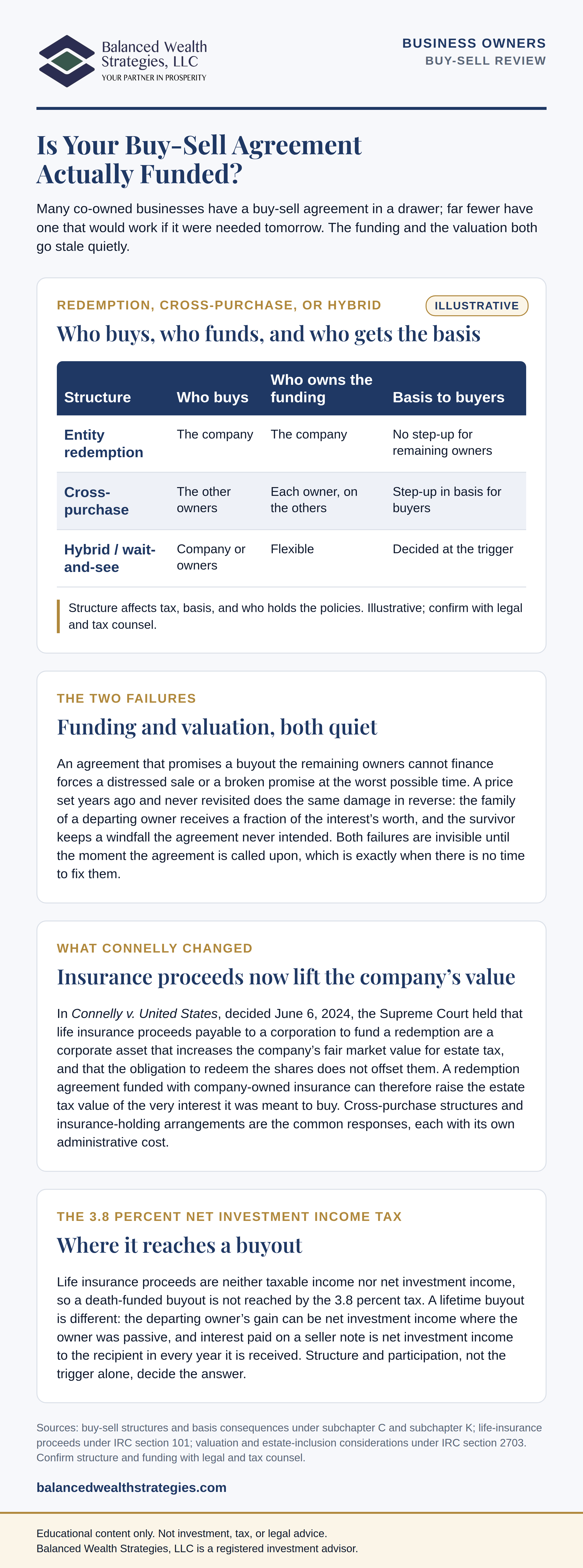
Whether the agreement is structured as an entity redemption, a cross-purchase among owners, or a hybrid affects the tax treatment, the cost basis the buyers receive, and how the funding is owned. The right structure depends on the number of owners and the tax picture, and a structure chosen a decade ago may no longer be the best fit. This is worth confirming as part of any review.

Redemption, Cross-Purchase, or Hybrid
| Structure | Who buys | Who owns the funding | Basis to buyers |
|---|---|---|---|
| Entity redemption | The company | The company | No step-up for remaining owners |
| Cross-purchase | The other owners | Each owner (on the others) | Step-up in basis for buyers |
| Hybrid / wait-and-see | Company or owners | Flexible | Decided at the trigger |
Case in point (illustrative). Two partners signed a buy-sell a dozen years ago pegging each half at $500,000, funded with matching $500,000 policies. The company had since quadrupled to a $4 million value, but no one revisited the numbers. When one partner died, the $500,000 the family received was a quarter of the half’s true worth, and the survivor kept a windfall the agreement never intended. A stale price, not a missing one, caused the harm. A periodic review would have re-set both the valuation and the coverage. The scenario is anonymized and illustrative and describes no identifiable client.
What Connelly Changed for Redemption Agreements
In Connelly v. United States, decided June 6, 2024, the Supreme Court held that life insurance proceeds payable to a corporation to fund a redemption are a corporate asset that increases the company’s fair market value for federal estate tax purposes, and that the obligation to redeem the deceased owner’s shares does not offset them. In that case the inclusion raised the value of the decedent’s interest substantially above the price the agreement had set. The practical consequence is that a redemption agreement funded with company-owned insurance can increase the estate tax value of the very interest it exists to purchase. Cross-purchase arrangements and insurance-holding structures are the common responses, each carrying its own administrative burden, and any redemption agreement written before 2024 is worth reviewing against this decision with counsel.
Three Technical Traps
First, the transfer-for-value rule: moving an existing policy between owners, which commonly happens when a buy-sell is restructured, can make the death benefit taxable unless the transfer falls within an exception. Second, employer-owned life insurance: policies the business owns on an owner or employee generally require written notice and consent before issue, and annual reporting, or the proceeds can lose their income-tax-free treatment. Third, the paperwork behind the agreement: policy ownership, beneficiary designations, and the entity named in the agreement all drift as businesses reorganize, and a policy still owned by a predecessor entity or payable to a former spouse is a funding failure that no one notices until a claim is filed.
Where the 3.8 Percent Net Investment Income Tax Reaches a Buyout
Life insurance proceeds are neither taxable income nor net investment income, so a buyout funded at death is not reached by the 3.8 percent tax. A buyout during life is different. The departing owner’s gain can be net investment income where that owner did not materially participate in the business, and interest paid on a seller note is net investment income to the recipient in every year it is received, which is easy to overlook when a buyout is spread across a decade. Structure and participation, rather than the triggering event alone, decide the answer, and both are easier to document before the trigger than after.
How to Review a Buy-Sell
- Confirm the triggers. Check that death, disability, and departure, and where relevant divorce and bankruptcy, are all addressed.
- Match funding to each trigger. Verify life insurance for death, disability coverage or a note for disability, and a credible source for a voluntary exit.
- Refresh the valuation. Update the price or formula to the business as it is now, and align the funding amount to it.
- Confirm the structure. Re-check whether redemption, cross-purchase, or hybrid still gives the best tax and basis result for the current ownership.
- Set a review cadence. Put the agreement on a recurring schedule, every few years and after any major change, and confirm current figures before relying on it.
If it has been years since anyone looked at your buy-sell agreement, an objective, CPA-led review can confirm it is still funded, fairly valued, and correctly structured. Schedule a confidential consultation with Mark J. Burger, CPA →
Frequently Asked Questions
How often should a buy-sell be reviewed?
On a regular cadence, many owners revisit the valuation and funding every few years and after any significant change in the business, ownership, or the owners’ personal circumstances. The goal is that the agreement always reflects the company as it is now, not as it was when signed.
Do we really need insurance to fund it?
Not always, but for a death trigger it is the most common solution because it delivers cash precisely when the obligation arises. For other triggers, funding can come from reserves or installment terms. The point is that some credible funding source must exist, or the agreement cannot do its job.
What happens if the price in our agreement is outdated?
It can produce an unfair or unintended result, shortchanging a departing owner’s family or overpaying at the company’s expense. Updating the valuation method and the figure, and aligning the funding to it, is usually the single most valuable part of a buy-sell review.
What is the difference between a redemption and a cross-purchase?
In a redemption the company buys the departing owner’s interest; in a cross-purchase the remaining owners buy it individually. The choice affects the tax treatment, the cost basis the buyers receive, and who owns any insurance funding. A hybrid, or wait-and-see, structure defers the choice to the moment of the trigger. The best fit depends on the number of owners and the tax picture.
We are family-owned. Do we still need a buy-sell?
Often yes. A buy-sell can keep an interest from passing to an in-law or an outside party on a death or divorce, set a fair price for a family member’s exit, and provide the liquidity to pay it. Family ownership does not remove the triggering events; it can make a clear, funded agreement even more important to family harmony.
Important Regulatory Disclosure
Balanced Wealth Strategies, LLC is a registered investment advisor. This is not an offer to sell securities or the solicitation of an offer to purchase securities. All investing involves risk, including the potential loss of principal. Past performance is not indicative of future results. Please see our Disclosures for Form ADV Part 2A and 2B for complete details about our services, fees and professional background.
Sources: buy-sell agreements and triggering events (death, disability, departure); entity-redemption, cross-purchase, and hybrid structures and their differing tax and basis consequences. Life insurance and disability funding of buyout obligations; periodic valuation updates. The dollar figures and premium in the worked example are illustrative and depend on age, health, and policy terms; buy-sell structure, valuation, and funding depend on the number of owners, entity type, and tax circumstances and should be reviewed with your legal, tax, and insurance advisors. Connelly v. United States, 602 U.S. 257 (June 6, 2024); transfer-for-value rule under IRC section 101(a)(2); employer-owned life insurance notice, consent, and reporting under IRC sections 101(j) and 6039I; net investment income tax under IRC section 1411.