

By Mark J. Burger, CPA · BalancedWealthStrategies.com · As of September 2026
Sudden wealth rarely arrives cleanly: an inheritance comes with grief, a settlement with exhaustion, a business-sale windfall with a lost identity, and each lands alongside pressure to do something. The single most valuable decision in that moment is the least intuitive one, to slow down. A deliberate first quarter, pause, protect, then plan, prevents most of the avoidable damage, because the after-tax outcome of a windfall is largely settled in the first months, not at the next April.
Sudden wealth rarely arrives cleanly. An inheritance comes with grief. A legal settlement comes with exhaustion. A business-sale windfall comes with the disorientation of an identity that was tied to the company now sold. Whatever the source, a large sum lands alongside strong emotion and, almost immediately, pressure, from institutions, from advisors, from family, and from the recipient’s own urge to do something. The single most valuable decision in that moment is the least intuitive one: to slow down. Helping recipients build a deliberate plan before the money is committed is the focus of our wealth management and financial planning services.
Why Sudden Wealth Is So Often Lost
The stories of windfalls squandered are not mostly stories of reckless spending. They are stories of ordinary people making a series of irreversible decisions while overwhelmed, investing before there is a plan, lending or gifting to family under emotional pressure, inflating a lifestyle to a level the money cannot sustain, and accepting the first confident-sounding advice that appears. A large sum attracts attention, and not all of it is disinterested. The recipient is asked to make consequential, permanent choices at exactly the moment they are least equipped to make them. Recognizing that dynamic is itself a form of protection.
The First Ninety Days: Pause, Protect, Plan
A deliberate first quarter prevents most of the avoidable damage. The first step is to pause. Money placed in safe, liquid holdings, a high-quality money market or short-term instruments, earns a reasonable return while nothing irreversible is decided. There is rarely a penalty for waiting a few months, and often a large cost to acting quickly. The second step is to protect. Secure the accounts, organize the paperwork, and understand exactly what was received and how it is taxed, because sudden wealth arrives in forms that behave very differently. An inherited retirement account carries its own distribution rules and is taxed as it comes out. Inherited investments held in a taxable account generally receive a stepped-up cost basis, which can erase much of the built-in gain. Life insurance proceeds are typically received free of income tax. The third step is to plan, and only then to invest, against a clear purpose rather than a product, the principle behind our planning-first investment approach.
Worked example (illustrative). Two heirs each inherit $500,000, and the difference in tax is entirely in the form. The first inherits a taxable brokerage account of appreciated stock; because it receives a stepped-up basis to date-of-death value, selling it soon after realizes essentially no capital gains tax, so nearly the full $500,000 is available. The second inherits a traditional IRA; every dollar is ordinary income as it comes out, and under the ten-year rule it must be drawn down within a decade, so at a 32 percent rate the $500,000 yields about $340,000 after tax, and the timing of the withdrawals affects the bill. Same headline number, a roughly $160,000 difference in what is kept, decided by understanding the character of each inheritance before acting. Figures are illustrative, ignore state tax, and depend on the reader’s own facts.
The Taxes Hide in the Details
Much of what determines the after-tax outcome of a windfall is settled in the first months, not at the next April. An inherited traditional retirement account is now commonly subject to a rule requiring most non-spouse beneficiaries to draw it down within ten years, which has real tax-timing consequences. The step-up in basis on inherited investments is valuable but must be documented. Some states impose their own inheritance taxes. And an estate may carry obligations that fall to the heirs to address. These are not reasons for anxiety; they are reasons to get organized early, with guidance, before decisions foreclose options.
Case in point (illustrative). Within weeks of a $1.2 million inheritance, a recipient still grieving felt pressure from every direction: a broker with a ready portfolio, a sibling asking for a loan, and a contractor pitching a second home. He moved most of the money into a money-market fund and told everyone he would decide in ninety days. In that window a review sorted the inheritance into its parts, documented the step-up on the taxable account, mapped the ten-year rule on the inherited IRA, and built a plan around his actual goals. The decisions he might have made in week one, an all-in investment, a large family loan, a lifestyle he could not sustain, were all avoided simply by waiting. The scenario is anonymized and illustrative and describes no identifiable client.
Learn More

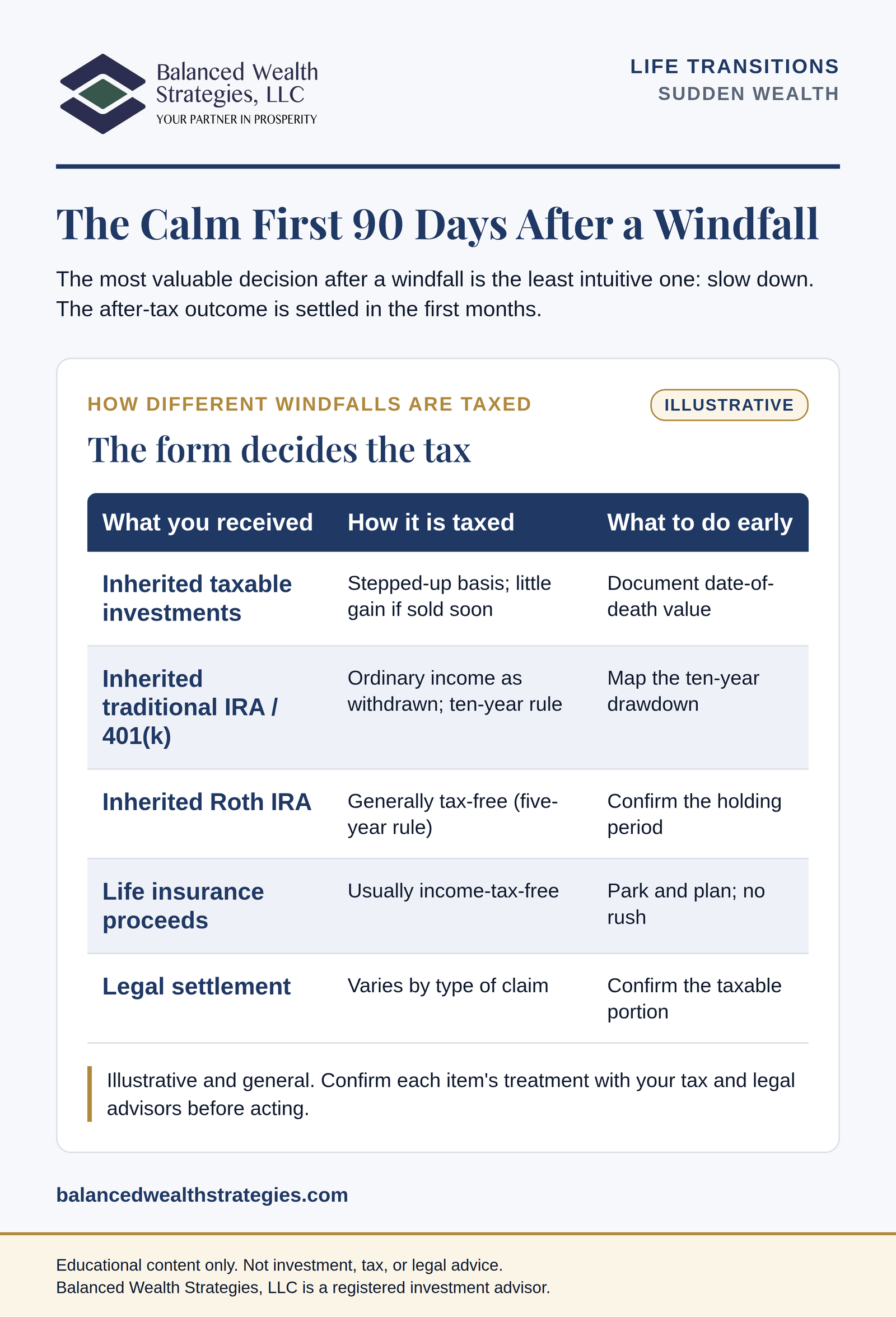
How Different Windfalls Are Taxed
| What you received | How it is taxed | What to do early |
|---|---|---|
| Inherited taxable investments | Stepped-up basis; little gain if sold soon | Document date-of-death value |
| Inherited traditional IRA / 401(k) | Ordinary income as withdrawn; ten-year rule | Map the ten-year drawdown |
| Inherited Roth IRA | Generally tax-free (5-year rule) | Confirm the holding period |
| Life insurance proceeds | Usually income-tax-free | Park and plan; no rush |
| Legal settlement | Varies by type of claim | Confirm the taxable portion |
The First 90 Days, Step by Step
- Pause. Move the funds to a safe, liquid place and give yourself permission to make no irreversible decisions for a while.
- Protect. Secure the accounts, gather the paperwork, and understand exactly what you received and how each piece is taxed.
- Assemble an independent team. A tax advisor, an estate attorney if needed, and a wealth advisor whose role is to plan, not to sell; choosing who manages the money comes last, a decision we support through our strategic wealth manager partnerships.
- Handle the time-sensitive items. Elections, retitling, and inherited-account rules have deadlines; address those while the rest can wait.
- Define the purpose, then invest. Decide what the money is for, build a strategy to match, and confirm current-year figures before acting.
If you have recently received, or expect to receive, an inheritance or windfall, an independent, CPA-led review can help you move calmly and avoid costly first steps. Schedule a confidential consultation with Mark J. Burger, CPA →
Frequently Asked Questions
What should I do first when I receive a large inheritance or windfall?
As a general educational matter, place the funds somewhere safe and liquid and give yourself permission to do nothing else for a while. The first task is to avoid irreversible decisions, not to make impressive ones. A deliberate pause is prudent, not passive.
Is an inheritance taxable?
It depends on what you inherited. Inherited traditional retirement accounts are taxed as they are withdrawn and carry distribution rules; inherited investments in a taxable account generally receive a stepped-up basis; life insurance is usually income-tax-free. Some states levy an inheritance tax. Understanding the character of what you received is one of the first and most important steps.
How long should I wait before investing?
Long enough to build a real plan, often a few months. There is rarely a meaningful cost to holding funds safely while you define goals and assemble advisors, and there is frequently a large cost to investing under emotional pressure. The waiting is part of the strategy, not a failure to act.
Everyone is offering me advice. How do I sort it out?
Seek advice from someone without a product to sell you. An independent, CPA-led review can help you evaluate the options, understand the tax consequences, and decide who should manage the money, separating genuine guidance from a sales process.
Does a stepped-up basis really matter that much?
It can be decisive. Inherited taxable investments are generally revalued to their date-of-death worth, so a lifetime of built-in gain can be erased if the assets are sold soon after. Failing to document that value can cost real money later. It is one of the reasons the character of each inherited asset should be established early.
Important Regulatory Disclosure
Balanced Wealth Strategies, LLC is a registered investment advisor. This is not an offer to sell securities or the solicitation of an offer to purchase securities. All investing involves risk, including the potential loss of principal. Past performance is not indicative of future results. Please see our Disclosures for Form ADV Part 2A and 2B for complete details about our services, fees and professional background.
Sources: step-up in basis of inherited property under IRC section 1014; income taxation of inherited traditional retirement accounts and the 10-year distribution rule for many non-spouse beneficiaries under the SECURE Act. Income-tax treatment of life insurance proceeds under IRC section 101; state inheritance and estate taxes vary by state. The $500,000 amounts and 32 percent rate in the worked example are illustrative; the tax character and best handling of a windfall depend on individual circumstances and should be confirmed with your tax and legal advisors.