
A $3,935,000 Net Unrealized Appreciation position generates a federal tax savings of $668,950 when a retiring executive distributes employer stock rather than rolling it to an IRA. That federal math — covered in the first article in this series — is settled, and permanent under current law.
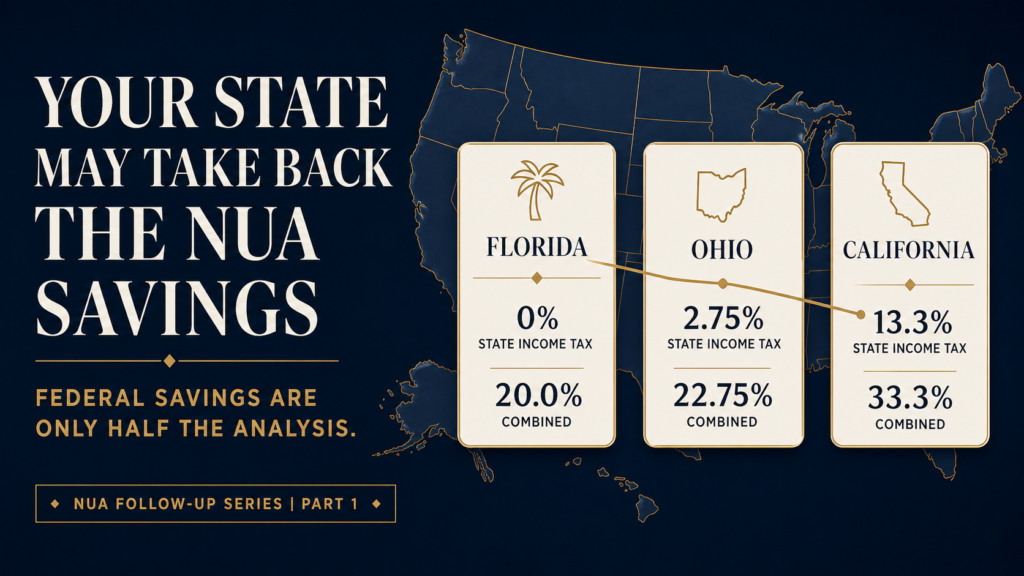
What is not settled is what happens next, at the state line. The same $3,935,000 gain that owes $787,000 in combined tax to a Florida resident owes $1,310,355 to a California resident — a difference of $523,355 in tax on the identical position, decided by residence alone.
This is the first of three follow-up articles addressing the questions readers raised after that federal analysis: what does my state do with the NUA, how do I find my cost basis, and once I take the distribution, when should I sell. We begin where the federal calculation ends — at the state line.
Where This Series Begins
The first article in this discussion — The Devastating Tax Mistake Retiring Executives Make With Employer Stock — made the federal case for Net Unrealized Appreciation. The math was clean. A participant retiring with highly appreciated employer stock can preserve more than half a million dollars in federal tax by distributing the stock rather than rolling it to an IRA. That analysis was complete and correct — at the federal level.
Then the questions arrived. Three of them, again and again, from readers who understood the federal mechanics and wanted to know what came next.
→ What does my state do with the NUA?
→ How do I find my cost basis, and who do I ask?
→ Once I take the distribution, when should I sell?
Three questions. Each one capable of changing the outcome. None of them answered by the federal analysis alone. This is the first of three follow-up articles, taken in the order the decisions actually arrive. We begin where the federal calculation ends — at the state line.
Why Does State Tax Treatment Matter for the NUA?
The federal long-term capital gains preference — the mechanism that allows the NUA to be taxed at 20% rather than 37% — is a federal construct. States set their own rules.
→ Some adopt the federal preference. The savings carry through.
→ Some tax every dollar of income at the same ordinary rate. The preference disappears.
→ Some impose no income tax at all. The federal savings stand undiminished.
Each rule feels like a footnote. Collectively, they determine whether the strategy delivers its full value or roughly half of it. A CPA can model the federal result to the penny. But no account statement shows what your state will take back when the stock is sold.
Return to the cornerstone illustration: a participant retiring at 60 with $65,000 of cost basis and $4,000,000 of employer stock — an NUA of $3,935,000. At the federal level, distributing rather than rolling that stock saves $668,950, the product of the 17-percentage-point spread between the 37% ordinary rate and the 20% long-term capital gains rate on the NUA. That federal saving is now permanent: the One Big Beautiful Bill Act, signed in July 2025, extended the ordinary income structure and preserved the long-term capital gains rates. For a taxpayer at this income level, the 20% rate on the NUA is not a best case. It is the rate.
What is not settled is the state’s treatment of that same $3,935,000. The answer depends entirely on where you live, and it determines whether the federal advantage survives the trip to your state return.
The Three State Categories for NUA Taxation
Nearly every state that taxes income taxes capital gains as ordinary income. The federal 0/15/20 preference is a federal construct, and only a handful of states reproduce anything like it. What varies from state to state is not whether gains receive a preference — it is the rate.
Category 1 — No State Income Tax
Florida, Texas, Nevada, Wyoming, Washington, South Dakota, Tennessee, and Alaska impose no state income tax. The federal NUA saving is preserved in full. For these residents, the strategy is as powerful as the federal analysis suggests.
Category 2 — A High Ordinary Rate on Capital Gains
These states tax gains as ordinary income at top rates high enough to erode much of the federal advantage:
- California — 13.3%
- New York — 10.9% at the top; New York City adds up to 3.876%
- New Jersey — 10.75%
- Oregon — 9.9%
- Minnesota — 9.85%, plus a 1% surcharge on net investment income above $1 million
In these states, the NUA is taxed at the state ordinary rate on top of the federal 20%. The federal capital gains preference does not carry over.
Category 3 — A Low or Flat Rate on Capital Gains
Most remaining states also tax gains as ordinary income, but at low or flat rates that leave the bulk of the federal advantage intact. Ohio, the example in the table below, applies a flat 2.75% as of 2026. A few states go further and grant a partial long-term exclusion. The federal benefit survives in this group not because the state reproduces the federal preference, but because the state rate is simply low.
What This Looks Like in Practice
Here is the combined federal and state burden on the $3,935,000 NUA across four residency scenarios:
| Residency | Federal Rate | State Rate | Combined Rate | NUA Tax on $3,935,000 |
| Florida (no state tax) | 20% | 0% | 20% | $787,000 |
| California | 20% | 13.3% | 33.3% | $1,310,355 |
| New York (state only) | 20% | 10.3%* | 30.3% | $1,192,305 |
| Ohio (low flat rate) | 20% | 2.75% | 22.75% | $895,213 |
The state figures are top marginal rates. They apply here because a position of this size pushes sale-year income into the top brackets. A smaller position, or a sale spread into lower-income years, faces a lower state rate and less erosion. *New York’s 10.9% statutory top rate applies only above roughly $25 million of income; at this income level the applicable rate is about 10.3%. New York City residents add up to 3.876%.

The Florida resident keeps the full federal advantage. The California resident still comes out well ahead of a full ordinary-income IRA distribution — but the 13.3% state layer absorbs a large share of the federal advantage, and the gap against a no-tax state is wide. Same strategy. Same stock. A difference of $523,355 in tax between Florida and California — more than half a million dollars, decided by residence alone.
Three Special-Case States Worth Knowing
Three states do not fit the categories cleanly.
Pennsylvania generally does not tax retirement income from qualified plans for residents over age 59½. A Pennsylvania resident who meets that requirement may owe no state tax on either the cost basis distribution or the NUA sale — an outcome that amplifies the federal savings considerably. This warrants confirmation with a Pennsylvania-licensed advisor before the distribution is taken.
Massachusetts applies a flat 5% rate to most income, including capital gains. The rate is low enough that the combined burden remains meaningfully below what a full IRA rollover would produce.
Illinois applies a flat 4.95% rate with no capital gains preference. The state impact is modest, and the strategy remains favorable on a combined basis for most Illinois residents.

If I Must Sell to Diversify, Am I Trading One Tax Problem for Another?
A reader raised the sharpest objection to the strategy. The NUA distribution leaves you holding a single stock. Diversifying that position means selling. Selling means realizing gain. So where, the reader asked, is the advantage — have I not simply moved the tax from one column to another?
It is a fair question, and the answer is that diversification and tax efficiency are not opposing goals. They are two variables in the same equation. The objective is not the lowest tax. It is not the fastest diversification. It is the lowest combined effective rate consistent with a level of concentration risk an investor can accept.
→ Sell too fast, and gains may land in the highest-rate years.
→ Sell too slow, and single-stock risk is carried longer than prudence allows.
There is no universal answer. There is a modeled one.
The Rate on the NUA Is Fixed. The Rate on Everything Else Is Not.
The NUA itself is locked at 20% — the long-term capital gains rate — whenever the shares are sold. The 3.8% Net Investment Income Tax does not reach it; the NUA is excluded from net investment income by statute. That figure does not move with timing.
But long-term capital gains do not sit at a single rate. They are taxed at 0%, 15%, or 20%, and they stack on top of ordinary income. The rate that applies to a given block of gain depends on total taxable income in the year it is realized. That is the lever.
→ In a high-income year — full salary, large distributions, business income — the gain lands in the 20% bracket with the 3.8% surtax on top.
→ In a low-income year — after separation, before Social Security and required minimum distributions begin — the same gain may fall partly into the 15% bracket, and below the NIIT threshold entirely.
A retiree often passes through a window of unusually low income between the year of separation and the year required minimum distributions begin. That window is typically the most efficient time to realize gain.
The NIIT Is a Threshold, Not a Constant
The 3.8% Net Investment Income Tax applies to net investment income once modified adjusted gross income exceeds $250,000 for married couples filing jointly, or $200,000 for single filers. Those thresholds are not indexed for inflation; they have not moved since 2013.
The NUA itself never triggers the surtax, no matter how large — it is excluded from net investment income by statute. That is why its federal rate is 20%, not 23.8%. But for post-distribution appreciation, and for diversification sales in lower-income years, the threshold matters. A multi-year sale plan is, in part, a plan to manage where income falls relative to that threshold.
What Does an Efficient Diversification Plan Look Like?
The mechanics of an efficient unwind are not complicated. They are deliberate.
- Sell in tranches across multiple tax years rather than in a single event.
- Size each tranche to fill the lower capital gains brackets in low-income years, rather than spilling the whole position into the top bracket in one year.
- Watch the IRMAA two-year lookback. A large gain year raises Medicare Part B and Part D premiums two years later. Spreading the sale can help avoid the highest premium tiers.
- Pair realized gains with any available losses elsewhere in the portfolio. Harvested losses offset diversification gains dollar for dollar.
Each of these moves lowers the effective rate on the unwind. None of them changes the rate on the NUA itself.
When Is a Position Large Enough to Warrant More Advanced Structures?
For a concentration measured in millions, ordinary bracket management may not be enough on its own. Several structures exist to diversify without recognizing the full gain at once. Each carries its own rules, costs, and tradeoffs, and none should be entered into without individualized analysis:
- Gifting appreciated shares to family members in lower brackets, within the annual exclusion, so the eventual sale occurs at their rate rather than yours.
- Donating appreciated shares to a donor-advised fund or charity, which removes the embedded gain from the return entirely and may produce a deduction.
- Contributing the position to an exchange fund, which pools concentrated holdings into a diversified portfolio and defers the gain, in exchange for a multi-year holding commitment.
- A charitable remainder trust for the largest positions, which permits diversification inside the trust and returns an income stream.
These are not recommendations. They are options whose suitability depends entirely on the size of the position, the state of residence, charitable intent, and the cash flow required. Evaluating them alongside our wealth managers and a coordinated tax and investment plan is how a concentrated position becomes a diversified one without surrendering the NUA advantage in the process.
The Principle Behind Diversification and the NUA
The NUA decision does one thing. It fixes a favorable rate on the appreciation that accrued inside the plan. What happens after the distribution determines two things the decision cannot: the effective rate on everything else, and exposure to a single company’s fortunes.
Diversification is not the enemy of the strategy. Unmanaged diversification is.
The rate on the NUA is set the day the distribution is taken. The pace at which the rest is unwound is a matter of ongoing management — and that pace, handled deliberately as part of a coordinated investment approach, is where the second half of the savings is either kept or surrendered.

What Is the Right Question Before the Distribution?
The question is not whether the NUA strategy is valuable. For most taxpayers in most states, it remains the superior approach when the cost basis is low relative to fair market value. The right question is narrower, and it is personal:
What is my combined federal and state burden on the NUA — and how does that compare to my combined burden on IRA distributions at my anticipated withdrawal rate?
That question requires the state of residence, the state’s current treatment of capital gains, anticipated income in the year of distribution, and anticipated income in the year of sale. It cannot be answered generically. It requires actual numbers, and it must be answered before the rollover paperwork is signed.
The federal analysis tells you whether the strategy works. The state analysis tells you how much of it you keep. One is published in the Internal Revenue Code. The other is written in fifty different places, and it changes the moment a state line is crossed. The distribution is the irreversible decision. The analysis that informs it should account for both.
37 years advising employers and business owners. Independent perspective. No product relationships. No rollover incentives.
Next in the series — Part 2: Before you can use the NUA strategy, you need one number. Most people do not know how to get it.

- What is Net Unrealized Appreciation (NUA) in simple terms? NUA is the difference between what a qualified retirement plan paid for employer stock and that stock’s fair market value when it is distributed. Under federal rules, that appreciation can be taxed at long-term capital gains rates rather than ordinary income rates when the stock is distributed and later sold, instead of rolled into an IRA.
- Does my state automatically follow the federal NUA tax treatment? No. States set their own income tax rules independently of the federal code. Some states have no income tax and preserve the federal advantage in full. Others tax capital gains as ordinary income at rates that reduce the benefit. A handful offer favorable treatment for retirement income under specific conditions. State residence should be reviewed before any distribution decision.
- Which states currently impose no income tax, preserving the full federal NUA advantage? As of 2026, Florida, Texas, Nevada, Wyoming, Washington, South Dakota, Tennessee, and Alaska impose no state income tax. Residents of these states generally keep the full federal NUA benefit, since there is no state-level layer to erode it. State tax law can change, so current residency and state law should always be confirmed before relying on this treatment.
- Does the 3.8% Net Investment Income Tax (NIIT) apply to the NUA itself? No. The NUA is excluded from net investment income by statute, so the 3.8% surtax does not apply to it regardless of the size of the gain. The NIIT can apply to appreciation that occurs after the distribution date, and to other investment income, once modified adjusted gross income exceeds the applicable threshold. This is a general federal rule and not a substitute for individualized tax advice.
- What is the IRMAA two-year lookback, and why does it matter for an NUA sale? Medicare uses income from two years prior to determine Part B and Part D premium surcharges under IRMAA. A large capital gain from selling NUA stock can raise reported income in the sale year, which may increase Medicare premiums two years later. Spreading a sale across multiple tax years is one general approach used to manage this effect, though the right approach depends on individual circumstances.
- Can I move to a no-tax state before I do this, and does timing matter? A genuine change of domicile can affect which state taxes each part of the transaction, and timing matters for both halves. Federal law generally bars a former state from taxing a qualified-plan distribution once someone is a bona fide nonresident, while the NUA gain is typically sourced to the state of residence in the year of sale. A partial or incomplete move does not reliably achieve this result, and high-tax states scrutinize large one-time events closely.
- What happens to the NUA tax if I hold the stock until death instead of selling? Ordinary appreciated stock generally receives a stepped-up basis at death, erasing the built-in gain. The NUA does not work this way: it is treated as income in respect of a decedent, meaning heirs generally inherit the original basis on that portion and still owe long-term capital gains tax when they eventually sell. Only appreciation accrued after the distribution date typically receives a step-up. This distinction matters for anyone considering NUA as part of estate planning.
Important Regulatory Disclosure: Balanced Wealth Strategies, LLC is a registered investment advisor. This is not an offer to sell securities or the solicitation of an offer to purchase securities. All investing involves risk, including the potential loss of principal. Past performance is not indicative of future results. Please see our Disclosures for Form ADV Part 2A and 2B for complete details about our services, fees and professional background.
Questions about how state residency affects your own NUA analysis? Schedule a confidential consultation with Mark J. Burger, CPA to review your specific numbers.