
The stretch IRA is gone. For decades, a child or grandchild who inherited a traditional IRA could draw it down slowly across their own life expectancy, letting most of the account grow tax-deferred for another thirty or forty years. The SECURE Act ended that for most beneficiaries who inherit on or after 2020. In its place is a far shorter and far less forgiving rule: the account must be emptied within ten years.
For a modest IRA, ten years is ample. For a large one, it is a compressed and expensive window — and it usually opens at the worst possible moment in the beneficiary’s own financial life. This article, the second in a three-part series, examines the question of legacy: not the tax you pay during your own life, which was the subject of Part One, but the tax your heirs will pay on what you leave them, and how a Roth conversion changes that arithmetic.
The End of the Stretch
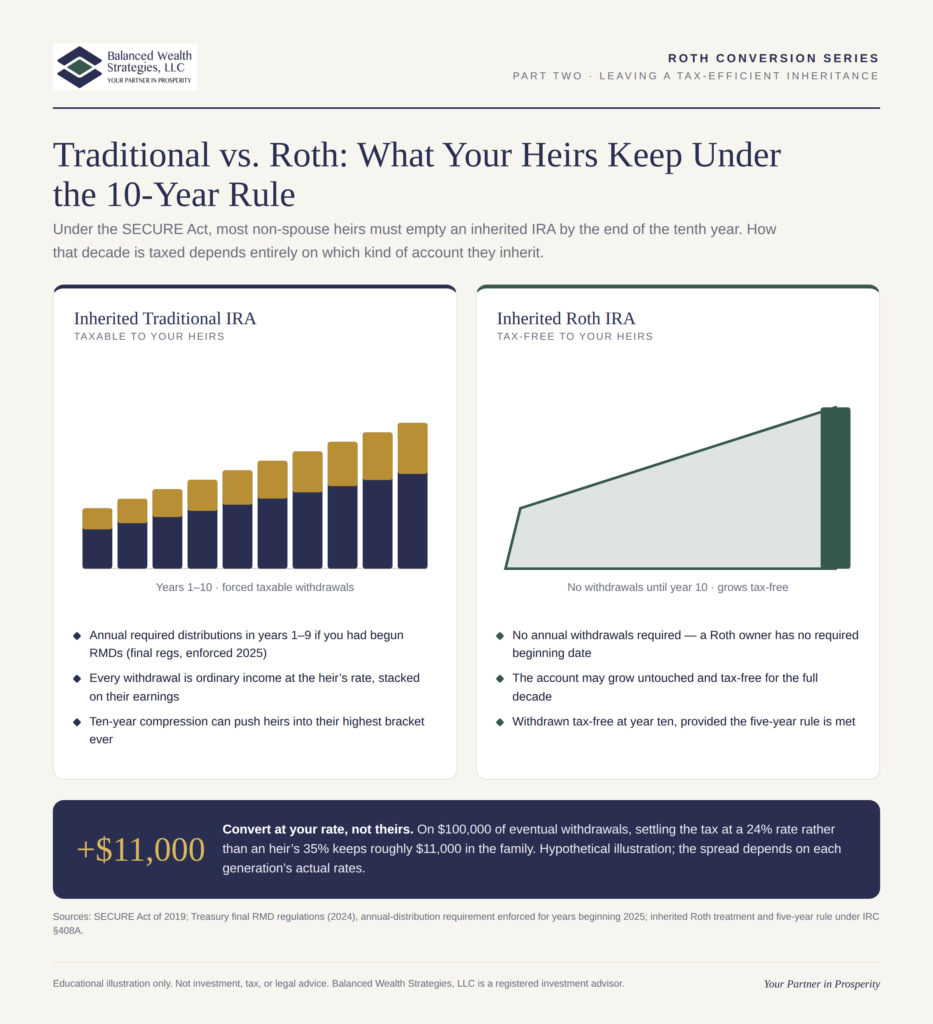
Under the SECURE Act, most non-spouse beneficiaries — adult children in particular — are what the rules call non-eligible designated beneficiaries. They must fully distribute an inherited IRA by the end of the tenth calendar year following the year of the owner’s death. The Treasury’s final regulations, issued in 2024, added a requirement that surprised many practitioners: if the original owner had already begun required distributions, the beneficiary must also take annual required distributions in years one through nine, not simply empty the account by year ten. The Internal Revenue Service began enforcing that annual-distribution requirement for distribution years beginning in 2025.
The effect is to concentrate the taxation of a lifetime’s tax-deferred savings into a single decade, and to remove much of the flexibility beneficiaries once had to time those withdrawals around their own circumstances.
Why an Inherited Traditional IRA Is a Tax Problem
Every dollar a beneficiary withdraws from an inherited traditional IRA is ordinary income to that beneficiary, taxed at their rates, in their state, stacked on top of their own earnings. For an adult child in their peak earning years, that is frequently the highest bracket they will ever occupy. A parent who spent a lifetime in the 22 or 24 percent bracket can, without intending to, bequeath an account that is taxed to the next generation at 32 or 35 percent.
The ten-year compression makes this worse. Because the account must come out over a decade rather than a lifetime, the annual withdrawals are larger, and larger withdrawals are more likely to push the beneficiary into higher brackets and across their own income thresholds. The inheritance, in other words, can raise the heir’s tax rate on the inheritance itself.
How a Roth Changes the Inheritance
A Roth conversion changes the character of what passes to the next generation. Qualified withdrawals from an inherited Roth IRA are generally free of income tax to the beneficiary, provided the five-year holding requirement under IRC §408A is satisfied. The tax on that money has already been settled — by you, during your life, at your rate — so the heir receives it without the income-tax drag that burdens a traditional inheritance.
There is a second, less obvious advantage. Because a Roth IRA owner is never subject to required distributions during life, an inherited Roth is treated as though the owner died before their required beginning date. That means the beneficiary is not required to take annual distributions in years one through nine of the ten-year window. They may leave the entire account untouched, growing tax-free, and withdraw it all at the end of the tenth year. A traditional inherited IRA forces taxable money out along the way; an inherited Roth allows a full decade of additional tax-free growth before anything must be taken.
Converting at Your Rate Versus Their Rate
The heart of the legacy case is a comparison of rates. If the eventual tax on a traditional IRA is unavoidable — and for an account large enough that required distributions cannot exhaust it, much of it is — then the only real question is who pays it and at what rate. When a parent’s rate is lower than the children’s expected rate, converting during the parent’s life captures the difference. This is exactly the kind of cross-generation comparison our wealth managers run as part of a legacy plan, since it depends entirely on the specific facts of both generations.
The following figures are a simplified, hypothetical illustration for educational purposes only. They are not a projection, a recommendation, or a representation of any particular result.
Suppose a retiree could convert a portion of an IRA at a 24 percent all-in rate. Suppose the same dollars, left in the traditional IRA, would eventually be withdrawn by two adult children whose combined income places those dollars in a 35 percent bracket. On $100,000 of eventual withdrawals, the difference between paying at 24 percent and paying at 35 percent is $11,000 — value that stays in the family only if the tax is settled at the lower rate rather than the higher one. The size of that spread, and whether it exists at all, depends entirely on the specific rates of the two generations, which is why this is a calculation to run rather than a rule to assume.

Coordinating With the Estate Picture
It is worth separating two different taxes that often get discussed together. The federal estate tax is a tax on the transfer of wealth at death; the One Big Beautiful Bill Act raised its exemption to $15 million for individuals and $30 million for married couples, indexed going forward, so the great majority of families will owe no estate tax at all. The tax discussed in this article is different — it is the income tax the heirs pay as they withdraw an inherited retirement account, and it applies regardless of the estate tax exemption. A Roth conversion addresses that income-tax drag specifically.
For those with charitable intent, a qualified charitable distribution under IRC §408(d)(8) can move part of a traditional IRA to charity without income tax and may handle a portion of the balance more efficiently than a conversion. Legacy planning is rarely a single lever, and a conversion is best considered alongside the rest of the estate picture rather than in isolation. The remaining question — what happens to a surviving spouse, who faces the tightest brackets of all — is the subject of Part Three.

- What is the ten-year rule for inherited IRAs? Under the SECURE Act, most non-spouse beneficiaries who inherit an IRA on or after 2020 must fully withdraw the account by the end of the tenth year after the owner’s death. If the owner had already started required distributions, the beneficiary must also take annual distributions in the intervening years. The rule replaced the former stretch IRA, which allowed withdrawals across the beneficiary’s lifetime.
- Do heirs pay income tax on an inherited Roth IRA? Generally no. Qualified withdrawals from an inherited Roth IRA are free of federal income tax to the beneficiary, provided the account has satisfied the five-year holding requirement. Because the tax was settled at conversion or contribution, the beneficiary receives the money without the ordinary-income tax that applies to every dollar withdrawn from an inherited traditional IRA.
- Do inherited Roth IRAs require annual withdrawals during the ten years? No. Because a Roth owner is never subject to lifetime required distributions, an inherited Roth is treated as a death before the required beginning date, so the beneficiary is not required to withdraw anything in years one through nine. The full account must still be emptied by the end of the tenth year, but it may grow untouched and tax-free until then.
- Is it better to pay the tax now or let heirs pay it later? It depends on the rates involved. If your heirs are likely to be in a higher tax bracket than you are, converting during your life settles the tax at your lower rate and can keep more in the family. If your heirs are likely to be in a lower bracket, the calculation may favor leaving the account traditional. The comparison should be run on the specific facts rather than assumed.
- Does the five-year rule affect what my heirs receive? Yes. For an inherited Roth to be fully tax-free, the account generally must have been open for at least five years. The original owner’s holding period carries over to the beneficiary, so a Roth established well before death is more likely to have cleared the five-year requirement by the time the heirs withdraw. This is one reason conversions are often begun sooner rather than later.
- How does the estate tax exemption interact with this? The two are separate taxes. The federal estate tax, with an exemption of $15 million per individual under current law, applies to very large estates and is unrelated to the income tax heirs pay on an inherited retirement account. A Roth conversion addresses the income-tax drag on inherited IRA dollars, a burden that applies to families well below the estate tax threshold.
This is Part Two of a three-part series on Roth conversions. Part One looked at the tax you pay during your own life; Part Three turns to the position of a surviving spouse. If part of your planning is to leave a tax-efficient inheritance, our wealth management services can help you weigh how a conversion fits your legacy goals, and you can browse more analysis like this in our Insights library.
Important Regulatory Disclosure: Balanced Wealth Strategies, LLC is a registered investment advisor. This is not an offer to sell securities or the solicitation of an offer to purchase securities. All investing involves risk, including the potential loss of principal. Past performance is not indicative of future results. Please see our Disclosures for Form ADV Part 2A and 2B for complete details about our services, fees and professional background.
If part of your planning is to leave a tax-efficient inheritance, schedule a confidential consultation with Mark J Burger, CPA, with Balanced Wealth Strategies to weigh how a conversion strategy fits your legacy goals.