
The NUA distribution locks in one tax advantage permanently. The stock does not stop moving the moment it leaves the plan, and a second decision begins — this one very much timing-dependent.
On a $250,000 post-distribution position, waiting past the one-year mark to sell versus selling at month eleven changes the federal tax on new appreciation by $3,300 — without changing the NUA tax itself by a single dollar. That gap, repeated across a larger position, is the second half of the NUA decision that most planning stops short of.
This is the third and final installment in this series. Part 1 looked at the state tax layer; Part 2 looked at the one number needed before the distribution begins. This installment takes up the decision that comes after the distribution is done — when to sell.

A note on the figures: this installment uses a smaller, round illustration than the cornerstone example in Part 1, because the timing effects that follow are clearest at a moderate scale. The mechanics apply identically to larger positions.
The appreciation that existed at the moment of distribution — $247,500 in this illustration — is taxed as a long-term capital gain when the stock is sold, at 20%, regardless of how long the stock is held afterward. That is not negotiable. It is built into the mechanics of the transaction.
But whatever happens to the share price after the distribution date creates a new tax question — one that is very much timing-dependent. And there is a second question most people miss entirely: what happens to Medicare premiums two years from now?
What Are the Two Tax Layers After an NUA Distribution?
After the distribution is complete, the position carries two distinct tax layers:
- Layer 1 — the NUA itself: $247,500, locked in as long-term capital gain, taxed at 20% whenever the stock is sold. This does not change with timing.
- Layer 2 — post-distribution movement: any change in value after the distribution date is a new gain or loss, taxed by reference to how long the stock is held from that date forward.
Most of the attention in NUA planning goes to Layer 1. The decision about when to sell is primarily a Layer 2 question — with one important exception addressed below.
How Does the One-Year Holding Period Affect Post-Distribution Gains?
If the stock appreciates after the distribution date, the treatment of that additional gain depends entirely on whether the sale happens before or after the one-year mark from the distribution date.
Suppose the stock rises 10% from $250,000 to $275,000 before it is sold. The additional $25,000 is new appreciation. Post-distribution appreciation, unlike the NUA itself, does carry the 3.8% Net Investment Income Tax when it is long-term.
| Scenario | Sale Price | Post-Dist. Gain | Rate on New Gain | Additional Tax | Total Tax |
| Sell immediately | $250,000 | $0 | N/A | $0 | $50,425 |
| Sell within 12 months | $275,000 | $25,000 | 37% short-term | $9,250 | $59,675 |
| Sell after 13 months | $275,000 | $25,000 | 23.8% long-term | $5,950 | $56,375 |
The difference between selling at month eleven and month thirteen on a $25,000 post-distribution gain is $3,300 in federal tax. The NUA itself is taxed identically in both cases.
The practical implication: if the stock has appreciated meaningfully after the distribution and there is no urgent need for liquidity, waiting past the one-year mark costs nothing on the NUA and saves on the new appreciation.

What Happens If the Stock Declines After the Distribution?
The risk runs in the other direction too. The NUA tax obligation is fixed at the distribution date, based on the fair market value of the stock at that moment — not the price ultimately received.
If the stock declines after the distribution, the NUA tax is still owed on the appreciation that existed at distribution.
Example: Stock is worth $250,000 at distribution. NUA of $247,500 creates a tax obligation of $49,500 at 20%. The stock then falls to $200,000 before it is sold. Proceeds are $200,000, but tax is owed on $247,500 in NUA. The $50,000 post-distribution loss is a capital loss — usable against other capital gains, or up to $3,000 against ordinary income per year. But the NUA tax is not reduced.
This is the concentration risk every NUA analysis must address. Holding a large, undiversified position after the distribution introduces market risk that did not exist inside the plan. A plan for diversification — with a defined timeline, developed as part of a coordinated investment approach — should be part of the strategy from the beginning, not an afterthought.
How Does the Sale Affect Medicare Premiums Two Years Later?
The NUA tax is paid in the year the stock is sold. That sale creates taxable income.
Medicare Part B and Part D premiums are determined by income from two years prior. Sell in 2026, and the income appears on the 2026 return, which is reviewed in 2028 to set 2028 premiums.
The Income-Related Monthly Adjustment Amount — IRMAA — adds surcharges for beneficiaries whose modified adjusted gross income exceeds $109,000 (single) or $218,000 (married filing jointly) in 2026. For a taxpayer recognizing $247,500 in the sale year, the surcharge two years later is nearly certain. The open question is which tier the income reaches — and whether selling across two years reduces the two-year-forward premium impact.
If the gain can be spread across two tax years — selling a portion in one year and the remainder in the next — the IRMAA impact may be reduced. This requires that the plan distribute the stock into a brokerage account rather than force an immediate sale, which is the standard outcome.
This is not a reason to avoid the strategy. It is a reason to model the multi-year cash flow before deciding when to sell.
How Does the Sale Year’s Income Affect the Rate Applied?
The year of sale also interacts with ordinary income earned that year. Long-term capital gains stack on top of ordinary income when determining which capital gains rate applies.
For a taxpayer firmly in the 37% ordinary bracket, the 20% long-term rate applies in virtually any year. But for a participant who has retired and whose ordinary income has fallen, it is worth confirming whether a lower capital gains rate reaches any portion of the gain. The sale year is worth running carefully — the same discipline applied to the state-residency review in Part 1 and the basis verification in Part 2.
So, Is There a Right Time to Sell?
There is no universal answer to when to sell. The right timing depends on:
- Whether the stock has appreciated or depreciated since the distribution date.
- Whether the one-year holding period for the new gain has been reached.
- The income composition of the sale year and its effect on IRMAA two years forward.
- The concentration risk tolerance of the client, and whether a phased sale over two years is preferable.
What the timing decision does not change is the NUA itself. That obligation was fixed at the distribution date.
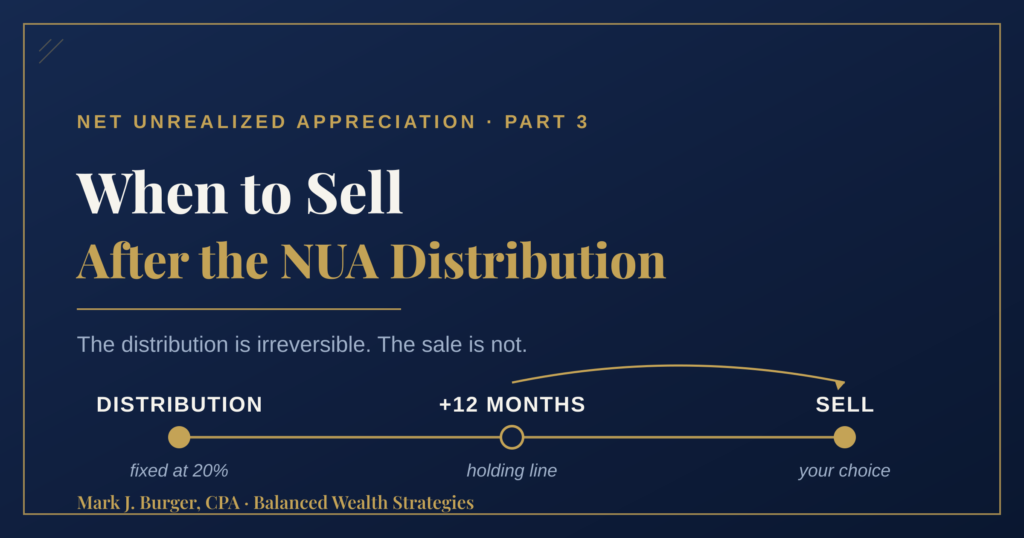
The distribution is the irreversible decision. The sale is the manageable one.
37 years advising employers and business owners. Independent perspective. No product relationships. No rollover incentives. To learn more about Mark J Burger, CPA
Previously in the series — Part 1: Your State May Take Back the NUA Savings Your Federal Return Earned • Part 2: Before You Can Use the NUA Strategy, You Need One Number.

- Does waiting to sell change the tax on the NUA itself? No. The NUA is taxed as a long-term capital gain at 20% based on its value at the distribution date, and that treatment does not change regardless of how long the stock is held afterward. Only appreciation or depreciation that occurs after the distribution date is affected by the timing of the sale.
- Why does the one-year holding period matter after an NUA distribution? Any appreciation that occurs after the distribution date is a separate gain, taxed under ordinary short-term or long-term capital gains rules based on how long the stock is held from the distribution date forward. Selling before twelve months generally means that new gain is taxed at short-term (ordinary income) rates; selling after twelve months generally qualifies it for long-term treatment.
- What happens to the NUA tax if the stock price falls after distribution? The NUA tax obligation is fixed at the fair market value on the distribution date and does not decrease if the stock later declines. A subsequent drop in value generally produces a separate capital loss, which may offset other gains, but it does not reduce the tax owed on the original NUA.
- How does selling NUA stock affect Medicare premiums? Medicare Part B and Part D premiums are calculated using income from two years prior, under the Income-Related Monthly Adjustment Amount (IRMAA) rules. A large capital gain in the year of sale can raise income enough to trigger an IRMAA surcharge that takes effect two years later, so the timing of a sale can have consequences beyond the current year’s tax return.
- Can spreading a sale across two years reduce the tax and IRMAA impact? Potentially. Selling a portion of the position in one tax year and the remainder in the next can, in some cases, keep income in each year further from the top brackets and IRMAA thresholds, compared to recognizing the full gain at once. Whether this approach makes sense depends on the specific income picture in each year and the concentration risk of continuing to hold the position.
- Is holding onto NUA stock after distribution risky? Yes, in the sense that a large single-stock position carries concentration risk that did not exist while the shares were inside the diversified structure of the plan. Because the NUA tax obligation does not shrink if the stock declines, an unmanaged, open-ended holding period adds market risk on top of a tax bill that is already fixed.
Important Regulatory Disclosure: Balanced Wealth Strategies, LLC is a registered investment advisor. This is not an offer to sell securities or the solicitation of an offer to purchase securities. All investing involves risk, including the potential loss of principal. Past performance is not indicative of future results. Please see our Disclosures for Form ADV Part 2A and 2B for complete details about our services, fees and professional background.
Working through the timing of your own NUA sale? Schedule a confidential consultation with Mark J. Burger, CPA to model the sale-year and IRMAA impact before you decide.