

By Mark J. Burger, CPA · BalancedWealthStrategies.com · As of October 2026
Equity compensation is taxed at different moments depending on its form: restricted stock units (RSU) as ordinary income at vesting, non-qualified options on the spread at exercise, and incentive stock options as an alternative minimum tax preference that can create a bill with no sale at all. The tax event and the cash to pay it do not always arrive together, and with options the timing is often within the recipient’s control. Knowing when the tax falls is the difference between a planned event and an April surprise.
Equity compensation can build significant wealth, and it can also produce a tax bill that arrives before the cash to pay it. Restricted stock units and stock options are taxed at different moments and in different ways, and the timing is often within the recipient’s control. Understanding when the tax falls is the difference between a planned event and an April surprise. Every vesting and exercise also quietly rebuilds a concentrated position, which is why this pairs with our anchor on diversifying a concentrated stock position.
Restricted Stock Units (RSU)
Restricted stock units are generally taxed as ordinary income when they vest, on the full market value of the shares that vest that day, whether or not the shares are sold. Employers usually withhold, but the standard withholding on supplemental wages can fall short of a high earner’s actual bracket, leaving a gap that surfaces at tax time. Once vested, the shares carry a new cost basis equal to that taxed value, and any change from there is a capital gain or loss based on how long they are held after vesting. A recipient who holds vested shares is, in effect, choosing to keep a concentrated position.
Worked example (illustrative). An employee vests $200,000 of restricted stock units in a year when her marginal rate is 35 percent, so the true federal tax on that income is about $70,000. Her employer withholds at the standard 22 percent supplemental-wage rate, or $44,000. The $26,000 gap does not disappear; it comes due with the return the following April. An employee who assumed the withholding covered it faces a surprise; one who set aside the difference at vesting does not. If she then holds the shares and they fall 30 percent before she sells, she has also taken a concentrated loss on stock she was already taxed on in full. Figures are illustrative, ignore state tax, and depend on the reader’s own facts.
Non-Qualified Stock Options
Non-qualified stock options are generally taxed at exercise, when the difference between the exercise price and the market value — the spread — is treated as ordinary income. The choice of when to exercise therefore controls when that income is recognized, which opens room to coordinate exercises with lower-income years or to spread them across tax years. After exercise, further appreciation is a capital gain measured from the exercise date.
Incentive Stock Options
Incentive stock options follow their own rules. There is generally no regular income tax at exercise, but the spread is a preference item for the alternative minimum tax, which can create a tax liability even though no shares were sold. If the shares are held long enough to meet the qualifying holding periods, the eventual sale can receive favorable long-term capital gain treatment; if they are sold too soon, the sale is disqualifying and is taxed less favorably. The interaction with the alternative minimum tax makes incentive stock options one of the most planning-sensitive forms of equity compensation.
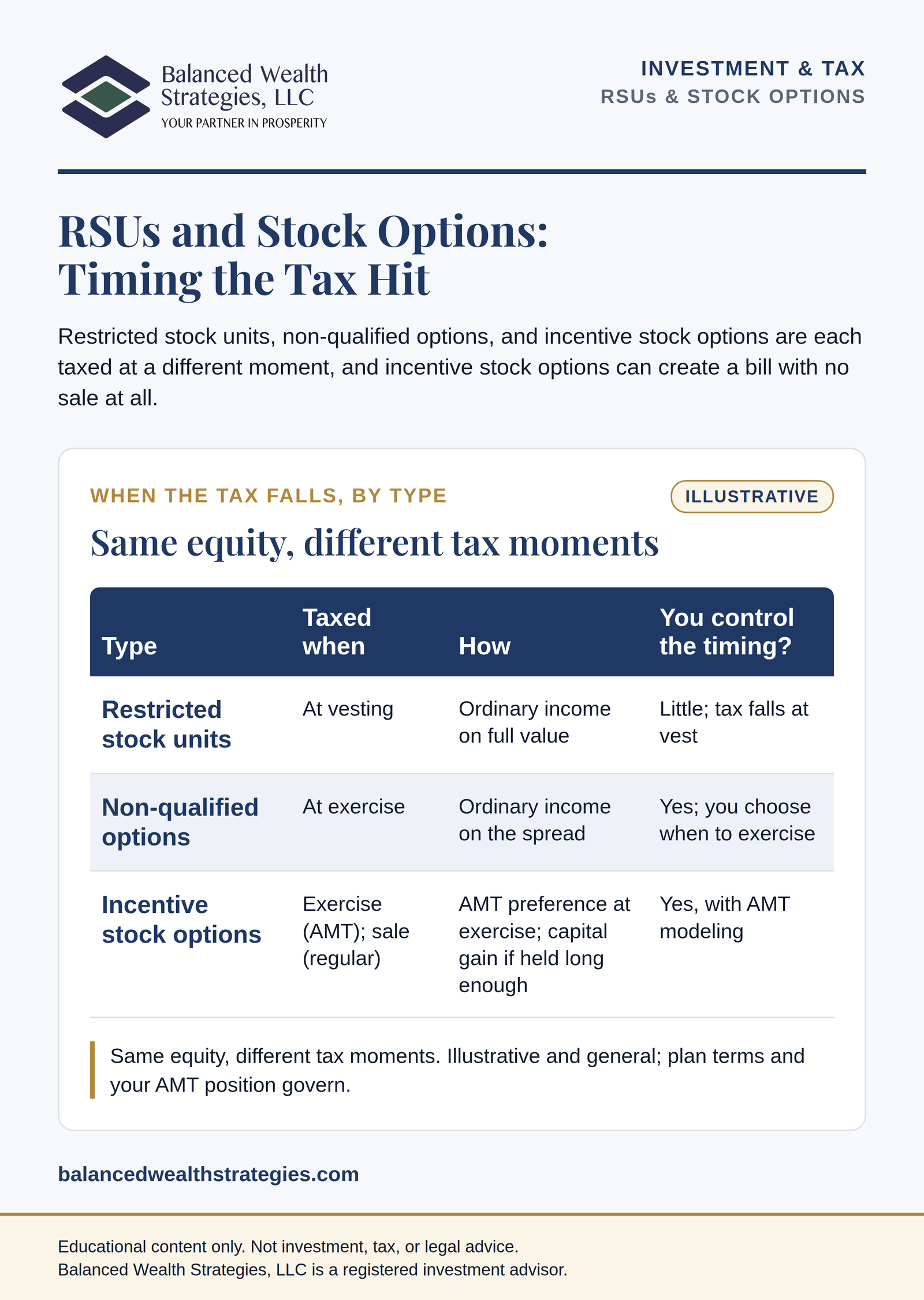
When the Tax Falls, by Type
| Type | Taxed when | How | You control the timing? |
|---|---|---|---|
| Restricted stock units | At vesting | Ordinary income on full value | Little; tax falls at vest |
| Non-qualified options | At exercise | Ordinary income on the spread | Yes; you choose when to exercise |
| Incentive stock options | Exercise (AMT); sale (regular) | AMT preference at exercise; capital gain if held long enough | Yes, with AMT modeling |
The Thread That Connects Them
Two themes run through all three. First, the tax event and the cash to pay it do not always arrive together, so setting aside funds for the shortfall is part of the plan. Second, every vesting and exercise decision quietly rebuilds a concentrated position in a single employer’s stock, which is why equity-compensation planning and diversification planning are really one conversation, and why both sit inside our wealth management and financial planning services.
Case in point (illustrative). An engineer held incentive stock options and exercised the full grant in a single year to start the long-term holding clock, without modeling the alternative minimum tax. The spread created a large AMT bill in a year with no share sale and no cash from the options to pay it. Spreading the same exercises across two or three years, sized to stay under the AMT threshold, would have secured the favorable treatment without the cash crunch. The tool was right; the timing was not modeled. The scenario is anonymized and illustrative and describes no identifiable client.

How to Plan the Timing
- Map each grant to its tax moment. Know whether each award is an RSU, an NSO, or an ISO, and when the tax event falls for each.
- Fund the shortfall. For RSUs, set aside the gap between supplemental withholding and your real bracket before April.
- Time exercises deliberately. For NSOs, coordinate exercises with lower-income years; for ISOs, model the AMT and spread exercises to stay under the threshold.
- Decide hold-versus-sell as a diversification question. Vested, already-taxed shares add concentrated risk; treat holding as a choice, not a default, and note that employer stock held in a retirement plan raises a separate tax question many executives miss.
- Coordinate with the rest of the plan. Align timing with charitable gifts, other income, and the concentrated-position strategy, and confirm current-year figures before acting.
If equity compensation is a growing part of your wealth, an independent, CPA-led review can plan the timing and the diversification together. Schedule a confidential consultation with Mark J. Burger, CPA →
Frequently Asked Questions
Why did I owe more tax than was withheld on my RSUs?
Because supplemental wage withholding is often a flat rate that can be lower than a high earner’s marginal bracket. The RSU value is ordinary income at vesting, and if your bracket exceeds the withholding rate, the difference is due at tax time. Planning for that gap prevents the surprise.
Should I sell my RSUs as soon as they vest?
Many recipients do, because the shares are already taxed at vesting and holding them simply adds concentrated risk in the employer’s stock. Whether to hold is a diversification and tax decision rather than a default, and it depends on your overall position and goals.
What makes incentive stock options tricky?
The alternative minimum tax. Exercising can create AMT exposure on the spread even without selling, while holding long enough can secure favorable treatment on the eventual sale. Balancing the two usually calls for modeling before you exercise, not after.
Can I control when I am taxed?
With options, largely yes, the exercise decision drives the timing, which allows coordination with lower-income years. With RSUs, the tax falls at vesting and is harder to shift, so the planning focuses on funding the liability and on what to do with the shares afterward.
What is a disqualifying disposition?
For incentive stock options, selling the shares before meeting the required holding periods is a disqualifying disposition, which taxes some or all of the gain as ordinary income rather than at long-term capital gain rates. Whether to hold for the favorable treatment or sell early to reduce concentration is a trade-off worth modeling.
Important Regulatory Disclosure
Balanced Wealth Strategies, LLC is a registered investment advisor. This is not an offer to sell securities or the solicitation of an offer to purchase securities. All investing involves risk, including the potential loss of principal. Past performance is not indicative of future results. Please see our Disclosures for Form ADV Part 2A and 2B for complete details about our services, fees and professional background.
Sources: taxation of restricted stock units as ordinary income at vesting; supplemental wage withholding rules (a 22 percent flat rate applies to supplemental wages up to $1 million). Non-qualified stock options taxed on the spread at exercise under IRC section 83; incentive stock options under IRC section 422 and the alternative minimum tax preference under IRC section 56; qualifying versus disqualifying dispositions. The 35 percent bracket and 22 percent withholding figures in the worked example are illustrative; equity-compensation outcomes depend on plan terms, bracket, and AMT position and should be modeled with your tax advisor before acting.