
By Mark J. Burger, CPA · BalancedWealthStrategies.com · As of October 2026
The stock that made someone wealthy is often the largest unguarded risk they hold. A single company can fall by half in a quarter for reasons that have nothing to do with the investor’s judgment, and the tax on selling is usually smaller, spread deliberately over several years, than the loss a concentrated holder risks by doing nothing. The goal is to reduce the risk efficiently, not to pretend the tax does not exist. There is a well-developed set of tax-aware tools, and the right plan usually combines several.
The stock that made someone wealthy is often the stock that can undo them. A single position that grew into the majority of a portfolio was, at one point, the reason for the success. Left unmanaged, it becomes the largest unguarded risk the investor holds. Concentration works powerfully in both directions, and the same volatility that built the position can take a meaningful part of it back in a single quarter. The obstacle to fixing it is rarely a lack of awareness. It is the tax bill that selling would trigger, and the attachment to a holding that has done well. Equity compensation adds its own wrinkles, which the companion article on RSUs and stock options takes up.
The Risk That Stopped Being Visible
A concentrated position tends to fade into the background precisely because it has performed. The investor stops seeing it as a bet and starts seeing it as a fact of the portfolio. But a position that represents a large share of net worth no longer offers upside in proportion to its risk; it offers survival exposure. A single company can fall by half for reasons that have nothing to do with the investor’s judgment, and when the position is large enough, that decline reshapes a retirement. The purpose of addressing concentration is not to abandon a good investment. It is to stop letting one company’s fortunes determine a family’s. Where the shares came from an employer plan, there is also a specific tax trap that catches many retiring executives, worth understanding before any sale.
Worked example (illustrative). An investor holds a $1.5 million single-stock position with a $150,000 basis, representing most of the portfolio. Diversifying it triggers tax on the $1,350,000 gain; spread over several years and paired with loss harvesting, suppose the effective cost is about $300,000 of capital gains tax. Set that against the risk of doing nothing: a 40 percent single-stock drawdown, well within the historical range for an individual company, would erase $600,000 of value, twice the tax cost, and a 50 percent fall would erase $750,000. The tax to diversify is a known, one-time, spreadable cost; the concentration risk is an open-ended one that recurs every quarter the position is held. The comparison, not the tax figure alone, is the decision. Figures are illustrative, ignore state tax, and depend on the reader’s own facts.
Why the Tax Bill Should Not Freeze You
Selling a low-basis position realizes a capital gain, and the tax on it is real. It is also, often, smaller than the loss a concentrated holder risks by doing nothing. More to the point, the entire position rarely needs to be sold at once. A capital gains cost spread deliberately over several years, and coordinated with the rest of a tax picture, is a manageable expense. An uncompensated, undiversified risk carried indefinitely is not. The goal is to reduce the risk efficiently, not to pretend the tax does not exist.
The Tax-Aware Tools
There is no single answer, but there is a well-developed set of approaches, and the right plan usually combines several. Shares can be sold in a staged, programmatic way across tax years, sized each year to fill a chosen bracket without spilling into the next. Losses elsewhere in the portfolio can be harvested to offset the gains as the position is trimmed. Appreciated shares can be given to family members in lower brackets, or contributed to a donor-advised fund or a charitable remainder trust, so that the gain on the gifted portion is reduced or never taxed while supporting a charitable goal. An exchange fund can allow an investor to pool a concentrated holding with others and receive a diversified interest without an immediate taxable sale, subject to its own holding requirements and trade-offs. Protective strategies such as a collar can manage the downside while a longer unwind proceeds. And for investors who must diversify around a position they cannot fully sell, a direct-indexing approach can build a complementary portfolio that offsets the concentration over time. Each of these carries rules, costs, and suitability limits; none is right for everyone.
Learn More
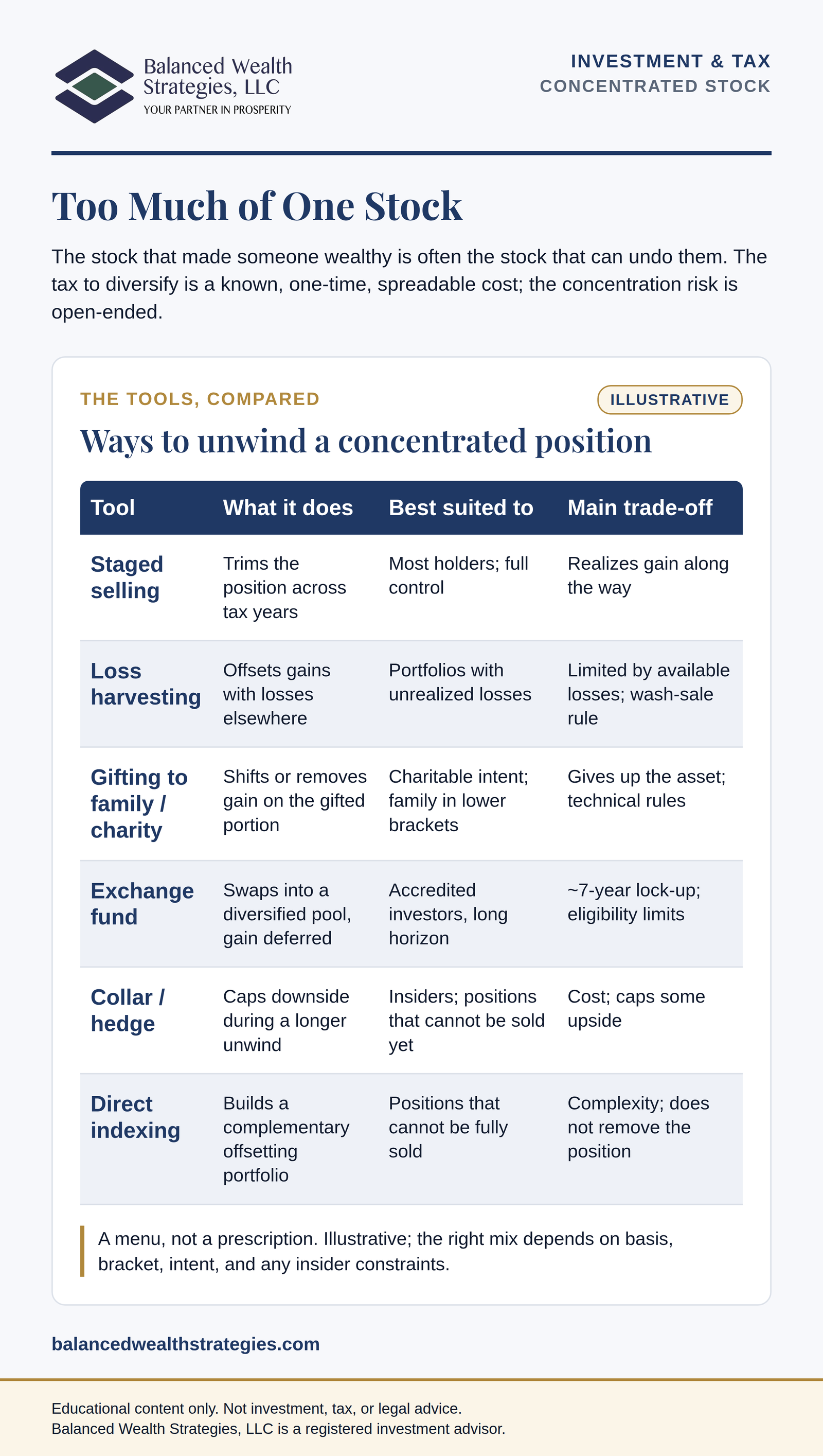
The Tools, Compared
| Tool | What it does | Best suited to | Main trade-off |
|---|---|---|---|
| Staged selling | Trims the position across tax years | Most holders; full control | Realizes gain along the way |
| Loss harvesting | Offsets gains with losses elsewhere | Portfolios with unrealized losses | Limited by available losses; wash-sale rule |
| Gifting to family / charity | Shifts or removes gain on the gifted portion | Charitable intent; family in lower brackets | Gives up the asset; technical rules |
| Exchange fund | Swaps into a diversified pool, gain deferred | Accredited investors, long horizon | ~7-year lock-up; eligibility limits |
| Collar / hedge | Caps downside during a longer unwind | Insiders; positions that cannot be sold yet | Cost; caps some upside |
| Direct indexing | Builds a complementary offsetting portfolio | Positions that cannot be fully sold | Complexity; does not remove the position |
Sequencing Is the Whole Game
The difference between a good outcome and an expensive one is usually not which tool is used but how the tools are sequenced. The right plan depends on the cost basis of the shares, the investor’s tax bracket now and expected later, charitable intentions, any restrictions that apply to a corporate insider, and the role the money must play in the overall plan. This is work that benefits from an independent, CPA-led vantage point: someone measuring the after-tax result, coordinating the unwind across years, and keeping the strategy aligned with the rest of the financial picture rather than optimizing the stock sale in isolation, which is the focus of our wealth management and financial planning services.
Case in point (illustrative). A recently retired executive held roughly 70 percent of her net worth in her former employer’s stock, with a very low basis, and had frozen on the decision for years because a full sale would have realized a large gain in one year at the top rate. A staged plan trimmed a set dollar amount each year to fill a target bracket, harvested losses elsewhere to offset part of the gain, and routed a slice of the most-appreciated shares to a donor-advised fund she was already funding for annual giving. Three years in, the position was down to a manageable share of the portfolio, the tax had been spread across years rather than spiking in one, and no single quarter could any longer reshape her retirement. The scenario is anonymized and illustrative and describes no identifiable client.

How to Unwind a Concentrated Position
- Size the risk honestly. Measure the position as a share of net worth and against a plausible drawdown, not just against its past returns.
- Pull the basis and the brackets. Identify the cost basis by lot and your capital gains bracket now and expected later; both drive the pace.
- Set an annual budget. Decide how much gain to realize each year to fill a target bracket without spilling into the next, and harvest losses to offset it.
- Layer in the other tools where they fit. Gifting, charitable vehicles, an exchange fund, or a hedge for shares you cannot yet sell, chosen for your facts.
- Coordinate insider constraints and diversify the proceeds. Use a pre-arranged trading plan if you are an insider, reinvest into a diversified portfolio consistent with a planning-first investment approach, and confirm current-year figures before acting.
If one stock has become too large a share of your net worth, an independent, CPA-led review can build a tax-aware plan to reduce the risk on your terms. Schedule a confidential consultation with Mark J. Burger, CPA →
Frequently Asked Questions
Why not just hold the stock if it keeps performing?
Because past performance does not reduce the risk of concentration; it increases the stakes. A position large enough to define your net worth exposes you to a single company’s specific risks, a product failure, a lawsuit, a sector shift, that diversification is meant to neutralize. The question is not whether the company is good, but whether one company should decide your financial future.
Will I not owe an enormous tax bill if I sell?
You will owe capital gains tax on the appreciation you realize, which is why the position is usually unwound gradually rather than all at once. Spread across years and paired with loss harvesting and, where appropriate, charitable strategies, the tax becomes a managed cost rather than a single shock, and often far less than the risk of holding.
What is an exchange fund?
It is a vehicle that lets investors contribute concentrated positions into a shared pool and receive back a diversified interest, deferring the tax that an outright sale would trigger. It comes with holding-period requirements, eligibility limits, and costs, and it suits some situations and not others. It is one tool among several, not a universal solution.
Can charitable giving help?
Often, yes. Donating appreciated shares to a donor-advised fund or a charitable remainder trust can avoid the capital gain on the donated portion while advancing a giving goal, and in the case of a charitable remainder trust can also provide an income stream. These are powerful but technical tools, best structured with tax and legal counsel.
I am an executive or insider. Does that change things?
It can add constraints, trading windows, holding requirements, and disclosure obligations, that shape both what you can do and when. A pre-arranged trading plan is a common way to diversify steadily within those rules. The constraints make early, coordinated planning more important, not less.
Important Regulatory Disclosure
Balanced Wealth Strategies, LLC is a registered investment advisor. This is not an offer to sell securities or the solicitation of an offer to purchase securities. All investing involves risk, including the potential loss of principal. Past performance is not indicative of future results. Please see our Disclosures for Form ADV Part 2A and 2B for complete details about our services, fees and professional background.
Sources: long-term capital gain rates under IRC section 1(h); net investment income tax of 3.8 percent under IRC section 1411; wash-sale rule under IRC section 1091 in coordination with loss harvesting. Charitable contributions of appreciated securities and donor-advised funds under IRC section 170; charitable remainder trusts under IRC section 664. Exchange funds, collars, and direct indexing are described in general educational terms; each carries eligibility rules, costs, and suitability limits. Corporate insiders are subject to securities-law trading restrictions, including Rule 10b5-1 plans. The drawdown percentages and tax figure in the worked example are illustrative; strategies depend on basis, bracket, and individual circumstances and should be structured with your tax and legal advisors.