

By Mark J. Burger, CPA · BalancedWealthStrategies.com · As of October 2026
An inheritance often arrives at the hardest possible time, in the middle of loss, and asks for decisions when clear thinking is in shortest supply. Five steps, ordered on purpose, protect what you received and buy the time to make good decisions rather than fast ones: park the funds, assemble an independent team, understand what you actually received, address the estate’s obligations and paperwork, and define your goals before you invest. Doing nothing, deliberately, is the first correct action.
An inheritance often arrives at the hardest possible time, in the middle of loss, and asks for decisions when clear thinking is in shortest supply. The five steps below are ordered on purpose. They are designed to protect what you received and to buy the time to make good decisions, rather than fast ones. They put into action the calm first quarter our anchor article on sudden wealth and the first 90 days describes.
1. Park the Funds
Move the money into a safe, liquid place, a high-quality money market or short-term instruments, and resist the urge to invest it right away. This single step prevents most of the costly, irreversible mistakes that follow a windfall. Doing nothing, deliberately, is the first correct action.
2. Assemble Your Team
Before making commitments, gather independent guidance: a tax advisor, an estate attorney if the situation calls for one, and a wealth advisor whose role is to plan rather than to sell. The right team early prevents expensive missteps and helps you sort genuine advice from a sales process. Building that plan before the money is committed is the focus of our wealth management and financial planning services.
3. Understand What You Actually Received
Inheritances come in forms that are taxed very differently. An inherited retirement account carries distribution rules and is taxed as it comes out. Inherited investments in a taxable account generally receive a stepped-up cost basis. Life insurance is usually income-tax-free. Knowing the character of each piece, and documenting the basis, shapes every decision that follows.
Worked example (illustrative). An heir inherits a taxable brokerage account holding stock her parent bought for $80,000, now worth $380,000. Under the step-up, her basis resets to the $380,000 date-of-death value. If she documents that value and sells soon after, the $300,000 of built-in gain is essentially erased, and a sale produces little or no capital gains tax. If instead no one records the date-of-death value and the original $80,000 basis is later used by mistake, that same sale would report a $300,000 gain, roughly $71,000 of tax at 23.8 percent, entirely avoidable. Step three, done right, is worth the whole difference. Figures are illustrative, ignore state tax, and depend on the reader’s own facts.
4. Address the Estate’s Obligations and Paperwork
There may be an estate to settle, accounts to retitle, beneficiary and account paperwork to complete, and possibly a portability election or state filing to consider. Handling the administrative and tax obligations correctly and on time avoids problems that are far harder to fix later.
5. Define Goals Before You Invest
Only after the first four steps should the money be put to work, and only against a clear purpose, the income it must produce, the obligations it must meet, and the goals and people it is meant to support. A plan built around your life will outperform one built around whatever product was offered first, which is the reasoning behind our planning-first investment approach.
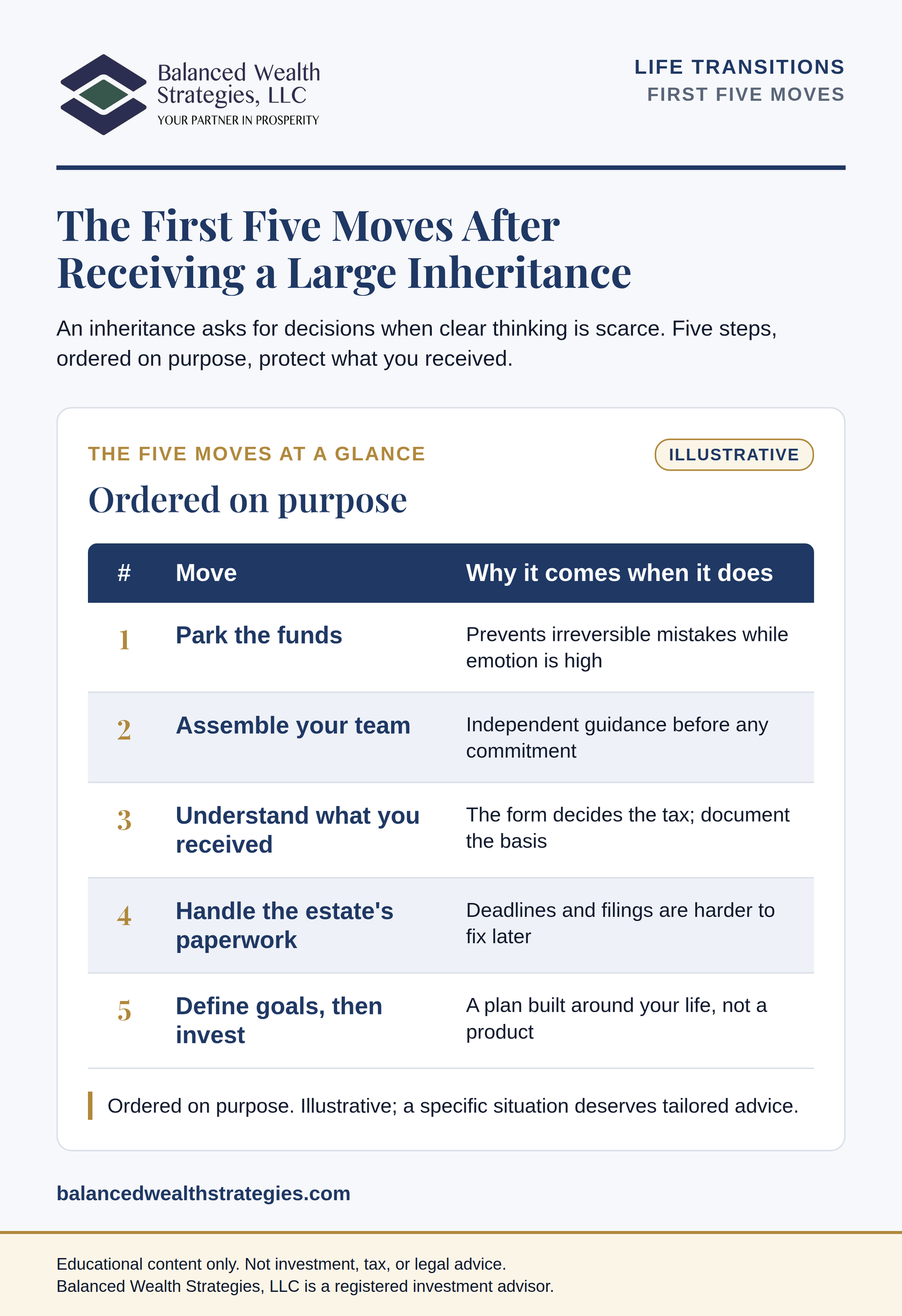
The Five Moves at a Glance
| # | Move | Why it comes when it does |
|---|---|---|
| 1 | Park the funds | Prevents irreversible mistakes while emotion is high |
| 2 | Assemble your team | Independent guidance before any commitment |
| 3 | Understand what you received | The form decides the tax; document the basis |
| 4 | Handle the estate’s paperwork | Deadlines and filings are harder to fix later |
| 5 | Define goals, then invest | A plan built around your life, not a product |
Case in point (illustrative). Two siblings inherited similar amounts. One followed the order: parked the funds, assembled a team, documented the step-up, handled the retitling and an inherited-IRA election on time, and invested only after defining her goals. The other skipped to step five, invested most of the money within a month, missed documenting the basis, and had to unwind positions at a loss when a time-sensitive election was nearly missed. Same inheritance, different order of operations, materially different result. The scenario is anonymized and illustrative and describes no identifiable client.

The Five Moves, in Order
- Park the funds. Move the money somewhere safe and liquid and make no irreversible decisions yet.
- Assemble your team. Gather independent guidance, a tax advisor, an estate attorney if needed, and a wealth advisor who plans rather than sells, before any commitment.
- Understand what you received. Sort the inheritance by type, document the stepped-up basis, and map any inherited-account rules.
- Handle the estate’s paperwork. Retitle accounts and complete any time-sensitive elections and filings on time.
- Define goals, then invest. Only after the first four steps, build a plan around your life and confirm current-year figures before acting.
If you have just received an inheritance, an independent, CPA-led review can walk these steps with you and handle what is time-sensitive first. Schedule a confidential consultation with Mark J. Burger, CPA →
Frequently Asked Questions
Why not invest the money right away?
Because a plan built in haste, under emotional pressure, tends to serve someone else’s product rather than your goals. Parking the funds safely costs little and preserves every option while you decide deliberately.
Do I owe tax on my inheritance?
It depends on what you inherited. Retirement accounts are taxed as they are withdrawn; taxable investments generally receive a stepped-up basis; life insurance is usually tax-free. Some states impose an inheritance tax. Sorting this out early is part of step three.
How quickly do I need to act on anything?
Most decisions can and should wait, but a few, certain elections, retitling, and inherited-account rules, have timelines. That is exactly why assembling a team early matters: so the time-sensitive items are handled while the rest can wait for a clear head.
What is the step-up in basis, and why does it matter here?
Inherited taxable investments are generally revalued to their date-of-death worth, so the built-in gain accumulated during the previous owner’s life can be erased if the assets are sold soon after. Documenting that value is a small task with a potentially large payoff, which is why it belongs in the first few steps rather than at the next tax filing.
Should I pay off debt or help family with the inheritance?
Both can be reasonable, but they belong in step five, after the funds are parked, the team is in place, and goals are defined. Loans and gifts made under emotional pressure in the first weeks are among the most common regrets. Deciding them within a plan, rather than ahead of one, protects both the money and the relationships.
Important Regulatory Disclosure
Balanced Wealth Strategies, LLC is a registered investment advisor. This is not an offer to sell securities or the solicitation of an offer to purchase securities. All investing involves risk, including the potential loss of principal. Past performance is not indicative of future results. Please see our Disclosures for Form ADV Part 2A and 2B for complete details about our services, fees and professional background.
Sources: step-up in basis under IRC section 1014; taxation and distribution rules for inherited retirement accounts under the SECURE Act; income-tax treatment of life insurance under IRC section 101. Estate administration, account retitling, and any portability (Form 706) or state filing considerations. The $80,000 basis, $380,000 value, and 23.8 percent rate in the worked example are illustrative; timelines and tax treatment depend on individual circumstances and should be confirmed with your tax and legal advisors.