

By Mark J. Burger, CPA · BalancedWealthStrategies.com · As of October 2026
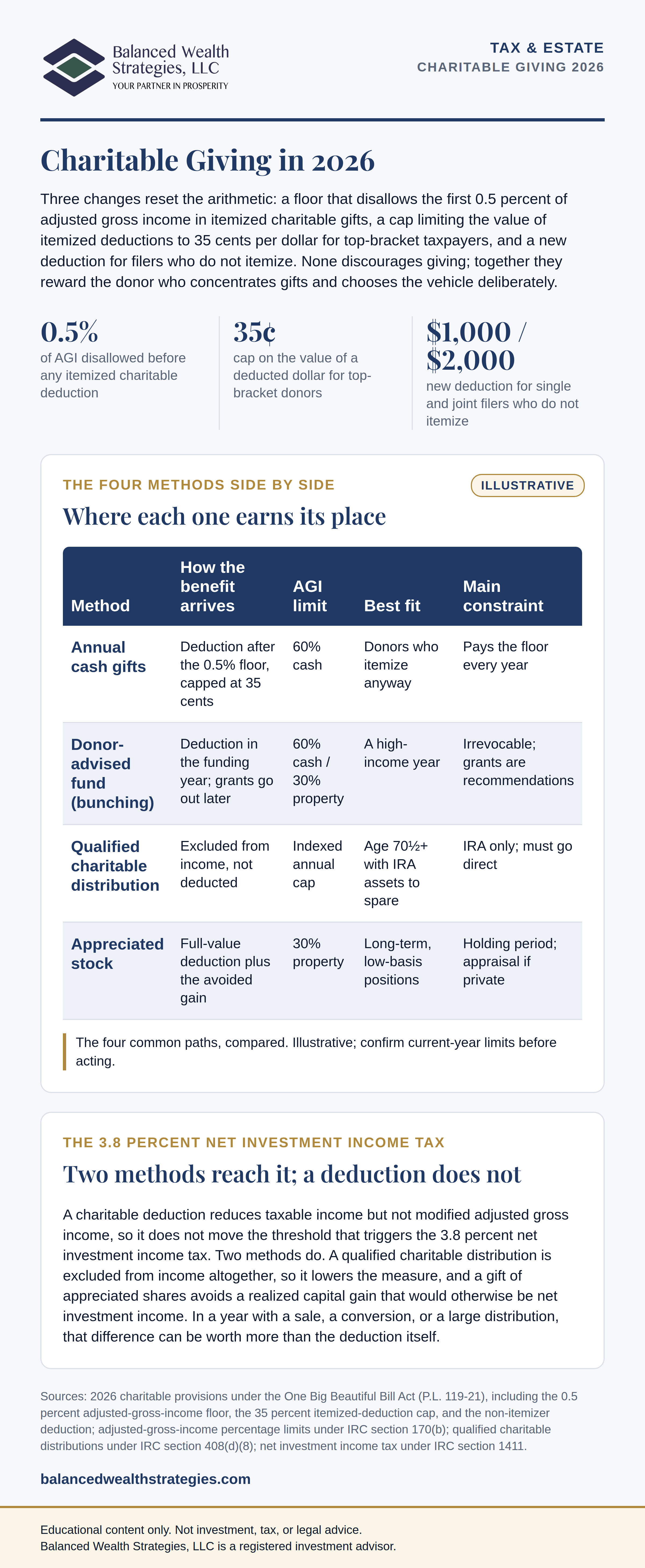
Three changes reset the arithmetic of charitable giving in 2026: a new floor that disallows the first 0.5 percent of adjusted gross income in itemized charitable gifts, a cap that limits the value of itemized deductions to 35 cents per dollar for top-bracket taxpayers, and a new deduction of up to $1,000 for single filers and $2,000 for joint filers who do not itemize at all. None of the three discourages giving. Together they reward the donor who concentrates gifts and chooses the vehicle deliberately over the donor who writes the same check every December.
The same act of generosity now produces a different tax result than it did a year earlier, so the question is less whether to give and more how to structure it. Three methods came through intact and are worth relatively more than they were: a donor-advised fund used to bunch several years of giving, a qualified charitable distribution from an individual retirement account, and a gift of long-term appreciated securities. The mechanics of the third are the subject of the companion article on giving appreciated stock instead of cash.
What Changed for Charitable Giving in 2026
Several provisions of the One Big Beautiful Bill Act took effect together for the 2026 tax year. Taxpayers who do not itemize can now deduct cash gifts to qualifying public charities, up to $1,000 for single filers and $2,000 for joint filers, a benefit that did not previously exist in permanent form. For those who do itemize, only contributions above 0.5 percent of adjusted gross income count, so the first slice of giving each year produces no benefit. For top-bracket taxpayers, the value of itemized deductions is now effectively capped at 35 cents per dollar rather than the 37 cents their marginal rate would suggest. The 60 percent of adjusted gross income limit for cash gifts to public charities was made permanent. Figures as summarized by the Tax Foundation, Fidelity Charitable, and Taft Law, 2025.
The combined effect on a high earner is subtle but real, and it runs in one direction: it penalizes habit. Spreading modest gifts evenly across every year is less efficient than it was, because the floor absorbs the first portion of every single year. Concentrating giving, and choosing the right vehicle, matters more than it used to. For donors already taking required minimum distributions, the interaction with the 2026 required minimum distribution rules is where most of the available benefit now sits.
Which Methods Reach the 3.8 Percent Net Investment Income Tax
A charitable deduction reduces taxable income but not modified adjusted gross income, so it does not move the threshold that triggers the 3.8 percent net investment income tax. Two methods do. A qualified charitable distribution is excluded from income altogether, so it lowers the measure rather than deducting against it. A gift of appreciated shares avoids a realized capital gain that would otherwise be net investment income as well as taxable gain. In a year with a business sale, a Roth conversion, or a large required distribution, that difference can be worth more than the deduction itself, which is the practical reason to choose the vehicle before choosing the amount.
The Floor Is the Part Most People Miss
The non-itemizer deduction drew the headlines. The floor is what changes behavior. Because it resets every year, a donor who gives the same amount annually pays the toll annually, while a donor who combines several years into one pays it once. Nothing about the generosity changes, only the number of times the first 0.5 percent is absorbed. The larger the adjusted gross income, the larger the toll, which is why the effect concentrates among the donors most likely to be giving consistently.
Worked example (illustrative). Assume a top-bracket household with $800,000 of adjusted gross income giving $40,000 to public charities each year. The floor is 0.5 percent of $800,000, or $4,000, so $36,000 is deductible, worth $12,600 at the 35-cent cap. Now assume the same household contributes three years of giving, $120,000, to a donor-advised fund in one year and gives nothing directly in the two years that follow. The floor is absorbed once: $120,000 less $4,000 leaves $116,000 deductible, worth $40,600. Three separate years would have produced $12,600 three times, or $37,800. Bunching captures $2,800 more from the same $120,000 of generosity, purely by clearing the floor once instead of three times, and stays well inside the 60 percent ceiling for cash gifts. Figures are illustrative, assume constant income, and depend on the reader’s own facts.
Donor-Advised Funds and the Case for Bunching
A donor-advised fund lets a donor make one large contribution, take the deduction that year, and recommend grants over time. Under the new floor it pairs naturally with bunching: combine several years of intended giving into one year to clear the floor decisively and exceed the standard deduction, then grant the funds out gradually. The charities still receive steady support; the tax benefit is simply captured more efficiently.
Two points shape the decision. Timing: the deduction lands in the year the fund is funded, not the year the grants go out, so bunching works best in a year of unusually high income, such as a business sale, a large bonus, or a Roth conversion. And what goes in: a donor-advised fund can receive appreciated securities as easily as cash, stacking the avoided capital gain and the concentrated deduction into one transaction.
Qualified Charitable Distributions
For donors who are at least 70½, a qualified charitable distribution may be the single most efficient way to give. Money moves directly from an individual retirement account to a qualified charity, up to an annually indexed limit of $111,000 per person for 2026. It counts toward the year’s required minimum distribution and is excluded from income entirely, which is more valuable than a deduction because it lowers adjusted gross income itself and therefore sidesteps both the new floor and the top-bracket cap at the same time.
Lowering adjusted gross income reaches beyond the charitable deduction, into Medicare premium surcharges, the taxable portion of Social Security, and the net investment income tax threshold. For a charitably inclined retiree facing required distributions at 73 or 75 depending on birth year, this deserves first consideration, before any discussion of itemizing.
Case in point (illustrative). A retired couple, both 74, took the standard deduction and gave $30,000 a year to their church and a local food bank by check from a taxable account. Because they did not itemize, the gifts produced almost no benefit beyond the $2,000 non-itemizer deduction. They were also taking required distributions from an individual retirement account they did not need for living expenses. Redirecting $30,000 of that distribution as a qualified charitable distribution kept the same money flowing to the same charities, satisfied that much of the requirement, and removed $30,000 from adjusted gross income, which also moved them below the next Medicare premium tier. The scenario is anonymized and illustrative and describes no identifiable client.
Gifts of Appreciated Stock
Giving long-term appreciated securities rather than cash remains one of the most efficient moves available, and the 2026 changes do not diminish it. Donating shares that have risen in value avoids the capital gains tax a sale would trigger while generally deducting full fair market value, and the tax-exempt charity sells without tax. Gifts of appreciated property carry their own adjusted gross income limit, generally 30 percent rather than 60 percent, with a five-year carryforward. Contributed into a donor-advised fund, appreciated stock combines the efficiency of the gift with the timing flexibility of the fund. For anyone carrying a single oversized holding, the same shares often answer two problems at once, as our article on diversifying a concentrated stock position discusses.
The Four Methods Side by Side
| Method | How the benefit arrives | AGI limit | Best fit | Main constraint |
|---|---|---|---|---|
| Annual cash gifts | Deduction after the 0.5% floor, capped at 35 cents | 60% cash | Donors who itemize anyway | Pays the floor every year |
| Donor-advised fund (bunching) | Deduction in the funding year; grants go out later | 60% cash / 30% property | A high-income year | Irrevocable; grants are recommendations |
| Qualified charitable distribution | Excluded from income, not deducted | Indexed annual cap | Age 70½+ with IRA assets to spare | IRA only; must go direct |
| Appreciated stock | Full-value deduction plus the avoided gain | 30% property | Long-term, low-basis positions | Holding period; appraisal if private |

Running the Floor Math Before You Set the Amount
The floor is an annual toll, not a one-time cost, and that single fact drives the bunching decision. Multiply adjusted gross income by 0.5 percent: that amount of itemized charitable giving is disallowed every year in which you give. A donor giving the same total across five separate years pays the toll five times; a donor who concentrates the same total into one funding year pays it once and takes the standard deduction in the intervening years. Where a gift exceeds the applicable adjusted-gross-income limit, the excess carries forward for up to five years, which makes a large bunched gift workable even when it cannot all be used at once.
Substantiation and Timing
The mechanics decide whether the deduction survives review. Any gift of $250 or more requires a contemporaneous written acknowledgment from the charity, obtained before the return is filed. Non-cash property above $5,000 generally requires a qualified appraisal, which is the usual stumbling block for private stock or an interest in a closely held business, though publicly traded securities are excepted. Timing is equally mechanical: a gift counts in the year the transfer is complete, not the year it is instructed, so securities transfers should start well before the final week of December. A qualified charitable distribution must move directly from the custodian to the charity, and where it is intended to satisfy the required distribution it has to be made before the distribution is otherwise taken.
How to Decide
- Start with your age and your accounts. At 70½ or older with an individual retirement account you do not need for living expenses, price the qualified charitable distribution first. It is the only method that lowers adjusted gross income rather than deducting against it.
- Look at what you hold, not what you can write a check for. Long-term securities with a low basis are almost always a better gift than cash, whether they go to the charity directly or into a donor-advised fund.
- Find your high-income year. A business sale, a large bonus, a vesting event, or a conversion year is the year to bunch. The deduction is worth most where income is highest and the floor is cleared once.
- Run the floor math before you set the amount. Multiply adjusted gross income by 0.5 percent. That is the annual toll. Compare paying it once against paying it every year across the same total giving.
- Coordinate, then commit. Charitable timing interacts with required distributions, conversions, capital gains, and Medicare thresholds. Set the vehicle and the year alongside the rest of the plan, and confirm current-year figures before the gift is made.
If charitable giving is a meaningful part of your plan, an objective review can structure it for the 2026 rules and coordinate it with your income and required distributions. Schedule a confidential consultation with Mark J. Burger, CPA →
Frequently Asked Questions
Do the 2026 changes mean I should give less?
No. They change how giving is best structured, not whether it is worthwhile. The most efficient methods, donor-advised funds used for bunching, qualified charitable distributions, and gifts of appreciated stock, remain fully available. Relative to casual annual cash gifts, they are now more attractive than they were, because the new floor and cap fall hardest on undifferentiated year-by-year giving.
What is bunching, and why does it matter now?
Bunching means combining several years of planned giving into a single tax year, often through a donor-advised fund, so the total clears the new 0.5 percent floor once and exceeds the standard deduction. Grants then go out to charities over the following years. It captures the deduction more efficiently while keeping charitable support steady from the recipient’s point of view.
Why is a qualified charitable distribution so efficient?
Because it is excluded from income rather than merely deducted. For someone 70½ or older, sending money directly from an individual retirement account to a charity satisfies part of the required distribution, keeps that amount out of adjusted gross income, and avoids both the new floor and the top-bracket cap. A lower adjusted gross income can also help with Medicare premiums and other income-linked thresholds.
Is it better to donate cash or stock?
For long-term appreciated securities, donating the shares directly is usually more efficient than selling and giving the proceeds, because it avoids the capital gains tax while generally allowing a deduction at fair market value. The trade-off is a lower adjusted gross income ceiling, generally 30 percent rather than 60 percent, with a five-year carryforward for the excess.
Does the new non-itemizer deduction help me?
It helps if you take the standard deduction, which most households do. Up to $1,000 for a single filer and $2,000 for a joint filer of cash gifts to qualifying public charities is now deductible without itemizing. It is modest, and it does not apply to gifts routed through a donor-advised fund, but it is permanent and it costs nothing to claim.
Can I combine these methods in the same year?
Yes, and coordinating them is usually where the benefit is largest. A common pattern pairs a qualified charitable distribution satisfying part of a required distribution with appreciated shares contributed to a donor-advised fund in a high-income year, then grants flowing out over following years. The sequencing belongs with the rest of the tax plan.
Can a charitable gift reduce the 3.8 percent net investment income tax?
A deduction alone does not, because it reduces taxable income rather than modified adjusted gross income, and the 3.8 percent tax is measured against the latter. Two methods do help. A qualified charitable distribution is excluded from income, which lowers the measure, and donating appreciated shares avoids realizing a gain that would otherwise be net investment income. In a high-income year the choice of vehicle can matter more than the size of the gift.
Important Regulatory Disclosure
Balanced Wealth Strategies, LLC is a registered investment advisor. This is not an offer to sell securities or the solicitation of an offer to purchase securities. All investing involves risk, including the potential loss of principal. Past performance is not indicative of future results. Please see our Disclosures for Form ADV Part 2A and 2B for complete details about our services, fees and professional background.
Sources: One Big Beautiful Bill Act provisions effective 2026, as summarized by the Tax Foundation, Fidelity Charitable, and Taft Law (2025). Qualified charitable distributions under IRC section 408(d)(8), age 70½ and older, annually indexed. Contributions of appreciated property and fair-market-value deductions under IRC section 170 (see IRS Publication 526), including the 30 percent limit and five-year carryforward. Required minimum distribution ages of 73 and 75 by birth year. Confirm all current-year figures against IRS guidance before acting. Net investment income tax under IRC section 1411; a charitable deduction reduces taxable income but not modified adjusted gross income, while a qualified charitable distribution is excluded from income and a gift of appreciated shares avoids realizing gain. Substantiation under IRC section 170(f)(8) and qualified-appraisal requirements under IRC section 170(f)(11) (see IRS Publication 561); five-year carryforward under IRC section 170(d).