
By Mark J. Burger, CPA · BalancedWealthStrategies.com · As of October 2026
On a $100,000 position bought for $20,000, selling first and donating the proceeds costs roughly $19,000 in capital gains tax before the charity sees a dollar. Donating the shares themselves sends the full $100,000, generally deducts the full $100,000, and leaves that tax unpaid by anyone. Same generosity, same donor, one procedural difference. This is how to donate appreciated stock: how the mechanics work, what the holding period and the adjusted gross income limits require, and how to execute the transfer.
Many people give with cash, out of habit. For anyone holding investments that have risen in value, cash is often the least efficient way to give. This is the companion piece to our broader analysis of charitable giving under the 2026 rules, which covers donor-advised funds and qualified charitable distributions alongside this method.
The Core Idea
When you sell an appreciated investment, you owe capital gains tax on the increase in value, and only the after-tax remainder is left to give. When you instead donate the shares themselves to a qualified public charity, two things happen at once. You generally deduct the full fair market value of the shares, and neither you nor the charity pays capital gains tax on the appreciation, because the charity is tax-exempt and sells without tax. The gain that would have gone to the government instead stays in the gift.
Worked example (illustrative). Shares bought long ago for $20,000 are now worth $100,000, an $80,000 long-term gain. Sell first, at a combined 23.8 percent long-term capital gains and net investment income tax rate, and the tax is $19,040, leaving $80,960 to give and to deduct. Donate the shares instead and the charity receives the full $100,000, the donor generally deducts $100,000, and the $19,040 is never paid by anyone. The charity is $19,040 better off and the deduction is $19,040 larger, worth about $6,664 more to a top-bracket donor at the 35-cent cap. The 0.5 percent of adjusted gross income floor applies to both paths equally, so it does not change the comparison. Figures are illustrative, assume a long-term holding and the 23.8 percent rate, and depend on the reader’s own facts.
The Avoided Gain Is Avoided Twice
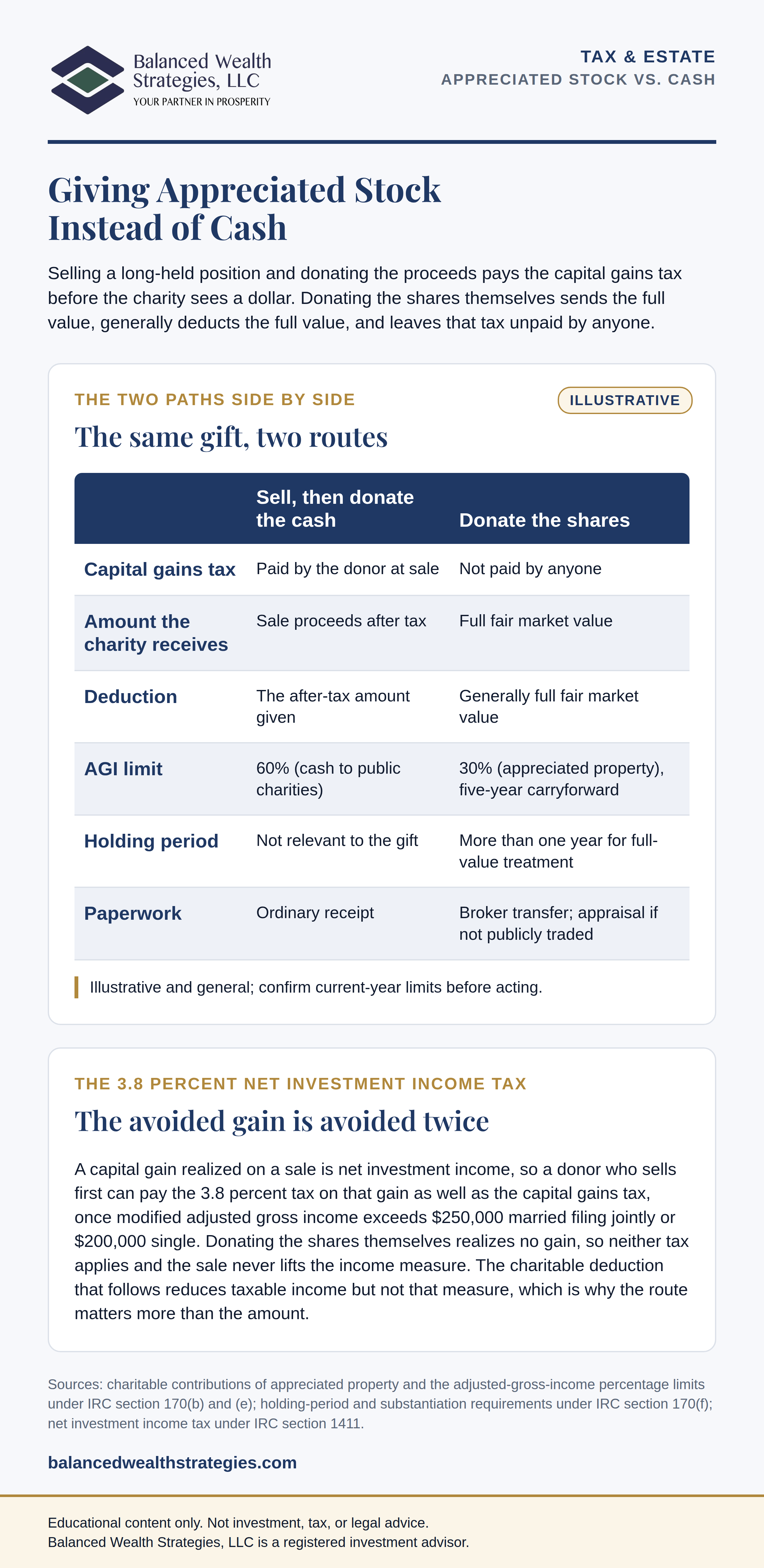
A capital gain realized on a sale is net investment income, so a donor who sells first can pay the 3.8 percent net investment income tax on that gain in addition to the capital gains tax, once modified adjusted gross income exceeds $250,000 married filing jointly or $200,000 single. Donating the shares themselves realizes no gain, so neither tax applies and the sale never lifts the income measure. The charitable deduction that follows reduces taxable income but not that measure, which is why the route matters more than the amount.
The Two Paths Side by Side
| Sell, then donate the cash | Donate the shares | |
|---|---|---|
| Capital gains tax | Paid by the donor at sale | Not paid by anyone |
| Amount the charity receives | Sale proceeds after tax | Full fair market value |
| Deduction | The after-tax amount given | Generally full fair market value |
| AGI limit | 60% (cash to public charities) | 30% (appreciated property), five-year carryforward |
| Holding period | Not relevant to the gift | More than one year for full-value treatment |
| Paperwork | Ordinary receipt | Broker transfer; appraisal if not publicly traded |
The Rules Worth Knowing
Four conditions shape the benefit. The shares should generally be long-term, held more than a year, to deduct fair market value; short-term holdings are limited to basis. Deductions for gifts of appreciated property to public charities are subject to a 30 percent of adjusted gross income limit rather than the 60 percent that applies to cash, with unused amounts carried forward for up to five years. Publicly traded stock is straightforward to value, while privately held or restricted shares generally require a qualified appraisal and additional substantiation. And a donor-advised fund can sit in the middle, receiving the appreciated shares and letting the donor recommend grants to charities over time. Positions carrying a large embedded gain are worth reading alongside our article on diversifying a concentrated stock position.

Case in point (illustrative). A donor planned a $50,000 year-end gift funded by selling a long-held, low-basis position. Selling would have triggered the gain and added to that year’s income. Transferring the shares to a donor-advised fund instead delivered the same $50,000, avoided the gain, and let grants go out to three charities over the following two years on the donor’s own schedule. The scenario is anonymized and illustrative and describes no identifiable client.
What Not to Donate
The strategy works in one direction only. A position held at a loss should be sold rather than given: selling realizes the capital loss, which can offset other gains, and the cash proceeds can then be donated for the same deduction. Donating the loss position instead wastes the loss entirely. Shares held one year or less are also poor candidates, because the deduction for short-term property is generally limited to cost basis, which removes most of the advantage. The ideal gift is the opposite case: the lowest basis and the longest holding period you own.
Execution and Timing
Identify the lot in writing with the broker before the transfer, since the default sale order may not deliver the shares you intend. Allow time, because a transfer between brokerage firms takes days and a mutual fund position can take longer; a gift counts in the year the shares leave your account and reach the charity’s, not the year you instruct it, which is why year-end gifts should start in early December. Confirm the recipient can accept securities and holds a brokerage account for the purpose, and remember that the deduction for appreciated property is limited to 30 percent of adjusted gross income, with any excess carried forward for up to five years.
How to Donate Appreciated Stock, Step by Step
- Pick the right lot. Identify the position with the lowest basis and the longest holding period. That combination produces the largest avoided gain per dollar given.
- Confirm the holding period. More than one year is required for full-value treatment. Shares held a year or less are generally limited to basis, which removes most of the advantage.
- Check the recipient and the ceiling. Confirm the charity is a qualified public charity and can accept securities, and compare the intended gift against the 30 percent of adjusted gross income limit for appreciated property.
- Transfer the shares, do not sell them. Instruct your broker to transfer the shares in kind to the charity’s or the donor-advised fund’s account. Selling first, even by a day, forfeits the benefit entirely.
- Document it. Keep the transfer confirmation and the charity’s written acknowledgment, and obtain a qualified appraisal for anything not publicly traded. Allow time before December 31, since transfers are not instantaneous.
If you hold appreciated investments and give to charity, an objective review can help you give the shares rather than the tax. Schedule a confidential consultation with Mark J. Burger, CPA →
Frequently Asked Questions
Why is donating stock better than donating cash?
Because it avoids the capital gains tax that selling would trigger, while generally allowing a deduction for the full fair market value. The appreciation that would have been taxed instead remains in the gift, so the charity receives more and the donor gives more efficiently from the same position.
Does the stock need to be held for a certain time?
Generally more than one year. Long-term appreciated shares qualify for a fair-market-value deduction, while shares held a year or less are generally limited to their cost basis, which removes most of the advantage. Confirm the holding period on the specific lot before instructing the transfer.
Can I use a donor-advised fund for this?
Yes, and it is a common and efficient pairing. You contribute the appreciated shares to the fund, take the deduction in that year, and recommend grants to your chosen charities over time. It combines the tax efficiency of the stock gift with flexible timing, which matters when the deduction is worth most in a single high-income year.
What if the stock is privately held or restricted?
It can often still be donated, but valuation and substantiation are more involved and generally require a qualified appraisal. Transfer restrictions and the charity’s own acceptance policy may also apply. These gifts are worth structuring with your tax advisor well before year end rather than in the final week.
What if the position has lost value instead?
Then the logic reverses. Donating a depreciated position wastes the loss, because the deduction is generally limited to fair market value and the built-in loss disappears. Selling the shares first to realize the loss, then donating the cash, generally produces the better result. The rule of thumb is simple: give the winners, sell the losers.
Does donating shares also avoid the 3.8 percent net investment income tax?
Yes, in the sense that there is no gain to tax. Selling first realizes a capital gain, which is net investment income and can carry the additional 3.8 percent above $250,000 joint or $200,000 single. Transferring the shares themselves realizes nothing, so neither the capital gains tax nor the 3.8 percent tax applies, and the transaction does not raise the income measure that exposes your other investment income.
Important Regulatory Disclosure
Balanced Wealth Strategies, LLC is a registered investment advisor. This is not an offer to sell securities or the solicitation of an offer to purchase securities. All investing involves risk, including the potential loss of principal. Past performance is not indicative of future results. Please see our Disclosures for Form ADV Part 2A and 2B for complete details about our services, fees and professional background.
Sources: charitable contributions of long-term appreciated property and fair-market-value deductions under IRC section 170 (see IRS Publication 526), including the 30 percent of adjusted gross income limit for appreciated property gifts to public charities and the five-year carryforward. Donor-advised funds under IRC section 170; substantiation and qualified-appraisal requirements for gifts of non-publicly-traded property (see IRS Publication 561). The 23.8 percent rate in the worked example combines the 20 percent long-term capital gains rate and the 3.8 percent net investment income tax. Confirm all current-year figures against IRS guidance before acting. Net investment income tax under IRC section 1411: a realized capital gain is net investment income, while a gift of appreciated shares realizes no gain. Deduction limited to basis for short-term property under IRC section 170(e); 30 percent adjusted-gross-income limit and five-year carryforward under IRC section 170(b) and (d).