
By Mark J. Burger, CPA · BalancedWealthStrategies.com · As of October 2026
For the shareholder of a qualifying C-corporation, Section 1202 can exclude 50 to 100 percent of the gain on a business sale from federal income tax, up to the greater of $15 million or ten times basis. The 2025 law expanded the benefit in three ways: a tiered exclusion of 50 percent at three years, 75 percent at four, and 100 percent at five; a per-issuer cap raised from $10 million to $15 million; and a gross-assets ceiling raised from $50 million to $75 million. It is one of the most valuable and most easily forfeited provisions in the code.
For the founder or shareholder of a C-corporation, one provision of the tax code can matter more to the outcome of a sale than any negotiating point over price. Section 1202 allows the gain on the sale of qualified small business stock to escape federal income tax entirely, up to a substantial cap. The 2025 tax law made the provision markedly more generous, and in doing so brought many more companies and owners into its reach. It also remains one of the most fact-specific benefits in the code, powerful when the requirements are met and easily forfeited when they are not. It is worth reading alongside our financial roadmap for selling a business, since the two decisions are made together.
What Section 1202 Does
In its established form, Section 1202 excludes from federal income tax the gain on the sale of qualified small business stock held long enough, subject to a per-issuer limit. The stock must be that of a domestic C-corporation, acquired by the taxpayer at its original issuance in exchange for money, property, or services. The corporation must have conducted an active qualified business and, at the time the stock was issued, its aggregate gross assets must have been below a defined threshold. When those conditions are satisfied and the holding period is met, a sale that would otherwise produce a large capital gain can produce little or no federal tax at all.
What the 2025 Law Changed
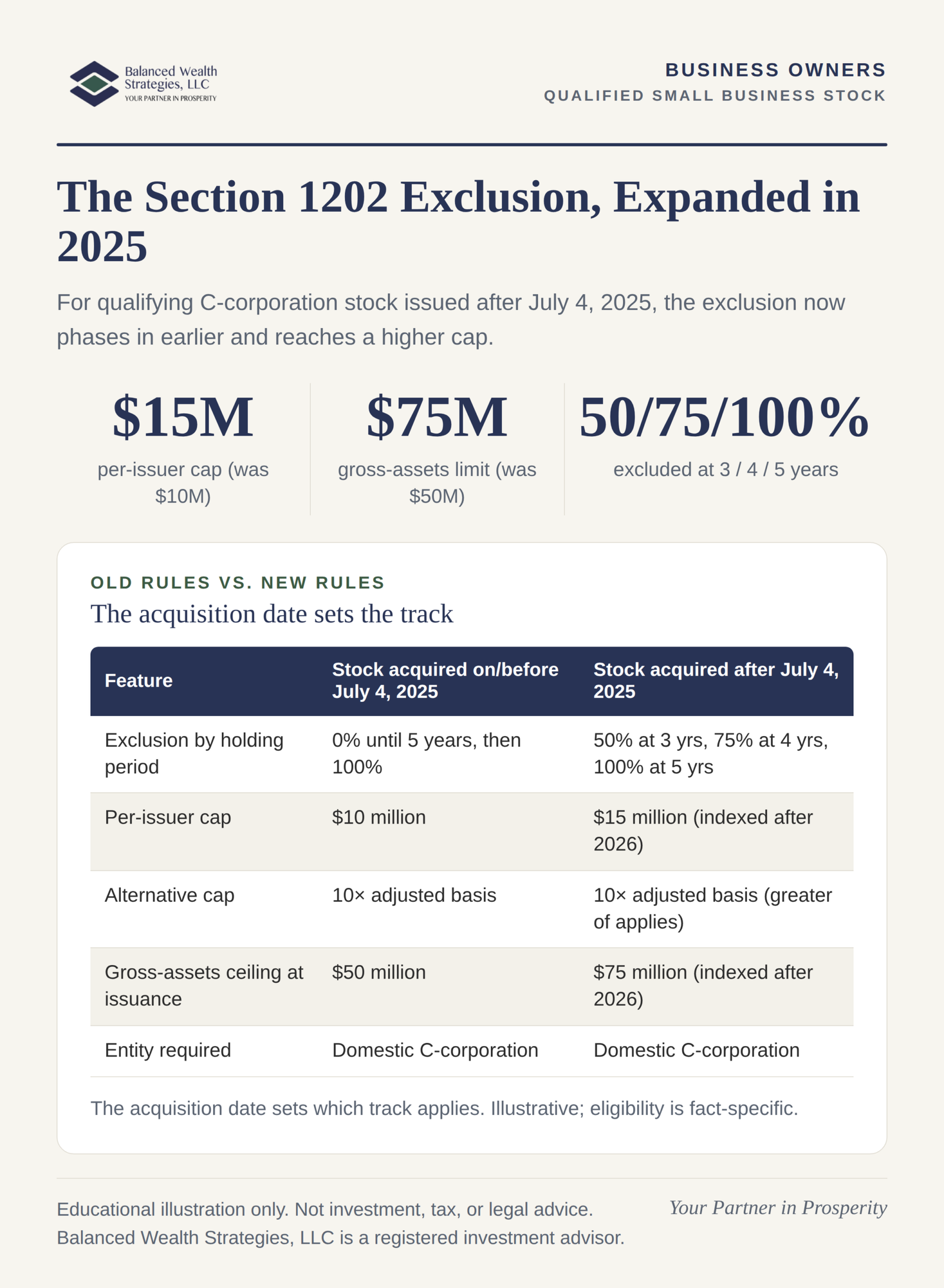
The One Big Beautiful Bill Act, effective for stock acquired after July 4, 2025, expanded the benefit in three consequential ways while leaving the core requirements intact. First, a tiered exclusion with earlier access: previously the full 100 percent exclusion required a holding period of more than five years, with nothing before that, and for newly issued stock the exclusion now phases in, 50 percent of the gain at a three-year hold, 75 percent at four years, and 100 percent at five years. Second, a higher per-issuer cap: the lifetime exclusion cap per company rose from $10 million to $15 million, indexed for inflation for tax years beginning after 2026, and the cap is actually the greater of that dollar amount or ten times the taxpayer’s adjusted basis in the stock. Third, a larger company can still qualify: the ceiling on a corporation’s aggregate gross assets at issuance rose from $50 million to $75 million, also indexed after 2026. Stock acquired on or before July 4, 2025 keeps the prior rules: a holding period of more than five years, the historical exclusion percentages, and the $10 million cap. The result is a two-track system in which the date a shareholder acquired the stock determines which set of rules applies.
Worked example (illustrative). A founder holds qualified small business stock issued after July 4, 2025 with a basis of $100,000, and sells five years later for a $12 million gain. Because the stock cleared the five-year hold, 100 percent of the gain is excluded up to the per-issuer cap, the greater of $15 million or ten times the $100,000 basis ($1 million). The $15 million cap governs and comfortably covers the entire $12 million gain, so the federal income tax on the sale is essentially zero, against roughly $2.86 million that a 23.8 percent rate would otherwise have taken. Sell the same stock at four years instead and only 75 percent is excluded; the remaining $3 million of gain is taxable, about $714,000 of tax. One extra year of holding was worth about $714,000. Figures are illustrative, ignore state tax, and depend on the reader’s own facts.
Why the Benefit Is So Easily Lost
The value of Section 1202 is matched by the number of ways to fall outside it, and most of them are decided years before a sale. The most common is entity choice: an S-corporation, partnership, or limited liability company does not issue qualified small business stock, so a business operated in one of those forms does not qualify unless and until it is a C-corporation, and the holding period generally runs from the date qualifying stock is issued. Corporate redemptions near the time of issuance can taint the stock. The active-business and gross-assets tests must hold as the rules require, not merely at a convenient moment. And certain service and investment businesses are excluded from the benefit altogether. None of this is a reason to avoid the provision; it is the reason to analyze it early — ideally alongside our wealth management and financial planning services — while entity form, timing, and structure can still be shaped.
Case in point (illustrative). Two founders built comparable software companies. One incorporated as a C-corporation at inception and issued stock while gross assets were well under the threshold; a sale years later excluded the entire gain under Section 1202. The other operated as an S-corporation for tax reasons in the early years and converted to a C-corporation only shortly before a sale. Because the qualifying stock was issued at conversion, the holding-period clock had barely started, and none of the gain qualified for exclusion. Same business model, same sale price; one paid essentially no federal tax on the gain and the other paid the full amount. The difference was a decision made years earlier. The scenario is anonymized and illustrative and describes no identifiable client.
Learn More
Old Rules vs. New Rules
| Feature | Stock acquired on/before July 4, 2025 | Stock acquired after July 4, 2025 |
|---|---|---|
| Exclusion by holding period | 0% until 5 years, then 100% | 50% at 3 yrs, 75% at 4 yrs, 100% at 5 yrs |
| Per-issuer cap | $10 million | $15 million (indexed after 2026) |
| Alternative cap | 10× adjusted basis | 10× adjusted basis (greater of applies) |
| Gross-assets ceiling at issuance | $50 million | $75 million (indexed after 2026) |
| Entity required | Domestic C-corporation | Domestic C-corporation |
How to Protect the Exclusion
- Get the entity right early. Only a domestic C-corporation issues qualifying stock; if you operate as an LLC or S-corporation, model the conversion decision well before any sale, since the clock starts at issuance.
- Document the gross-assets test at issuance. Confirm and record that aggregate gross assets were under the threshold when the stock was issued.
- Mind the holding-period tiers. Track the issuance date against the three-, four-, and five-year marks; a few months can move the exclusion from 75 to 100 percent.
- Avoid tainting events. Watch for corporate redemptions near issuance and confirm the business is not an excluded service or investment activity.
- Explore stacking early. Gifts of stock to family members or non-grantor trusts before a sale can multiply the per-taxpayer cap; and Section 1045 can roll gain into replacement QSBS if five years is not reached. Confirm all figures and execute with counsel well in advance.
QSBS is one piece of the picture. For a broader pre-sale readiness check — the after-tax number, deal structure, your team, and business readiness — see our five questions to answer before you sell your business.
If you own or are building a C-corporation, or are weighing a conversion ahead of a possible sale, an early, independent Section 1202 analysis can be worth far more than it costs. Schedule a confidential consultation with Mark J. Burger, CPA →
Frequently Asked Questions
What is the most I can exclude?
For stock issued after July 4, 2025 and held at least five years, the per-issuer cap is the greater of $15 million or ten times your adjusted basis in the company’s stock, with the dollar figure indexed for inflation after 2026. A shareholder with significant basis can therefore exclude well beyond $15 million. Stock acquired earlier remains subject to the $10 million figure.
My business is an LLC or S-corporation. Does it qualify?
Not as such. Qualified small business stock must be stock of a C-corporation. A business in another form does not issue qualifying stock unless it converts, and the holding period generally begins when qualifying C-corporation stock is issued. Whether and when to convert is a significant decision with trade-offs that should be modeled well before any sale.
When does the holding-period clock start?
Generally at the original issuance of the qualifying stock to you. Because the new tiers reward three, four, and five years of holding, the issuance date directly affects how much gain can be excluded on a future sale, which is one more reason the analysis belongs early rather than at closing.
Can the exclusion be multiplied?
In some circumstances, yes. Because the cap applies per taxpayer and per issuer, planning that involves additional eligible taxpayers, for example certain gifts of stock to family members or to non-grantor trusts before a sale, can, when done correctly and well in advance, expand the total gain excluded. These strategies are technical and must be executed carefully and early with legal and tax counsel.
What if I sell before five years?
For newly issued stock, you may still exclude 50 percent at three years or 75 percent at four. Separately, Section 1045 can allow gain to be rolled into replacement qualified small business stock to preserve the benefit when the five-year mark has not been reached. The right path depends on the facts.
Does the exclusion help with state tax?
It depends on the state. Some states conform to the federal exclusion and some do not. For a Florida resident there is no state income tax on the gain in any case, which is one more reason domicile can affect the after-tax result of a sale.
Important Regulatory Disclosure
Balanced Wealth Strategies, LLC is a registered investment advisor. This is not an offer to sell securities or the solicitation of an offer to purchase securities. All investing involves risk, including the potential loss of principal. Past performance is not indicative of future results. Please see our Disclosures for Form ADV Part 2A and 2B for complete details about our services, fees and professional background.
Sources: qualified small business stock exclusion under IRC section 1202; original-issuance, C-corporation, active-business, and aggregate-gross-assets requirements. One Big Beautiful Bill Act (effective for stock acquired after July 4, 2025): tiered exclusion of 50% at three years, 75% at four years, 100% at five years; per-issuer cap increased from $10 million to $15 million (indexed after 2026); aggregate gross assets limit increased from $50 million to $75 million (indexed after 2026); as summarized by Baker Tilly and Mintz, July 2025. Per-issuer limitation as the greater of the dollar cap or 10 times adjusted basis under IRC section 1202(b); rollover of gain into replacement QSBS under IRC section 1045. The 23.8 percent rate in the worked example is the 2026 top long-term capital gains plus NIIT rate. Stock acquired on or before July 4, 2025 retains the prior more-than-five-year holding period and $10 million cap. Eligibility is fact-specific; confirm all figures with your tax advisor before acting.