

By Mark J. Burger, CPA · BalancedWealthStrategies.com · As of October 2026
Most owners begin thinking about a sale when an offer arrives, and by then several of the decisions that most affect the outcome have already narrowed. Five questions are worth answering while a sale is still hypothetical, because that is when the answers can still change the result: your after-tax number, the deal structure, the day after, your team, and whether the business is ready to command its value. This is a readiness check, not advice on a specific transaction.
The questions below pair with our fuller financial road-map for before and after a business sale. They are not a substitute for advice on a specific transaction; they are a readiness check to run early, while the answers can still influence structure, tax, and value.
1. What Is Your Number — After Tax?
Not the price you hope to command, but the amount you need to keep after every tax and cost, in order to fund the rest of your life. That figure, worked backward from your living expenses and goals, tells you whether a given offer actually works and how hard the proceeds will have to work once invested. An owner who knows the after-tax number negotiates differently than one who is anchored to a headline price.
Worked example (illustrative). An owner needs $180,000 a year, before tax, to fund the household. A common planning guideline of withdrawing about 4 percent of a portfolio each year implies a portfolio of roughly $4.5 million to generate that income ($180,000 divided by 0.04). Working backward: if a sale is taxed at a combined 23.8 percent on a low-basis business, the owner keeps about 76 cents on the dollar, so a headline price near $5.9 million is needed to net the $4.5 million the plan requires ($4.5 million divided by 0.762). An offer of $5 million, which sounds ample, nets about $3.8 million and funds roughly $152,000 a year, short of the goal. The after-tax number, not the headline, tells the owner whether the offer works. Figures are illustrative, ignore state tax and other assets, and depend on the reader’s own facts.
2. How Will the Deal Be Structured, and What Will It Cost in Tax?
Whether the sale is of assets or stock, how the price is allocated, and whether it includes an installment note or an earnout all change the tax owed on the same headline number. These are not details to leave to the closing; they are terms to model before you negotiate, because the after-tax result is decided in the structure.
3. What Will You Do the Day After the Sale Closes?
A sale ends a role that often defined an owner’s days for decades. The financial plan for the proceeds matters, and so does the plan for the time — the kind of planning we cover in our wealth management and financial planning services. Owners who have thought about both tend to make calmer, better decisions with the money, precisely because they are not filling a sudden void with activity.
4. Who Is on Your Team, and When Did They Join?
A strong sale is supported by a transaction attorney, a tax advisor, a deal intermediary, and a wealth advisor — a role we support through our strategic wealth manager partnerships — who can plan for the proceeds. The timing of their involvement matters as much as their presence. A team assembled a year ahead can position the business and the owner; a team assembled after the offer can mostly react.
5. Is the Business Ready to Command Its Value?
Buyers pay for clean books, transferable relationships, a management team that survives the founder, and diligence that turns up no surprises. Time spent making a business less dependent on its owner and easier to examine is often the highest-return work in the entire process, and it can only be done before a buyer is looking.
Case in point (illustrative). Two owners of similar companies each received an offer near $6 million. The first had spent eighteen months building a management team, cleaning up the books, and reducing customer concentration; diligence was smooth and the deal closed at the offer. The second was still the single point of contact for the largest customers; diligence surfaced that concentration, the buyer re-priced, and the deal closed roughly 15 percent lower, a difference of about $900,000. The businesses were comparable; the readiness was not. The scenario is anonymized and illustrative and describes no identifiable client.
Learn More
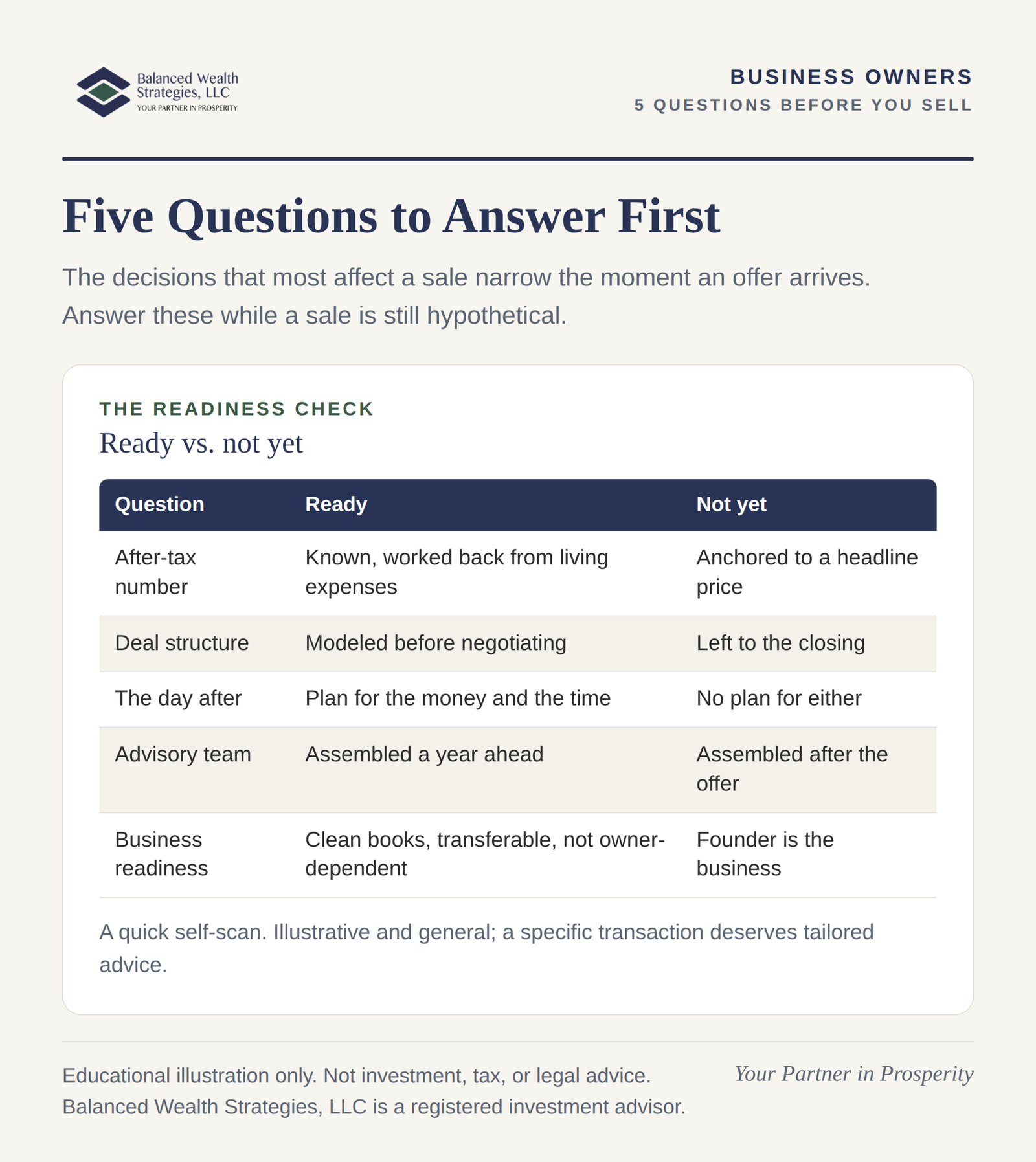
The Readiness Check at a Glance
| Question | Ready | Not yet |
|---|---|---|
| After-tax number | Known, worked back from living expenses | Anchored to a headline price |
| Deal structure | Modeled before negotiating | Left to the closing |
| The day after | Plan for the money and the time | No plan for either |
| Advisory team | Assembled a year ahead | Assembled after the offer |
| Business readiness | Clean books, transferable, not owner-dependent | Founder is the business |
Where to Start
- Calculate the after-tax number first. Work back from your living expenses to the portfolio you need, then to the net proceeds, then to the headline price that produces them.
- Model at least two structures. Compare asset versus stock, and any installment or earnout terms, for the after-tax result before you negotiate.
- Assemble the team early. Bring in the attorney, tax advisor, intermediary, and wealth advisor while the sale is still hypothetical.
- Reduce owner dependence. Build a management layer and diversify customer concentration so diligence turns up no surprises.
- Plan the day after. Decide what the proceeds must do and what you will do with your time, and confirm current-year figures before acting.
If a sale is on the horizon, or already in front of you, an independent, CPA-led review can pressure-test these answers before they are locked in. Schedule a confidential consultation with Mark J. Burger, CPA →
Frequently Asked Questions
When should I start answering these questions?
As early as you can, ideally a year or more before a contemplated sale. The earlier the answers are clear, the more they can influence structure, tax, and readiness while those things are still changeable.
Do I need all of these settled before I take a meeting?
No. A first conversation with a buyer or advisor does not require finished answers. It does help to have thought about your after-tax number and your team, so that early discussions move in a direction that serves you.
What if an offer has already arrived?
It is later than ideal, but not too late. Several decisions remain open until a binding agreement is signed, which is exactly why an independent review before you sign can still protect the outcome.
How do I calculate my after-tax number?
Start with the annual income you need, convert it to the portfolio required to sustain it using a conservative withdrawal rate, then gross that up for the tax the sale will trigger and any transaction costs. The result is the headline price the deal must reach to fund your life. A CPA can run this precisely against your facts.
What makes a business less dependent on its owner?
A management team that can run day-to-day operations, customer relationships that belong to the company rather than to the founder, documented processes, and clean financial records. Buyers pay more, and re-trade less at diligence, for a business that will keep running after the founder leaves.
Important Regulatory Disclosure
Balanced Wealth Strategies, LLC is a registered investment advisor. This is not an offer to sell securities or the solicitation of an offer to purchase securities. All investing involves risk, including the potential loss of principal. Past performance is not indicative of future results. Please see our Disclosures for Form ADV Part 2A and 2B for complete details about our services, fees and professional background.
Sources: general educational discussion of business-sale readiness; deal structure and tax outcomes depend on entity type, state law, and negotiation. Asset vs. stock sale under IRC section 1060; installment sales under IRC section 453; net investment income tax under IRC section 1411; qualified small business stock under IRC section 1202. The 4 percent withdrawal guideline and the 23.8 percent combined rate in the worked example are illustrative planning assumptions; confirm all figures against your facts and current guidance before acting.