

By Mark J. Burger, CPA · BalancedWealthStrategies.com · As of October 2026
The $15 million exemption decides exactly one thing: whether your estate owes the 40 percent federal estate tax. It decides nothing about who makes decisions if you are incapacitated, who raises your minor children, whether your estate goes through probate, or whether an inheritance is protected from a creditor or a divorce. For most families, the estate tax was never the largest reason to have a plan. If you do one thing in response to the new law, make it a short review rather than a dismissal.
Since the estate and gift tax exemption became a permanent $15 million per person, one question has arrived more often than any other. If that much is shielded, and the amount no longer expires, do I still need to do anything about my estate? It is a fair question, and the honest answer is worth stating plainly. The exemption determines whether your estate will owe federal estate tax, and almost nothing else about whether your plan actually works. This is the companion to our fuller analysis of the permanent $15 million exemption and what the new law means for your plan.
What the Exemption Decides, and What It Does Not
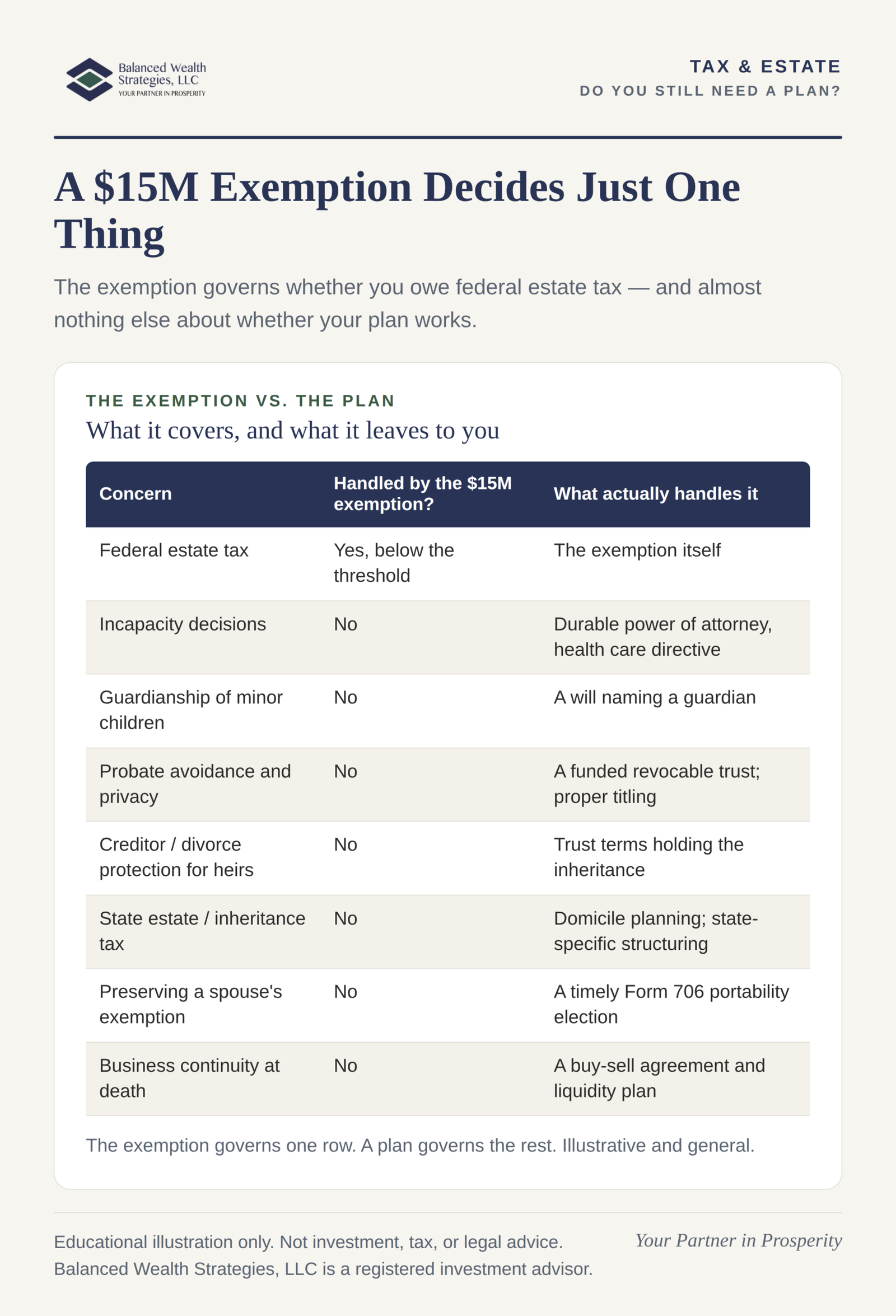
The exemption is a threshold. Below it, no federal estate tax is due; above it, the excess is taxed at 40 percent. That is the entire scope of what the number governs. It does not decide who makes financial or medical decisions if you become incapacitated. It does not name a guardian for minor children. It does not move an estate through, or around, the probate court. It does not protect an inheritance from a beneficiary’s creditors or a future divorce. It does not keep a family business from being forced into a sale to raise cash. A larger exemption changes none of these things, because none of them was ever a function of the estate tax.
The Questions a Plan Answers That Have Nothing to Do With Tax
Consider what an estate plan is actually for, setting the tax question aside entirely. It appoints someone you trust to act for you under a durable power of attorney and a health care directive, so that a court does not have to appoint someone for you. It names who will raise your minor children, rather than leaving that decision to a judge. It can hold assets in trust so they pass to heirs on terms you choose — at an age, for a purpose, or with protection from a divorce or a lawsuit — instead of as a lump sum. It keeps your affairs private and out of the public probate record. For a business owner, it provides the liquidity and the succession terms that let the company survive a death rather than be sold under pressure. None of that is affected by whether the exemption is seven million dollars or fifteen. Protect Family Wealth: How to Allocate the New $15 Million GST Exemption to Non-Exempt Trusts
Case in point (illustrative). A couple in their forties, with a combined net worth of about $3 million and two children under ten, concluded that the $15 million exemption meant they had nothing to do. They had a will from before the children were born and no powers of attorney. One spouse was seriously injured in an accident. Because no durable power of attorney or health care directive existed, the family had to petition a court to manage finances and medical decisions, a months-long, public, and expensive process that a $400 document would have avoided. The estate tax exemption was never the issue; the missing incapacity documents were. The scenario is anonymized and illustrative and describes no identifiable client.
The Tax Reasons That Survive a High Exemption
Even on the narrower tax question, the high exemption does not close the file. State taxes are the first: a number of states impose their own estate or inheritance taxes at thresholds far below the federal line, untouched by federal law. Florida and New Hampshire impose neither, which is one reason where a person is legally domiciled is itself a planning question for anyone who divides the year between states. Portability is the second: a surviving spouse can use the first spouse’s unused exemption, but only if an estate tax return is filed to elect it, even when no tax is due. Cost basis is the third: with fewer estates exposed to the 40 percent tax, the more common tax question is now an income tax one, because assets held until death generally receive a stepped-up basis that can erase a lifetime of capital gain, while assets given away during life usually do not. And permanence is not the same as forever; the law removed the scheduled expiration date, but a future Congress can still change the figure.
Worked example (illustrative). Suppose a surviving spouse skips the estate tax return at the first death in 2026 because no tax is owed, forfeiting the deceased spouse’s $15 million of unused exemption. Years later the survivor’s own estate has grown to $22 million. With only one $15 million exemption preserved, $7 million is now exposed to the 40 percent rate, a $2.8 million federal estate tax. Had a timely Form 706 been filed to elect portability, the second $15 million of exemption would have covered the entire estate, and the tax would have been zero. The election was a filing, not a payment; skipping it cost $2.8 million. Figures are illustrative and depend on the reader’s own facts.
A Short Review, Even If You Are Well Under the Threshold
If you take one action in response to the new law, let it be a review rather than a dismissal. A sound review confirms that the people named to act for you — executor, trustee, agent under a power of attorney, health care proxy, and guardian for any minor children — are still the right people and are current. It confirms that beneficiary designations on retirement accounts and insurance actually match the intentions in your will, since those designations control regardless of what the will says. It checks whether any trust in the plan uses a formula tied to the exemption amount, because a clause written to fund a trust “up to the exemption” can now direct far more than intended, in some cases at a surviving spouse’s expense. For married couples, it confirms there is a plan to preserve the first spouse’s exemption through portability. And it verifies that assets are titled consistently with the plan, since a trust controls only the assets actually transferred into it.
None of this requires rebuilding a plan from scratch. It requires confirming the pieces already in place still do what you intend. See how we approach that kind of review: our approach to independent, CPA-led wealth oversight.
What the Exemption Covers, and What It Leaves to You
| Concern | Handled by the $15M exemption? | What actually handles it |
|---|---|---|
| Federal estate tax | Yes, below the threshold | The exemption itself |
| Incapacity decisions | No | Durable power of attorney, health care directive |
| Guardianship of minor children | No | A will naming a guardian |
| Probate avoidance and privacy | No | A funded revocable trust; proper titling |
| Creditor / divorce protection for heirs | No | Trust terms holding the inheritance |
| State estate / inheritance tax | No | Domicile planning; state-specific structuring |
| Preserving a spouse’s exemption | No | A timely Form 706 portability election |
| Business continuity at death | No | A buy-sell agreement and liquidity plan |
What to Confirm, Even Under $15 Million
- Check who is named. Confirm the executor, trustee, agent under your power of attorney, health care proxy, and any guardian for minor children are current and still the right people.
- Match your beneficiary designations to your will. Retirement accounts and insurance pass by designation regardless of the will; confirm they say what you intend.
- Re-read any exemption-based trust formula. A clause funding a trust “up to the exemption amount” can now direct far more than it did when drafted; have it reviewed against $15 million.
- Set the portability plan if you are married. Decide now that a Form 706 will be filed at the first death to preserve the exemption, even when no tax is due.
- Confirm titling. Verify that assets are actually titled into the trust or aligned with the plan, since a trust controls only what is transferred into it, and confirm current-year figures before acting.
For an independent, CPA-led review to confirm your existing plan still does what you intend under the new law, no major overhaul assumed, schedule a confidential consultation with Mark J. Burger, CPA →
Frequently Asked Questions
My estate is under $15 million. Do I really need an estate plan?
Yes. A plan governs incapacity decisions, guardianship of minor children, probate avoidance and privacy, and protection of an inheritance from creditors or divorce. These purposes are independent of the estate tax, and they apply regardless of the size of your estate.
Is a simple will enough?
A will directs who receives your assets and names a guardian for minor children, but it does not avoid probate and does not operate if you are alive but incapacitated. Most complete plans pair a will with a durable power of attorney, a health care directive, and, where appropriate, a trust. The right combination depends on your circumstances.
We are married with about $20 million. Are we automatically fine now?
Not automatically. Two exemptions can shield $30 million, but capturing the first spouse’s exemption generally requires filing an estate tax return to elect portability, even when no tax is due. Older trust language tied to the exemption should also be reviewed, because a formula clause can behave very differently at $15 million than it did when drafted.
Does “permanent” mean the exemption will never change?
No. Permanent means there is no longer a scheduled expiration built into the law, so the amount does not automatically revert. A future Congress can still amend it. The change removes urgency; it does not lock the figure in place indefinitely.
If I am not planning any large gifts, is there anything to do right now?
Usually a brief review. Confirm that the people named in your documents are current, that beneficiary designations match your will, that any exemption-based trust formula still works as intended, and that a married couple has a plan to preserve portability. These are confirmations, not major undertakings, and they are where most avoidable problems are found.
Important Regulatory Disclosure
Balanced Wealth Strategies, LLC is a registered investment advisor. This is not an offer to sell securities or the solicitation of an offer to purchase securities. All investing involves risk, including the potential loss of principal. Past performance is not indicative of future results. Please see our Disclosures for Form ADV Part 2A and 2B for complete details about our services, fees and professional background.
Sources: One Big Beautiful Bill Act, Public Law 119-21 (July 4, 2025), permanent $15 million per person exemption for 2026, indexed, no sunset. IRS 2026 inflation adjustments (Rev. Proc. 2025-32): $15 million basic exclusion; $19,000 annual gift tax exclusion. Federal top transfer tax rate 40 percent under IRC section 2001; portability under IRC section 2010(c), requiring a timely Form 706 election; step-up in basis at death under IRC section 1014. State estate and inheritance taxes vary; Florida and New Hampshire impose neither. Confirm all figures against IRS guidance before acting.