
By Mark J. Burger, CPA · BalancedWealthStrategies.com · As of October 2026
The federal estate and gift tax exemption did not fall in 2026. It rose to $15 million per person, $30 million for a married couple, and the law removed the scheduled expiration date entirely. For two years, affluent families planned against a deadline that has now been cancelled. The urgency is gone. The reasons to keep a plan current are not, and for most families they have simply moved from estate tax avoidance to the cost-basis step-up, the portability election, state domicile, and old trust language that no longer does what it was written to do.
For most of the past two years, affluent families planned against a deadline. The estate and gift tax exemption, temporarily doubled under the 2017 tax law, was scheduled to fall by roughly half at the end of 2025. A great deal of urgent gifting, trust drafting, and “use it or lose it” advice followed. That deadline is now gone. The exemption did not fall. It rose, and the law removed the expiration date entirely. The change alters the posture of estate planning without removing the need for it, a question our companion article, “why you still need an estate plan under the $15 million exemption,” takes up in detail once it publishes.
What the Law Now Says
The One Big Beautiful Bill Act, signed into law on July 4, 2025, set the federal estate, gift, and generation-skipping transfer tax exemption at $15 million per person for 2026, up from $13.99 million in 2025. For a married couple, that is $30 million of combined transfers shielded from the 40 percent federal transfer tax. The amount is indexed for inflation going forward, and, unlike the prior law it replaced, it carries no sunset provision. It does not count down to an expiration date.
The distinction between “permanent” and “unchangeable” matters, and a careful reader should hold both ideas at once. Permanent, in this context, means the higher exemption is now the baseline of the law rather than a temporary provision scheduled to lapse. It does not mean the figure is beyond the reach of a future Congress, which can amend the exemption as it has many times before. What has been removed is the automatic reversion, not the possibility of legislative change.
Why the Urgency Is Gone but the Planning Is Not
The old case for acting quickly rested largely on the deadline. Families were told to make large lifetime gifts before the exemption was cut, to lock in the higher amount while it lasted. With the reversion cancelled, that particular clock has stopped. There is no longer a reason to rush a gift merely to beat a date on the calendar. What remains is a quieter and more durable set of reasons to keep an estate plan current, several of which have become more important precisely because the federal exemption is now so high — a shift reflected in our approach to independent, CPA-led wealth oversight.
The Basis Question Now Outweighs the Estate Tax for Many Families
When the exemption was low, the central worry was the 40 percent estate tax, and moving assets out of the estate through lifetime gifts was often the priority. With $15 million per person shielded, far fewer families will owe any federal estate tax at all. For them, the more consequential question is an income tax question: the step-up in cost basis at death. Assets held until death generally receive a new cost basis equal to their value on that date, which can erase a lifetime of unrealized capital gain for the heirs. Assets given away during life usually carry their original basis to the recipient. When an estate is comfortably below the exemption, gifting a highly appreciated asset can hand the next generation an avoidable capital gains bill that a simple bequest would have eliminated.
Worked example (illustrative). A widowed parent with a $9 million estate, comfortably under the $15 million exemption, holds a stock position worth $2 million that was bought years ago for $400,000. Gift it to a child during life and the child takes the parent’s $400,000 basis; a later sale realizes a $1.6 million gain, taxed at a combined 23.8 percent long-term capital gains and net investment income tax rate, or about $380,800. Hold the same shares until death and they receive a stepped-up basis to $2 million, erasing that gain; a sale by the heir the next day triggers essentially no capital gains tax. Because the estate is already below the exemption, neither path owes federal estate tax, so the lifetime gift buys nothing and costs the family roughly $380,800. Figures are illustrative, assume the 23.8 percent rate and no state tax, and depend on the reader’s own facts.
State Taxes, Portability, and the Documents Themselves
The federal exemption is only part of the picture. A number of states impose their own estate or inheritance taxes at thresholds far below $15 million, and those taxes are unaffected by the federal change. Florida imposes no state estate or inheritance tax, and New Hampshire imposes none either, which is one reason domicile is itself a planning matter for clients who divide their year between states. Where a person is legally domiciled can determine whether a state-level estate tax applies at all.
Portability deserves particular attention. A surviving spouse may use the deceased spouse’s unused exemption, but only if an estate tax return is filed to elect it, even when no tax is due. Families sometimes skip that filing precisely because there is no tax, and in doing so forfeit millions of dollars of exemption that could matter later. It is a costly omission that is entirely avoidable.
There is also the matter of the documents already in place. Many wills and trusts drafted when the exemption was low contain formula clauses that fund a family or credit-shelter trust “up to the exemption amount.” With the exemption now at $15 million, such a clause can direct far more into that trust than the drafter intended, in some cases unintentionally reducing what passes outright to a surviving spouse. A plan written for a $5 million or $11 million world does not necessarily behave the way its owner expects in a $15 million one. This is the single most common reason to have an existing plan reviewed rather than assumed to be current. The same “the document says one thing, the family expected another” problem shows up in retirement accounts too, as we cover in The Ten-Year Clock: How a Roth Conversion Changes What Your Heirs Actually Keep.
Case in point (illustrative). A couple signed wills in 2012, when the exemption was about $5 million. Each will funds a credit-shelter trust for the children “up to the maximum federal exemption,” with the remainder passing outright to the surviving spouse. The first spouse dies in 2026 with a $16 million combined estate. The formula now sweeps $15 million into the children’s trust and leaves the surviving spouse just $1 million outright, the opposite of what the couple assumed the document did when the exemption was a third of today’s figure. No tax was triggered, and nothing was illegal; the language simply behaved as written in a world it was not written for. A short review would have caught it. The scenario is anonymized and illustrative and describes no identifiable client.
Learn More

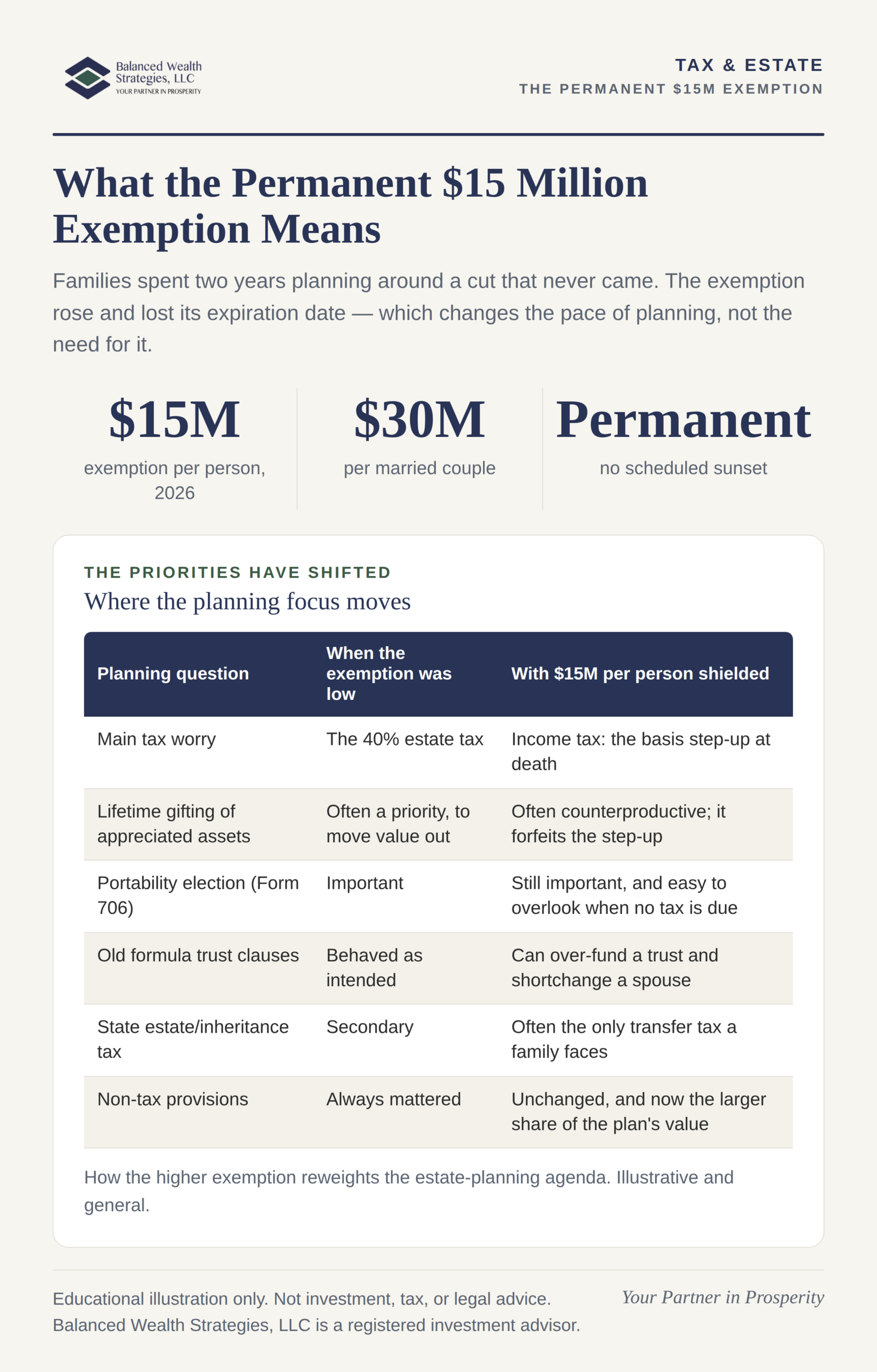
How the Priorities Shifted
| Planning question | When the exemption was low | With $15M per person shielded |
|---|---|---|
| Main tax worry | The 40% estate tax | Income tax: the basis step-up at death |
| Lifetime gifting of appreciated assets | Often a priority, to move value out | Often counterproductive; it forfeits the step-up |
| Portability election (Form 706) | Important | Still important, and easy to overlook when no tax is due |
| Old formula trust clauses | Behaved as intended | Can over-fund a trust and shortchange a spouse |
| State estate/inheritance tax | Secondary | Often the only transfer tax a family faces |
| Non-tax provisions | Always mattered | Unchanged, and now the larger share of the plan’s value |
What Does Not Change: The Non-Tax Purposes of a Plan
A great deal of estate planning was never about the estate tax in the first place. A plan governs who makes decisions if you cannot, who raises minor children, how assets are protected from creditors or divorce, how a business interest passes without forcing a sale, and how wealth reaches heirs on terms you set rather than in a lump sum. It keeps an estate out of probate and out of public record. None of these purposes is affected by the size of the federal exemption, and for most families they are the larger part of why a plan exists.
What to Do Now
- Pull the documents and read the funding formulas. Any will or trust that funds a credit-shelter or family trust “up to the exemption amount” should be re-read against a $15 million figure, not the amount in effect when it was signed.
- Confirm the portability plan. If a spouse has died, check whether a timely Form 706 was filed to elect portability. Going forward, treat that filing as mandatory even when no tax is due.
- Map your most-appreciated assets. Identify what carries a large embedded gain and lean toward holding it for the step-up rather than gifting it, unless a specific non-tax reason outweighs the lost basis.
- Check your state, and your domicile. Confirm whether your state imposes an estate or inheritance tax, and, if you split the year, where you are legally domiciled. Florida and New Hampshire impose neither.
- Review the non-tax provisions. Incapacity decision-makers, guardianship, trustees, and how and when heirs receive assets deserve a fresh look regardless of the exemption, and confirm the 2026 figures before acting on any of the above.
For an independent, CPA-led review of how the permanent $15 million exemption affects the plan you already have, including whether older trust language still does what you intend, schedule a confidential consultation with Mark J. Burger, CPA →
Frequently Asked Questions
Did the federal estate tax exemption go down in 2026?
No. It increased. The exemption rose to $15 million per person for 2026, up from $13.99 million in 2025, and the scheduled reduction under prior law was cancelled. Many families spent 2024 and 2025 planning around a cut that will not occur.
How much can a married couple protect?
Up to $30 million combined, using each spouse’s $15 million exemption. Capturing the full amount at the first death, however, generally requires filing an estate tax return to elect portability of the first spouse’s unused exemption, even when no tax is owed.
Does “permanent” mean the exemption can never change?
No. Permanent means there is no longer a scheduled expiration date built into the law, so the amount does not automatically revert. A future Congress can still amend it. The removal of the automatic sunset reduces urgency; it does not guarantee the figure forever.
My estate is well under $15 million. Do I still need an estate plan?
Yes. A plan controls incapacity decisions, guardianship of minor children, probate avoidance, creditor and divorce protection, and how and when heirs receive assets. It may also address state-level estate taxes, which can apply far below the federal threshold. These purposes are independent of the federal exemption.
What is the annual gift tax exclusion for 2026?
$19,000 per recipient in 2026, the same as in 2025. Gifts within this annual amount do not use any of the $15 million lifetime exemption and do not require a gift tax return, which makes annual exclusion gifting a clean, ongoing tool separate from the larger exemption.
Should I still make large lifetime gifts now that the deadline is gone?
It depends on the goal and the asset. The reason to rush before a sunset has been removed. Gifting can still make sense for removing future appreciation from an estate or for non-tax reasons, but for many families the loss of the basis step-up on gifted assets now weighs against it. This is an analysis to run on the specific facts, not a default.
Do Florida and New Hampshire have their own estate taxes?
Neither imposes a state estate or inheritance tax. Several other states do, at thresholds well below the federal amount, which is why the state in which a person is legally domiciled can change the result. For clients who split the year between states, domicile is itself worth planning.
Important Regulatory Disclosure
Balanced Wealth Strategies, LLC is a registered investment advisor. This is not an offer to sell securities or the solicitation of an offer to purchase securities, nor is it legal or tax advice. Estate, gift, and tax rules are complex and depend on individual circumstances; consult your attorney and tax advisor before acting. All investing involves risk, including the potential loss of principal. Past performance is not indicative of future results. Please see our Disclosures for Form ADV Part 2A and 2B for complete details about our services, fees and professional background.
Sources: One Big Beautiful Bill Act, Public Law 119-21 (signed July 4, 2025), permanent estate, gift, and generation-skipping transfer tax exemption of $15 million per person for 2026, indexed for inflation, with no sunset. IRS 2026 inflation adjustments (Rev. Proc. 2025-32, announced October 2025): basic exclusion amount of $15 million; annual gift tax exclusion of $19,000 per recipient; annual exclusion for gifts to a non-citizen spouse of $194,000; as reported by Morgan Lewis. Federal top estate and gift tax rate of 40 percent under IRC section 2001; portability of the deceased spousal unused exclusion under IRC section 2010(c), requiring a timely filed Form 706 election. Step-up in basis at death under IRC section 1014; carryover basis for lifetime gifts under IRC section 1015. The 23.8 percent rate combines the 20 percent long-term capital gains rate and the 3.8 percent net investment income tax. State estate and inheritance taxes vary; Florida and New Hampshire impose none. Confirm all 2026 figures against IRS guidance before acting.