
There is a moment in many households’ financial lives that almost no one plans for, and it arrives at the hardest possible time. When one spouse dies, the survivor’s income often changes very little — the pensions, the required distributions, most of the Social Security continue — but the tax brackets that income falls into nearly cut in half. The year after a spouse’s death, the survivor generally files as a single taxpayer, and the difference is stark.
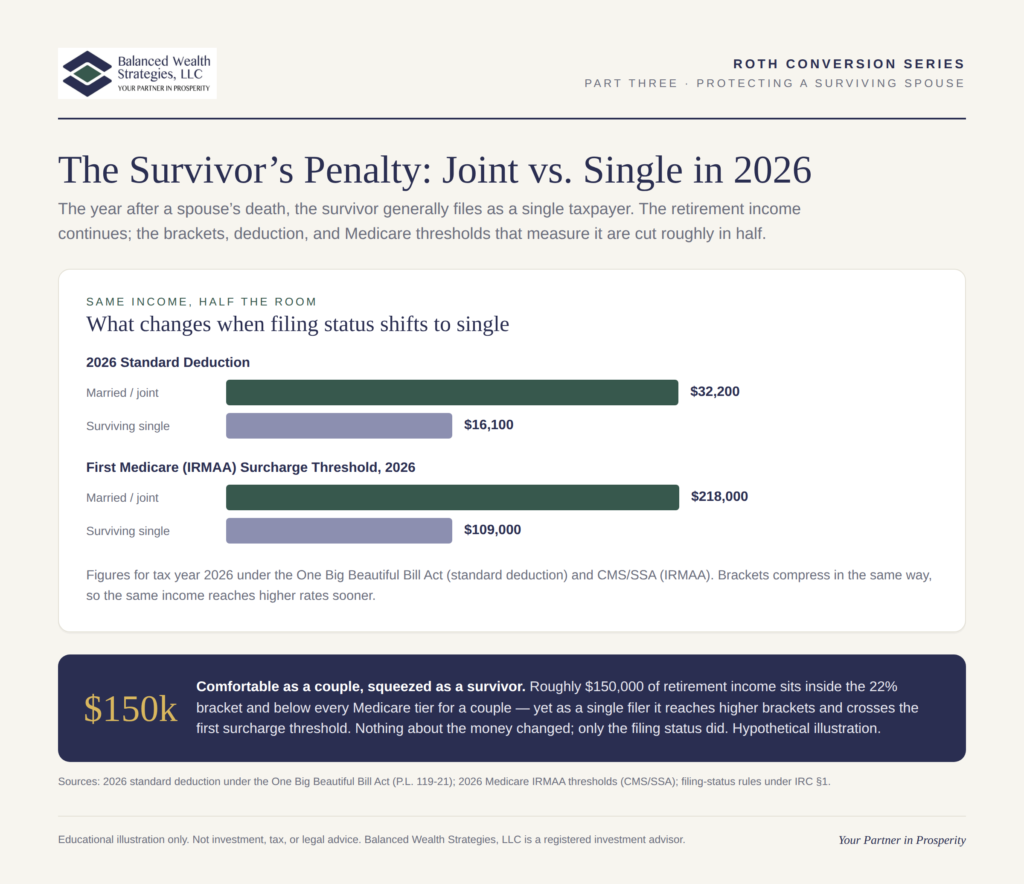
For 2026, a married couple filing jointly claims a standard deduction of $32,200 and stays free of Medicare income surcharges below $218,000 of modified income. A single filer claims $16,100 and crosses the first surcharge threshold at $109,000. The brackets themselves compress in the same way. This is the survivor’s penalty, sometimes called the widow’s penalty, and it is the subject of this third and final article in the series: not your own lifetime tax, which was the subject of Part One, and not your heirs’ inheritance, covered in Part Two, but the position of the person most likely to outlive you.

What Changes the Year After
In the year of a spouse’s death, a couple may still file jointly. Beginning the following year, the survivor files as a single taxpayer — unless a dependent child qualifies them for a brief window of surviving-spouse status. From that point forward, the same retirement income is measured against single-filer brackets, a single standard deduction, single-filer Medicare thresholds, and a single senior deduction rather than two.
What does not shrink is the income. Required distributions from the couple’s combined retirement accounts continue, and after a spousal rollover the survivor takes required distributions on the full balance. Much of the Social Security income continues as well, though the survivor keeps only the larger of the two benefits. The arithmetic is unforgiving: roughly the same taxable income, taxed on a schedule built for one.
The Survivor’s Squeeze, Illustrated
The following figures are a simplified, hypothetical illustration for educational purposes only. They are not a projection, a recommendation, or a representation of any particular result.
Consider a couple with $150,000 of taxable retirement income. Filing jointly, that income sits comfortably within the 22 percent bracket, below the net investment income tax threshold, and clear of every Medicare surcharge tier. Now suppose one spouse dies and the survivor, the next year, has largely the same income. As a single filer, that $150,000 is measured against a standard deduction half as large, reaches into higher brackets sooner, and lands above the first Medicare surcharge threshold of $109,000 — adding premium surcharges the couple never paid. Nothing about the money changed. Only the filing status did, and with it the tax.
This is why the survivor’s penalty is a planning problem and not merely an unfortunate fact. The higher tax is baked in by the eventual, and often unpredictable, order of events. What can be managed is how much taxable retirement income remains to be squeezed into those narrower brackets when the day comes.
How Conversions Help While Both Spouses Are Alive
A Roth conversion done while both spouses are living and filing jointly moves income out of the survivor’s future single-filer brackets and into today’s wider joint ones. Every dollar converted now, at joint rates, is a dollar the survivor will not have to take later as a required distribution taxed on a single-filer schedule. The joint-filing window is finite — no one knows how long it lasts — which is precisely the argument for using it deliberately rather than assuming it will always be there. Modeling that window is exactly the kind of planning our wealth managers walk through with a household.
The conversion also reduces the required distributions the survivor will face. Because money in a Roth is never subject to lifetime required distributions, converting shrinks the traditional balance that drives those future taxable withdrawals. The survivor inherits not only a tax-free account but a smaller forced-income problem in the years when their brackets are tightest.
The Senior Deduction and the Timing Window
The One Big Beautiful Bill Act’s temporary senior deduction sharpens the timing. For tax years 2025 through 2028, each taxpayer age 65 and older may claim an additional deduction of up to $6,000, phasing out as modified income rises above $150,000 for joint filers and disappearing entirely by roughly $250,000. While both spouses are alive and eligible, a couple may claim two of these deductions; a survivor claims one. Both the second deduction and the wider joint brackets are available only for a limited time, and only while both spouses live — a combination that argues for attending to conversions within that window rather than deferring them indefinitely.

Balancing the Three Goals
This series has set out three distinct reasons to consider a Roth conversion: reducing your own lifetime tax, leaving a more tax-efficient inheritance, and protecting a surviving spouse from the single-filer squeeze. They are related, but they are not identical, and they can point toward different conversion amounts. A plan sized purely for a surviving spouse may look different from one sized purely for the heirs, which may differ again from one sized to minimize a couple’s joint lifetime tax. Weighing those goals against each other is exactly the judgment call built into a coordinated investment approach rather than a single-issue calculation.
The right size, in the end, depends on which of these outcomes you weight most heavily, on the specific brackets of everyone involved, and on thresholds — Medicare surcharges, the investment-income surtax, the senior deduction phase-out — that turn the true cost of a conversion into something more nuanced than a single rate. That is a calculation to model carefully and to revisit as circumstances change, not a decision to make from a rule of thumb.

- What is the survivor’s penalty, or widow’s penalty? It is the higher tax a surviving spouse often pays after a partner’s death. The survivor generally files as a single taxpayer the following year, with roughly half the standard deduction, narrower brackets, and lower Medicare surcharge thresholds, while much of the household’s retirement income continues. The same income, taxed on a single-filer schedule, produces a materially higher tax bill.
- How soon does a surviving spouse have to file as single? A couple may generally file jointly for the year in which one spouse dies. Beginning the following tax year, the survivor files as single, unless a qualifying dependent child allows a limited period of surviving-spouse status. From that point forward, all retirement income is measured against single-filer brackets, deductions, and Medicare thresholds.
- Can a surviving spouse still do Roth conversions? Yes, but generally in tighter single-filer brackets and against lower Medicare thresholds, which can make each converted dollar more expensive. This is a central reason conversions are often weighted toward the years when both spouses are alive and filing jointly, when the brackets are wider and two senior deductions may be available.
- Does a surviving spouse have to take required distributions on the deceased spouse’s IRA? A surviving spouse may roll the deceased spouse’s IRA into their own and then takes required distributions on the combined balance under the standard rules. Because the accounts are consolidated and taxed on a single-filer schedule, required distributions can push the survivor’s income higher relative to their now-narrower brackets, compounding the survivor’s penalty.
- How does IRMAA change for a surviving spouse? Medicare surcharge thresholds for single filers are roughly half those for joint filers. For 2026, a joint filer avoids surcharges below $218,000 of modified income, while a single filer crosses the first threshold at $109,000. A survivor with similar income can therefore face Medicare premium surcharges the couple never paid, on the same two-year lookback that applies to all beneficiaries.
- Should conversions be done while both spouses are alive? For households concerned about the survivor’s penalty, front-loading conversions into the joint-filing years is often part of the discussion, because those years offer wider brackets and, through 2028, potentially two senior deductions. How much to convert still depends on the full picture, including lifetime tax and legacy goals, so the timing is one factor among several to weigh rather than a rule applied on its own.
This is Part Three, the final installment of a three-part series on Roth conversions. Part One looked at reducing your own lifetime tax; Part Two looked at what a traditional IRA leaves your heirs. You can browse more analysis like this in our Insights library.
Important Regulatory Disclosure: Balanced Wealth Strategies, LLC is a registered investment advisor. This is not an offer to sell securities or the solicitation of an offer to purchase securities. All investing involves risk, including the potential loss of principal. Past performance is not indicative of future results. Please see our Disclosures for Form ADV Part 2A and 2B for complete details about our services, fees and professional background.
If protecting a surviving spouse is part of your planning, schedule a confidential consultation with Mark J Burger CPA
#RothConversion #EstatePlanning #InheritedIRA #SECUREAct #LegacyPlanning #CPA #WealthTransfer