

By Mark J. Burger, CPA · BalancedWealthStrategies.com · As of October 2026
A business sale is described by one number, the price on the term sheet, and for the owner it is the least useful number in the deal. What matters is what remains after tax, and whether it can do everything the business used to do for a life that may run another thirty or forty years. The after-tax result is negotiated in the structure, not just the price, and most of the planning that protects it must happen before the letter of intent is signed.
A business sale is usually described by a single number: the price on the term sheet. For the owner, that is the least useful number in the transaction. What matters is what remains after tax, and whether that amount can do everything the business used to do — fund a lifestyle, support a family, and last for the rest of a life that may run another thirty or forty years. The distance between the headline price and that after-tax, life-funding number is where the real planning lives, and most of it must happen before the deal is signed. Turning a single, concentrated business interest into a diversified plan for that next chapter is the focus of our wealth management and financial planning services.
The Headline Price Is Not the After-Tax Number
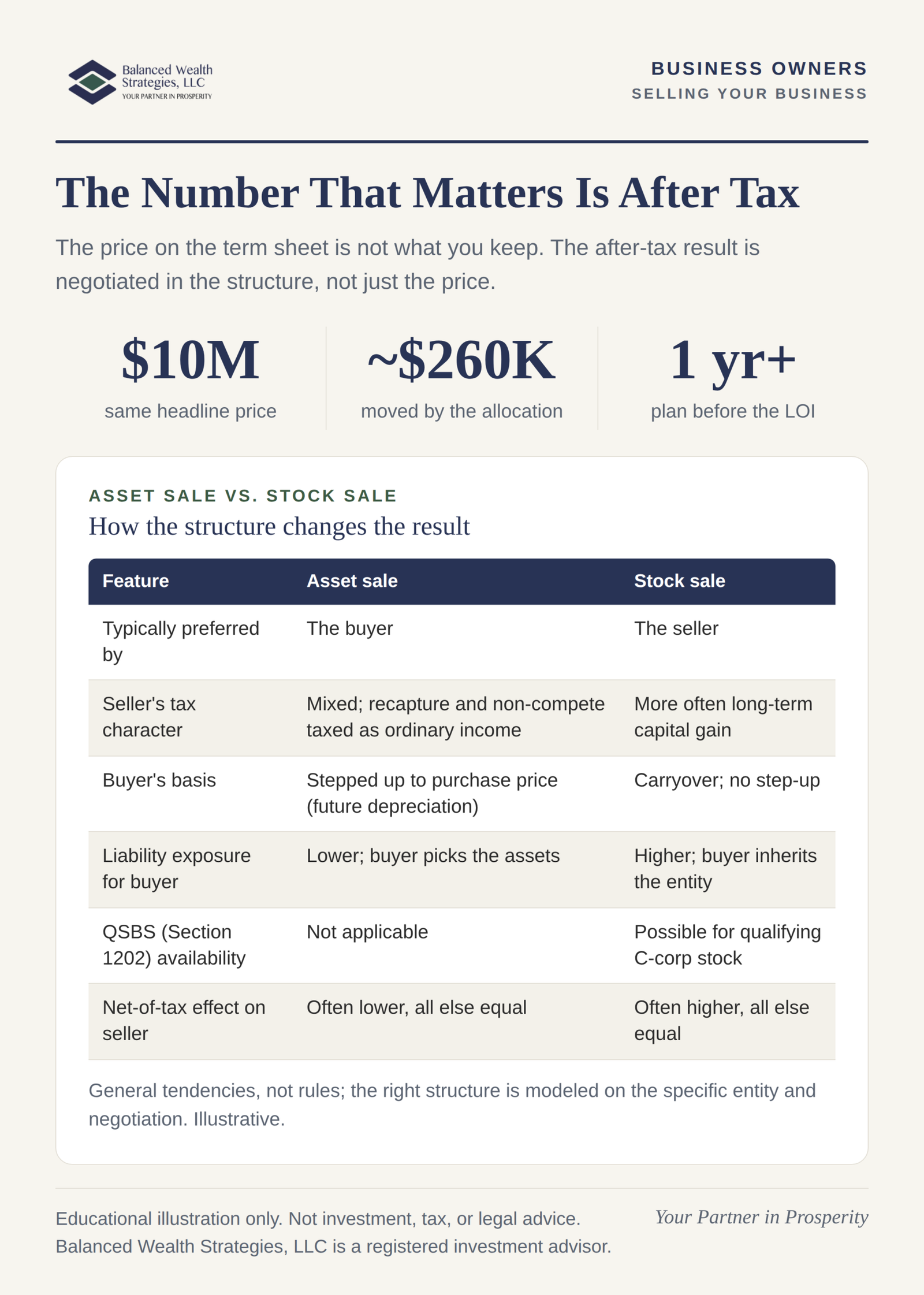
Two identical prices can produce very different results. Whether the transaction is structured as a sale of assets or a sale of stock changes how the proceeds are taxed, because portions allocated to items such as equipment, a non-compete, or consulting can be taxed as ordinary income rather than at long-term capital gain rates. State tax adds another layer, and the 3.8 percent net investment income tax often applies on top of the federal rate. Installment sales and earnouts spread the proceeds — and the tax — across years, which can help or hurt depending on the rest of the picture. The point is not that one structure is always better; it is that the after-tax result is negotiated in the structure, not just the price, and the owner who understands that negotiates from a stronger position.
Worked example (illustrative). An owner sells for $10 million on a business with negligible basis. Structured as a stock sale, essentially the whole $10 million gain is long-term capital gain, taxed at a combined 23.8 percent (20 percent plus the 3.8 percent net investment income tax), or about $2.38 million, leaving roughly $7.62 million. Structured as an asset sale, suppose $2 million of the price is allocated to depreciation recapture and a non-compete, both taxed as ordinary income at 37 percent rather than 23.8 percent. That $2 million now carries about $264,000 more tax, dropping the net to roughly $7.36 million for the same $10 million price. State tax, not modeled here, would widen the gap further. The lesson is that $260,000 moved in the allocation schedule, not the price. Figures are illustrative, ignore state tax, and depend on the reader’s own facts.
The Planning That Must Happen Before the Letter of Intent
The most valuable moves in a business sale have an expiration date, and it usually falls before a binding agreement is signed. Strategies that shift future appreciation out of the estate, that place a portion of the stock into a charitable vehicle so the gain on that portion is never taxed, or that position the stock to qualify for a capital gains exclusion, generally must be in place before the sale becomes a done deal. Once a letter of intent is signed and the sale is effectively certain, the door on several of these closes. For owners of C-corporation stock in particular, a separate and potentially decisive analysis — the qualified small business stock exclusion under Section 1202 — is worth running early with your advisory team. This is the single strongest argument for involving a CPA-led advisory team a year or more ahead of a contemplated sale rather than after the offer arrives. The planning window is widest when the sale is still hypothetical.
The Day After the Wire
For years, the owner’s risk was concentration in a single illiquid asset: the business. On the day the sale proceeds arrive, that risk does not disappear — it inverts. The owner now holds a large, concentrated position in cash, and cash carries its own risks, inflation chief among them. The instinct to do something with it quickly is strong, and it is usually the wrong instinct. There is rarely a penalty for parking proceeds in safe, liquid holdings for a few months while a real plan is built, and there is often a significant cost to deploying them under the emotional pressure of a recent windfall.
The right sequence is deliberate. Secure the proceeds. Define what the money must accomplish — the income it must generate, the obligations it must cover, the legacy it is meant to support. Only then build the investment strategy to match, and only then choose who manages it — a decision we support through our strategic wealth manager partnerships. The order matters, because a plan built after the money is already invested is a plan built around someone else’s product.
Case in point (illustrative). An owner planned to give 10 percent of the company’s stock to a donor-advised fund before a sale, which would have placed the gain on that slice beyond tax and produced a large deduction. The idea surfaced two weeks after the letter of intent was signed and the sale was effectively certain. By then the assignment-of-income doctrine treated the gain as already the owner’s; contributing the shares no longer avoided the tax on the appreciation. The same move, made three months earlier while the sale was still hypothetical, would have worked. Timing, not merit, was the deciding factor. The scenario is anonymized and illustrative and describes no identifiable client.
Learn More
Asset Sale vs. Stock Sale, at a Glance
| Feature | Asset sale | Stock sale |
|---|---|---|
| Typically preferred by | The buyer | The seller |
| Seller’s tax character | Mixed; recapture and non-compete taxed as ordinary income | More often long-term capital gain |
| Buyer’s basis | Stepped up to purchase price (future depreciation) | Carryover; no step-up |
| Liability exposure for buyer | Lower; buyer picks the assets | Higher; buyer inherits the entity |
| QSBS (Section 1202) availability | Not applicable | Possible for qualifying C-corp stock |
| Net-of-tax effect on seller | Often lower, all else equal | Often higher, all else equal |
The Sequence, Start to Finish
- Start a year or more out. Bring in a CPA-led team while the sale is still hypothetical, when the widest set of tax strategies is still available.
- Model the structure before terms are set. Run asset-versus-stock and the purchase-price allocation for the after-tax result, not just the headline price.
- Complete time-sensitive moves before the LOI. Any gifting, charitable, estate, or Section 1202 positioning must be done while the sale is not yet certain.
- Secure the proceeds at closing. Park the wire in safe, liquid holdings and resist deploying it under windfall pressure.
- Define the mandate, then invest. Decide what the money must accomplish, build the strategy to match, choose the manager last, and confirm current-year figures before acting.
If you are considering a sale in the next few years, or have just received an offer, an independent, CPA-led review can protect the after-tax result and plan what the proceeds must do next. Schedule a confidential consultation with Mark J. Burger, CPA →
Frequently Asked Questions
What is the difference between an asset sale and a stock sale for me as the seller?
They can produce meaningfully different after-tax results. Sellers often prefer a stock sale because more of the gain may be taxed at long-term capital gain rates, while buyers often prefer an asset sale for liability and basis reasons. Portions of an asset deal allocated to items such as equipment recapture or a non-compete can be taxed as ordinary income. The right structure depends on the entity, the assets, and the negotiation, which is why it should be modeled before terms are set.
How far ahead of a sale should I start planning?
Ideally a year or more. Several of the most effective tax strategies must be in place before a binding agreement, and some carry their own holding-period or timing requirements. Waiting until an offer is on the table forecloses options that were available only while the sale was still hypothetical.
Should I give some of my stock to family or charity before the sale?
It can be powerful, and it is time-sensitive. Gifting or contributing appreciated stock before a sale is binding can move future appreciation out of your estate or place the gain on that portion beyond tax, depending on the vehicle used. Done after the sale is effectively certain, the same moves lose much of their benefit. This is an analysis to run early with your tax and legal advisors.
What should I do with the proceeds right away?
As a general educational matter, secure them in safe, liquid holdings and resist the pressure to invest quickly. Define what the money must accomplish first, then build a strategy to match. A brief, deliberate pause after a sale is normal and prudent, not a lost opportunity.
I already have a CPA. Do I also need a wealth manager?
The two roles are different. Tax preparation records what happened; post-sale wealth planning decides what happens next with a suddenly liquid and much larger portfolio. Balanced Wealth Strategies bridges them, applying CPA-level oversight to the wealth management relationship rather than replacing your tax preparer.
How is an earnout taxed?
An earnout ties part of the price to the future performance of the business, so the proceeds, and the tax, arrive in later years and can be treated in different ways depending on how the deal is written. Because earnouts shift income across tax years, they should be modeled as part of the overall structure rather than treated as an afterthought.
Important Regulatory Disclosure
Balanced Wealth Strategies, LLC is a registered investment advisor. This is not an offer to sell securities or the solicitation of an offer to purchase securities. All investing involves risk, including the potential loss of principal. Past performance is not indicative of future results. Please see our Disclosures for Form ADV Part 2A and 2B for complete details about our services, fees and professional background.
Sources: asset vs. stock sale and purchase price allocation under IRC section 1060; depreciation recapture under IRC sections 1245 and 1250. Long-term capital gain rates under IRC section 1(h); net investment income tax of 3.8 percent under IRC section 1411. Installment sale treatment under IRC section 453; qualified small business stock exclusion under IRC section 1202. Assignment-of-income doctrine on pre-sale charitable gifts of appreciated stock. The 23.8 percent and 37 percent rates in the worked example are the 2026 top long-term capital gains plus NIIT and the top ordinary rate, respectively. Structure and after-tax outcomes depend on entity type, state law, and negotiation; confirm all figures with your tax and legal advisors before acting.