

By Mark J. Burger, CPA · BalancedWealthStrategies.com · As of October 2026
Every owner leaves the business eventually; the only question is whether the exit happens on planned terms or on terms circumstance imposes. A company generally passes in one of three directions, each with its own tax, funding, control, and legacy consequences: to family, to partners or management, or to an outside buyer. For most owners the company is the largest and least liquid asset, which is exactly why business succession planning deserves as much attention as the building of the business ever did, and years before the intended hand-off rather than months.
Every owner leaves the business eventually. The only question is whether the exit happens on planned terms or on terms that circumstance imposes, a death, a disability, a falling-out, or an unsolicited offer that arrives before anyone is ready. Succession planning is the work of deciding the terms in advance, while there is still time to shape them. For most owners the company is both the largest asset and the least liquid, which is exactly why the transition deserves as much planning as the building of the business ever did. When the exit is an outright sale, our financial roadmap for selling a business takes up the after-tax mechanics.
Three Paths, Three Sets of Consequences
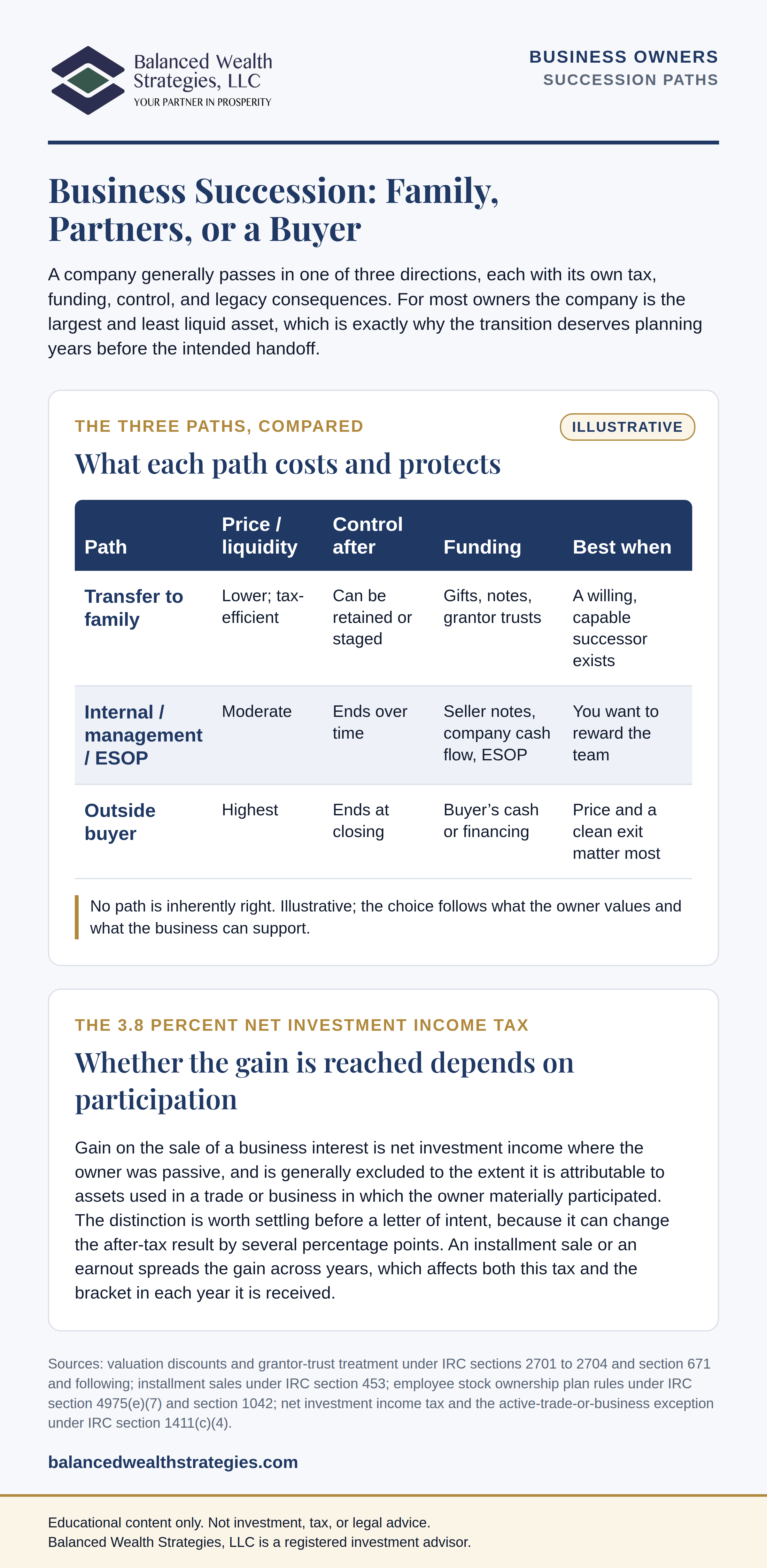
A business generally passes in one of three directions, and each carries its own tax, funding, control, and legacy implications. A transfer to family keeps the company in the bloodline but raises hard questions of fairness among heirs and readiness among successors. A sale to partners, management, or employees, including, for some companies, an employee stock ownership plan, rewards the people who helped build the business and can carry meaningful tax advantages, but internal buyers rarely have cash and the deal must be funded over time. A sale to an outside buyer usually maximizes price and liquidity but ends the owner’s influence and hands the culture to someone new. None is inherently right; the best path depends on what the owner values most and what the business and the successors can actually support.
The Tax and Estate Dimension
Succession and estate planning are the same conversation viewed from two angles. Transferring ownership during life can move future growth out of the estate and, with tools such as valuation discounts for minority or non-controlling interests and sales to grantor trusts, can do so at a favorable transfer-tax cost. The permanent higher estate and gift exemption, addressed in our article on the $15 million exemption, changes the pressure on this planning without removing its value. An installment sale can spread a family or internal transfer over years, and an employee stock ownership plan can offer the selling owner deferral opportunities that an ordinary sale does not.
Worked example (illustrative). An owner wants to move a 40 percent stake in a $5 million company to a child during life. The pro-rata value of that stake is $2 million, but because a 40 percent interest is a non-controlling, hard-to-sell minority position, a qualified appraisal supports a combined minority and marketability discount of, say, 30 percent, reducing the taxable gift to about $1.4 million. That uses roughly $1.4 million of lifetime exemption instead of $2 million, and every dollar the transferred stake appreciates afterward grows outside the owner’s estate. Left undone, the same 40 percent could be worth far more at death, fully in the estate. The discount must be supported by a defensible appraisal, not assumed. Figures are illustrative and depend on the reader’s own facts.
The 3.8 Percent Net Investment Income Tax on a Sale
Gain on the sale of a business interest is net investment income where the owner was passive, and is generally excluded to the extent it is attributable to assets used in a trade or business in which the owner materially participated. The distinction is worth settling before a letter of intent rather than at the return, because it can change the after-tax result by several percentage points and it depends on facts that are easier to document while the business is still operating. An installment sale or an earnout spreads the gain across years, which affects both this tax and the bracket in each year the money is received.
The Problem of Funding
A succession plan that names a successor but does not fund the transfer is only half a plan. Family and internal buyers seldom have the capital to buy out an owner at once, so the transition is typically financed, through seller notes, through insurance in the case of death or disability, or through the company’s own cash flow over time. How the purchase will actually be paid for is not a detail to settle at the end; it is the constraint that determines whether the plan works at all. The mechanics of funding a co-owner transition are the subject of our companion article on buy-sell agreements.
The Human Dimension
The hardest parts of succession are rarely technical. They are whether a successor is genuinely ready and willing, how to be fair to children who work in the business and children who do not, and how to hand over control without either clinging to it or abandoning the people left to run things. These questions take time to work through, which is the strongest argument for beginning years before the intended transition rather than months. A plan built under time pressure tends to serve the calendar rather than the family.

Case in point (illustrative). An owner had three children, one of whom had worked in the company for a decade while the other two built careers elsewhere. Dividing the business equally would have handed the two outside children a veto over the one running it, a recipe for conflict. Instead, the plan left the company to the active child and balanced the inheritance with life insurance and other assets for the other two, so each received comparable value without shared control of the business. Equal was not the same as fair; the design made both possible. The scenario is anonymized and illustrative and describes no identifiable client.
The Three Paths, Compared
| Path | Price / liquidity | Control after | Funding | Best when |
|---|---|---|---|---|
| Transfer to family | Lower; tax-efficient | Can be retained/staged | Gifts, notes, grantor trusts | A willing, capable successor exists |
| Internal / management / ESOP | Moderate | Ends over time | Seller notes, company cash flow, ESOP | You want to reward the team |
| Outside buyer | Highest | Ends at closing | Buyer’s cash / financing | Price and a clean exit matter most |
Valuation Comes First
Every path depends on a defensible number. A current appraisal from a qualified valuation professional anchors gift reporting to family, the price in an internal sale, and the expectations an owner brings to an outside negotiation, and it is the document that supports discounts for lack of control or marketability where the facts justify them. A valuation obtained years ago, or a figure carried forward from an old agreement, tends to be wrong in the direction that causes the most harm, and it is the first thing a buyer, a lender, or the Internal Revenue Service will test.
Estate Liquidity and the Nine-Month Clock
A succession plan has to survive the owner’s death as well as the owner’s retirement. Federal estate tax is generally due nine months after death, in cash, at a point when the estate’s largest asset is the least liquid thing it owns. Where the closely held business makes up more than 35 percent of the adjusted gross estate, section 6166 can allow the tax attributable to that interest to be paid in installments over as long as fourteen years, which converts a forced sale into a manageable obligation. Life insurance owned outside the estate, a funded buy-sell, and a holding of marketable assets are the other common answers, and each has to be arranged before it is needed.
How to Begin Business Succession Planning
- Name your priority. Decide what you value most, keeping it in the family, rewarding the team, or maximizing price and a clean exit; that choice narrows the path.
- Test successor readiness. Assess honestly whether a family or internal successor is willing and able, and build a development runway if not.
- Model the after-tax result of each path. Compare the paths on tax, using discounts, grantor trusts, installment sales, or an ESOP where they fit.
- Solve the funding. Decide how a family or internal buyout will actually be paid for before committing to it, coordinated with a funded buy-sell.
- Balance the family. Use other assets or insurance to treat active and inactive children fairly, and start years ahead; confirm current-year figures before acting.
If a transition is on your horizon, even years out, an objective, CPA-led review can compare the paths and their after-tax results before circumstances narrow the choice. Schedule a confidential consultation with Mark J. Burger, CPA →
Frequently Asked Questions
When should succession planning start?
Earlier than most owners expect, commonly five to ten years before an intended transition. The tax strategies that shift value efficiently, the development of a successor, and the funding of a buyout all take time, and a compressed timeline forecloses the most effective of them.
How do I treat children who work in the business fairly against those who do not?
This is one of the central challenges of a family transfer. Equal is not always the same as fair, and dividing the business itself among active and inactive children can create conflict. Techniques such as using other assets or life insurance to balance inheritances, while leaving control with those who run the company, are common; the right approach is personal and worth deliberate planning.
What is an ESOP, and is it right for my company?
An employee stock ownership plan is a qualified plan that buys the company’s stock on behalf of employees, providing a market for the owner’s shares and potential tax advantages, including deferral for the seller in some cases. It suits certain companies and not others, based on size, cash flow, and workforce, and it is complex to establish. It is one option among several to evaluate.
Can I keep some control after transferring the business?
Often, yes. Ownership and control can be separated through the structure of the transfer, retaining voting interests, staging the hand-off, or serving in a defined role for a period. The design depends on the path chosen and should be documented clearly so expectations are shared.
Does the higher estate exemption mean I can skip succession planning?
No. The $15 million exemption reduces the estate-tax pressure for many families, but succession is about control, funding, successor readiness, and family fairness as much as tax. Those questions are unaffected by the exemption, and an unfunded or undecided succession fails whether or not any estate tax is due.
Does the 3.8 percent net investment income tax apply when I sell the business?
It depends on participation. Gain allocable to a trade or business in which you materially participated is generally outside the tax, while gain attributable to passive activity or to investment assets held by the company is generally within it. The analysis rests on facts that are easier to establish before a sale than after, which is one more reason to model the after-tax result early. Confirm the treatment with your tax advisor against your own records.
Important Regulatory Disclosure
Balanced Wealth Strategies, LLC is a registered investment advisor. This is not an offer to sell securities or the solicitation of an offer to purchase securities. All investing involves risk, including the potential loss of principal. Past performance is not indicative of future results. Please see our Disclosures for Form ADV Part 2A and 2B for complete details about our services, fees and professional background.
Sources: valuation discounts for minority and non-controlling interests; sales to grantor trusts; installment sales under IRC section 453; interplay with the federal estate and gift tax exemption. Employee stock ownership plans under IRC sections 409 and 4975, and seller deferral under IRC section 1042 for certain transactions. The 30 percent valuation discount in the worked example is illustrative and must be supported by a qualified appraisal; succession outcomes depend on entity type, valuation, family circumstances, and state law and should be structured with your tax, legal, and valuation advisors. Net investment income tax and the active-trade-or-business exception under IRC section 1411(c)(4); installment sales under IRC section 453. Installment payment of estate tax attributable to a closely held business under IRC section 6166; valuation discounts as supported by the facts.