

Does the New $15 Million Exemption Mean You Can Ignore Estate Planning?
The exemption decides whether you owe estate tax – not whether your plan works. See what still needs attention even if your estate is under $15 million.
Tips on tax efficiency, estate planning, and legacy preservation.
The exemption decides whether you owe estate tax – not whether your plan works. See what still needs attention even if your estate is under $15 million.
The estate tax exemption did not fall in 2026 – it rose to $15M per person, permanently. See what the new law means for your plan, and why review still matters.

A hypothetical case study: how a measured Roth conversion turned a $3.6M IRA’s forced-distribution tax into a far larger tax-free legacy. Illustrative.

When a spouse dies, the survivor files as single and the brackets nearly halve. Part Three of a three-part series looks at how Roth conversions made while both spouses are alive can ease the survivor’s penalty.

The SECURE Act’s ten-year rule can tax an inherited IRA at your heirs’ highest rate. Part Two of a three-part series looks at how a Roth conversion changes what your children actually keep.

Required minimum distributions can keep a large traditional IRA taxed for the rest of your life. Part One of a three-part series looks at how a measured Roth conversion strategy under 2026 tax law may reduce your own lifetime tax.

The NUA distribution locks in one tax advantage permanently, but the stock keeps moving after it leaves the plan. This final installment covers the one-year holding period on new gains, the concentration risk of holding, and the Medicare IRMAA surcharge that arrives two years after the sale.

The NUA strategy hinges on one number — the cost basis of your employer stock. Most participants have never seen it. This second installment in the series explains exactly what it is, who maintains it, and how to request it before the distribution paperwork arrives.
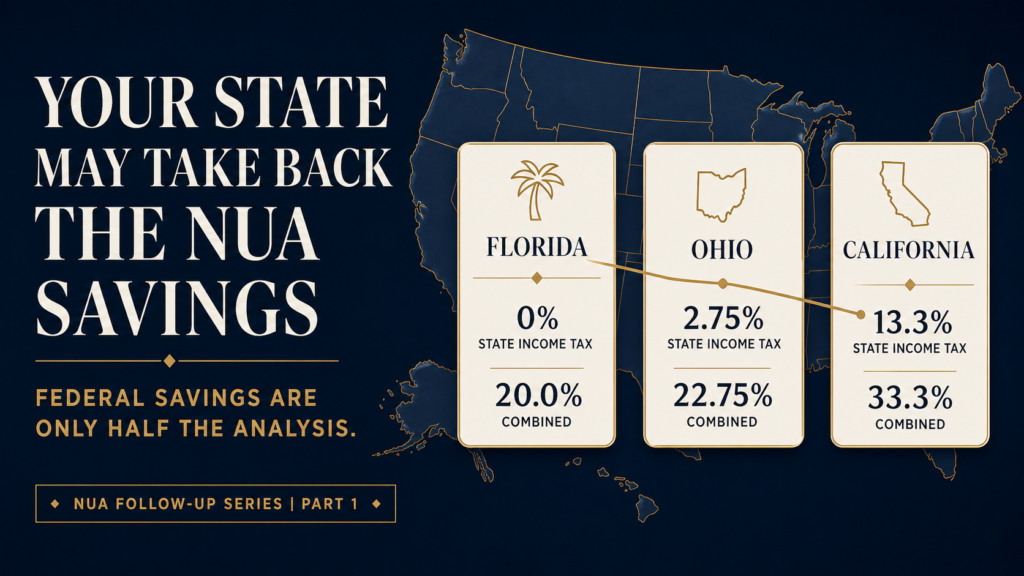
The federal NUA tax break can save retiring executives over $600,000 — but your state may claw much of it back. This first follow-up article maps which states preserve the advantage, which erode it, and the one question worth answering before the distribution becomes irreversible.
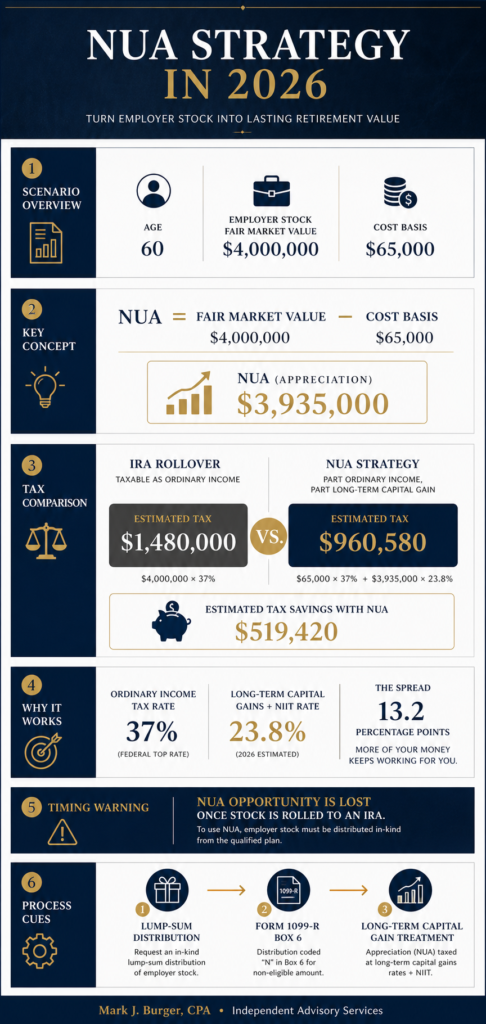
The strategy is called Net Unrealized Appreciation — NUA — and after 37 years in CPA practice, I continue to